
Stakeholder Alignment: Driving SaaS Product Growth
Misunderstandings and clashing priorities between teams can slow even the most promising SaaS products. Achieving real growth requires more than technical excellence or sharp vision. It demands strategic stakeholder alignment, where every team from Product Management to Engineering and Executive Leadership operates with clear, shared objectives. This approach turns conflicting interests into unified action, paving the way for faster innovation and stronger market impact.
Table of Contents
- Defining Stakeholder Alignment in SaaS
- Key Stakeholder Types and Roles
- Alignment Processes and Best Practices
- Common Pitfalls and Misconceptions
- Impact on Product Growth and Execution
Key Takeaways
| Point | Details |
|---|---|
| Stakeholder Alignment is Crucial | Effective stakeholder alignment fosters collaboration among diverse teams, driving successful product development in SaaS environments. |
| Diverse Stakeholder Roles Matter | Understanding the unique contributions of various stakeholders, such as executives and customer success representatives, enhances overall product success. |
| Implementation of Best Practices | Establishing clear communication protocols and collaborative decision-making structures are essential for maintaining stakeholder alignment. |
| Monitoring and Adapting is Key | Regular assessments and feedback loops help organizations navigate potential misalignments and respond dynamically to changing landscapes. |
Defining Stakeholder Alignment in SaaS
Stakeholder alignment represents the strategic synchronization of diverse organizational perspectives, expectations, and goals to drive collaborative product development in SaaS environments. At its core, this process ensures that all key participants—from product managers and engineers to executives and customer success teams—work cohesively toward shared objectives.
In SaaS contexts, stakeholder alignment goes beyond traditional coordination, requiring a dynamic approach to managing stakeholder interactions and perspectives. The primary stakeholders typically include:
- Product development teams
- Engineering departments
- Executive leadership
- Customer success representatives
- Sales and marketing professionals
- External investors or board members
Successful alignment demands understanding each stakeholder’s unique priorities, communication styles, and potential constraints. This means creating transparent mechanisms for:
- Regular cross-functional communication
- Clear goal-setting processes
- Collaborative decision-making frameworks
- Shared performance metrics
- Iterative feedback loops
The ultimate objective is transforming potential organizational friction into a synchronized, innovation-driven environment where different perspectives contribute to holistic product growth strategies.
Pro tip: Implement monthly cross-functional workshops that explicitly focus on aligning diverse team perspectives and creating shared understanding of product objectives.
Key Stakeholder Types and Roles
In SaaS product development, stakeholders represent diverse groups with unique perspectives and critical contributions to organizational success. Comprehensive stakeholder typologies reveal complex interconnections between different organizational roles and their strategic impacts.
The primary stakeholder types in SaaS environments typically include:
- Executive Leadership: Strategic decision-makers who define overall product vision and resource allocation
- Product Management: Responsible for product strategy, roadmap development, and market positioning
- Engineering Teams: Technical architects who translate product vision into functional solutions
- Customer Success Representatives: Front-line advocates connecting user experiences with product development
- Sales and Marketing Professionals: Responsible for market communication and revenue generation
- External Investors: Providing financial resources and strategic guidance
- Customer Advisory Boards: Offering direct user insights and validation
Each stakeholder group brings distinctive perspectives that contribute to holistic product development. Effective stakeholder management requires understanding their specific motivations, communication preferences, and potential influence on product outcomes.
Here’s a summary of stakeholder group contributions and their organizational impact:
| Stakeholder Group | Main Contribution | Impact on SaaS Success |
|---|---|---|
| Executive Leadership | Strategic vision and resource allocation | Drives long-term direction |
| Product Management | Roadmap planning and strategy | Aligns products with user needs |
| Engineering Teams | Technical solution development | Delivers reliable functionality |
| Customer Success Representatives | User advocacy and feedback | Improves customer retention |
| Sales & Marketing Professionals | Revenue generation and market insight | Fuels market growth |
| External Investors | Funding and strategic oversight | Enables scalable expansion |
| Customer Advisory Boards | Real-world use case validation | Informs feature prioritization |
The intricate relationships between these groups demand sophisticated engagement and prioritization strategies that balance diverse expectations while maintaining organizational coherence. Successful SaaS organizations create transparent communication channels that enable cross-functional collaboration and shared accountability.
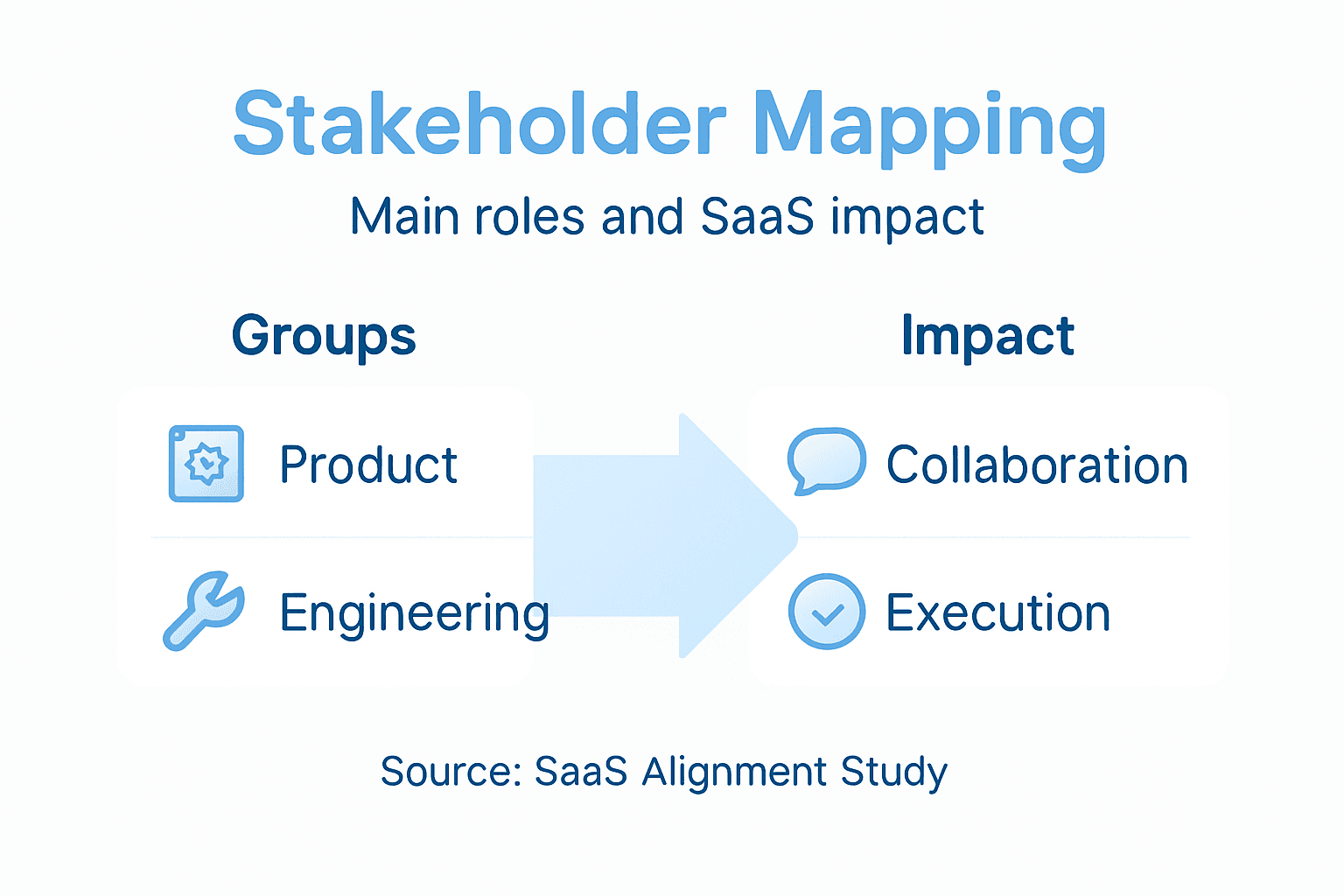
Pro tip: Create a stakeholder mapping matrix that visualizes each group’s influence, interests, and potential impact on product development strategies.
Alignment Processes and Best Practices
Stakeholder alignment in SaaS product development requires sophisticated strategic engagement frameworks that systematically synchronize diverse organizational perspectives. These frameworks go beyond traditional communication methods, creating dynamic mechanisms for collaborative decision-making and continuous engagement.
Key alignment processes include:
- Communication Protocols: Establishing clear, transparent communication channels
- Collaborative Decision-Making: Creating inclusive mechanisms for collective input
- Conflict Resolution Strategies: Developing structured approaches to address divergent perspectives
- Digital Collaboration Tools: Implementing technologies that facilitate real-time interaction
- Performance Alignment Metrics: Defining shared objectives and measurement standards
Successful alignment demands more than procedural implementations. It requires cultivating a culture of mutual respect, shared accountability, and strategic interdependence. Organizations must move beyond siloed interactions, creating environments where different stakeholder groups view collaboration as a core organizational value.

The most effective SaaS teams develop robust alignment mechanisms that dynamically adapt to changing product landscapes. These mechanisms prioritize continuous feedback, transparent communication, and flexible governance structures that can quickly respond to emerging challenges and opportunities.
Pro tip: Conduct quarterly cross-functional alignment workshops that explicitly map interdependencies and realign strategic priorities across different stakeholder groups.
Common Pitfalls and Misconceptions
Stakeholder alignment is fraught with challenges that can derail even well-intentioned product development efforts. Theoretical misunderstandings about stakeholder engagement often create significant barriers to effective collaboration, revealing critical gaps between expectation and reality.
Common misconceptions that undermine stakeholder alignment include:
- Over-Simplification: Treating all stakeholders as having uniform perspectives
- Power Dynamics Ignorance: Neglecting the subtle influence hierarchies create
- Communication Assumptions: Believing one-size-fits-all communication strategies work
- Engagement Superficiality: Conducting perfunctory meetings without meaningful dialogue
- Metric Misalignment: Using inconsistent or mismatched performance indicators
- Feedback Dismissal: Inadequately addressing or integrating stakeholder input
Successful SaaS product teams recognize that stakeholder alignment is a nuanced, dynamic process requiring continuous attention and adaptive strategies. Misconceptions often emerge from fundamental misunderstandings about the complex interdependencies between different organizational roles and perspectives.
This table compares common stakeholder alignment pitfalls with effective remedies:
| Pitfall | Typical Risk Outcome | Best Remedy |
|---|---|---|
| Over-Simplification | Misunderstood needs | Tailored engagement plans |
| Power Dynamics Ignorance | Hidden resistance | Transparent decision-making |
| Communication Assumptions | Missed information | Channel variety and clarity |
| Engagement Superficiality | Low stakeholder trust | Meaningful dialogue sessions |
| Metric Misalignment | Unclear performance | Unified measurement standards |
| Feedback Dismissal | Stakeholder disengagement | Formal feedback integration |
The most sophisticated organizations develop robust mechanisms for acknowledging and navigating these potential pitfalls, creating flexible frameworks that can absorb and integrate diverse stakeholder perspectives without losing strategic focus. This requires a combination of empathy, strategic thinking, and structured communication protocols.
Pro tip: Implement a quarterly stakeholder perception audit to systematically identify and address emerging misalignment risks before they become critical challenges.
Impact on Product Growth and Execution
Stakeholder alignment transcends traditional collaboration, serving as a critical strategic lever for SaaS product growth. Strategic positioning through stakeholder alignment directly impacts organizational innovation, execution capabilities, and competitive positioning.
The multifaceted impact of effective stakeholder alignment manifests through several key dimensions:
- Accelerated Innovation: Faster ideation and product development cycles
- Enhanced Execution Speed: Reduced friction in cross-functional implementation
- Strategic Resilience: Better adaptation to market changes and technological shifts
- Resource Optimization: More efficient allocation of organizational resources
- Competitive Differentiation: Creating unique value propositions through integrated perspectives
Successful SaaS organizations recognize that stakeholder alignment is not merely a process, but a sophisticated organizational capability. It transforms potential internal conflicts into collaborative energy, enabling teams to navigate complex product development challenges with unprecedented agility and strategic coherence.
The most advanced product teams view stakeholder alignment as a dynamic, continuous investment. They create adaptive frameworks that not only synchronize current perspectives but also anticipate and proactively integrate emerging organizational and market dynamics. This approach transforms alignment from a static management technique into a living, breathing strategic advantage.
Pro tip: Develop a quarterly cross-functional alignment scorecard that objectively measures collaboration effectiveness and identifies emerging strategic integration opportunities.
Boost Your SaaS Product Growth with Aligned Design Leadership
Stakeholder alignment is key to transforming diverse perspectives into unified, strategic product growth. The challenges of navigating complex communication frameworks, balancing executive vision, and synthesizing customer insights can stall innovation and slow down execution. At The Good Side Oy, we understand these pain points and embed outcome-driven, senior design leadership directly into your SaaS teams to bridge these gaps. By integrating seamlessly with product and engineering teams, our designers accelerate collaboration, sharpen prioritization, and help you execute with clarity and speed.
Experience a hands-on partnership that moves beyond surface-level UI fixes toward deeper alignment across product design, onboarding, and go-to-market efforts. Get measurable improvements in user activation, adoption, and long-term revenue impact. Learn how our strategic design capabilities can help your organization overcome the common pitfalls of stakeholder misalignment detailed in the article and unlock new levels of cross-functional synergy.
Discover the difference for your SaaS business today at The Good Side and explore how our embedded design leadership drives real business outcomes.
Ready to remove friction from your product development? Visit The Good Side to partner with senior SaaS designers who align your teams and accelerate growth. Learn more about how embedded design leadership can transform your stakeholder collaboration at The Good Side. Act now to convert stakeholder complexity into your strongest competitive advantage.
Frequently Asked Questions
What is stakeholder alignment in SaaS?
Stakeholder alignment in SaaS refers to the strategic synchronization of various organizational perspectives, expectations, and goals to ensure that all key participants collaborate effectively in product development.
Why is stakeholder alignment important for SaaS product growth?
Stakeholder alignment is crucial for SaaS product growth as it enhances innovation, speeds up execution, optimizes resource allocation, and fosters strategic resilience in adapting to market changes.
What are some common pitfalls in stakeholder alignment?
Common pitfalls include over-simplification of stakeholder perspectives, ignoring power dynamics, relying on one-size-fits-all communication, superficial engagement, metric misalignment, and dismissing feedback from stakeholders.
How can organizations improve stakeholder alignment processes?
Organizations can improve alignment by establishing clear communication protocols, creating collaborative decision-making frameworks, implementing digital collaboration tools, defining shared performance metrics, and conducting regular feedback sessions.
Recommended
- What Is Scalable SaaS Design? Complete Overview
- Brand Alignment: Driving SaaS Product Growth | The Good Side Blog
- Blog & Insights | The Good Side | The Good Side
- Brand Alignment: Driving SaaS Product Growth | The Good Side Blog | The Good Side
- What is Software as a Service (SAAS): Definition and Examples - MaxCloudON