
What Is Customer Activation and Its SaaS Impact
Every SaaS leader knows the moment when a new user moves from curiosity to confident engagement can define the future of both product adoption and company growth. Without a strong focus on customer activation, even the best features can get overlooked, leading to missed revenue opportunities and increased churn. By sharpening your approach to customer activation touchpoints during onboarding, you can deliver meaningful value early, encourage productive usage, and lay the groundwork for higher retention and lasting customer relationships.
Table of Contents
- Defining Customer Activation In SaaS
- Key Activation Moments And Metrics
- Strategies To Improve Activation Rates
- Common Pitfalls And How To Avoid Them
- Customer Activation’s Impact On Growth
Key Takeaways
| Point | Details |
|---|---|
| Significance of Customer Activation | Customer activation is crucial for transforming potential users into engaged participants who realize product value quickly. |
| Critical Activation Moments | Identify key touchpoints in the user journey to enhance engagement and ensure users achieve their goals. |
| Strategies for Improvement | Implement personalized onboarding and contextual guidance to streamline user experiences and reduce friction. |
| Impact on Growth | Effective customer activation reduces churn and enhances revenue, leading to improved customer lifetime value and referrals. |
Defining Customer Activation in SaaS
Customer activation represents a pivotal moment in the SaaS user journey where potential users transition from passive observers to engaged product participants. This critical process goes beyond initial sign-up, focusing on guiding users to experience meaningful value from the product quickly and effectively.
In the context of Software as a Service (SaaS), customer activation focuses on actual value delivery through strategic engagement touchpoints during onboarding. Unlike simple user acquisition, activation is about creating tangible behavioral changes that drive product usage and demonstrate real utility.
Key characteristics of effective customer activation include:
- Identifying precise moments where users recognize product value
- Creating frictionless pathways to initial product engagement
- Developing personalized onboarding experiences
- Minimizing time-to-value for new users
- Establishing clear user success metrics
The core objective of customer activation is transforming potential users into committed product advocates by helping them achieve their fundamental goals quickly and efficiently. This requires understanding user motivations, designing intuitive interfaces, and providing immediate, demonstrable value.
Pro tip: Design your product’s initial user experience with laser focus on helping users achieve their primary objective within the first 10 minutes of interaction.
Key Activation Moments and Metrics
Customer activation moments represent the critical touchpoints where users transition from initial curiosity to genuine product engagement. These pivotal interactions determine whether a user will continue using a SaaS platform or abandon it during the early stages of adoption.

In SaaS environments, activation rates measure meaningful user engagement through specific milestones and behavioral indicators. These metrics go beyond simple sign-ups, focusing on users completing key actions that demonstrate they understand and derive value from the product.
Key activation moments typically include:
- Completing comprehensive onboarding sequences
- Utilizing core product features
- Integrating the product into existing workflows
- Achieving a specific outcome using the platform
- Inviting team members or colleagues
Measuring activation requires tracking multiple performance indicators such as feature adoption rates, time-to-value, and user engagement levels. Successful SaaS companies prioritize reducing friction during these critical moments, ensuring users can quickly realize the product’s fundamental value proposition.
Effective activation strategies transform casual users into committed product advocates by demonstrating immediate and tangible benefits.
Pro tip: Design your onboarding flow to highlight 2-3 maximum impactful features that solve user problems immediately and dramatically.
Strategies to Improve Activation Rates
Improving activation rates requires a strategic approach that transforms initial user interactions into meaningful engagement. SaaS companies must design comprehensive experiences that quickly demonstrate product value and reduce potential friction points in the user journey.
Implementing targeted activation strategies involves creating personalized pathways that guide users toward experiencing core product benefits. These strategies go beyond generic onboarding, focusing on individual user needs and specific pain points.
Effective activation improvement strategies include:
- Creating contextual in-app guidance
- Developing personalized onboarding experiences
- Implementing interactive product tours
- Establishing clear user success milestones
- Designing intuitive user interfaces
- Providing immediate value demonstration
Successful activation requires a holistic approach that combines user experience design, data-driven insights, and proactive customer support. By understanding user behavior and anticipating potential obstacles, SaaS companies can create seamless pathways that encourage rapid product adoption.
Compare two common approaches to SaaS customer activation:
| Approach | Typical Methods | Ideal For |
|---|---|---|
| Generic Onboarding | Email sequences, basic tutorials | Small user base, low complexity |
| Personalized Activation | In-app guides, tailored walkthroughs | Diverse users, scalable platforms |
Activation is not about complexity, but about making the user’s path to value as smooth and intuitive as possible.
Pro tip: Map out your ideal user journey and identify potential friction points before designing your activation strategy, focusing on removing barriers and highlighting immediate product value.
Common Pitfalls and How to Avoid Them
Customer activation in SaaS can quickly become challenging when companies fail to understand the nuanced dynamics of user engagement. Recognizing and addressing potential obstacles is crucial for maintaining a healthy product adoption trajectory and preventing user dropout.
SaaS customer activation struggles often stem from systemic issues that create barriers to user understanding and product value realization. These challenges can significantly impact a company’s ability to convert interested users into committed customers.
Common activation pitfalls include:
- Overly complex onboarding processes
- Lack of clear value proposition demonstration
- Insufficient user guidance
- Poor user interface design
- Minimal personalization
- Delayed time-to-value
- Inadequate user support during initial stages
Successful SaaS companies mitigate these risks by developing strategic intervention approaches that proactively address potential user friction points. This involves creating intuitive experiences that quickly communicate product benefits and provide immediate pathways to user success.
User activation is not about overwhelming users with features, but about creating a clear, simple path to realizing genuine product value.
Pro tip: Conduct regular user interviews and analyze dropout points to continuously refine your activation strategy and remove potential barriers.
Customer Activation’s Impact on Growth
Customer activation represents a critical growth engine for SaaS companies, transforming potential users into committed, revenue-generating customers. By strategically guiding users through meaningful product interactions, businesses can unlock substantial long-term value and sustainable expansion.
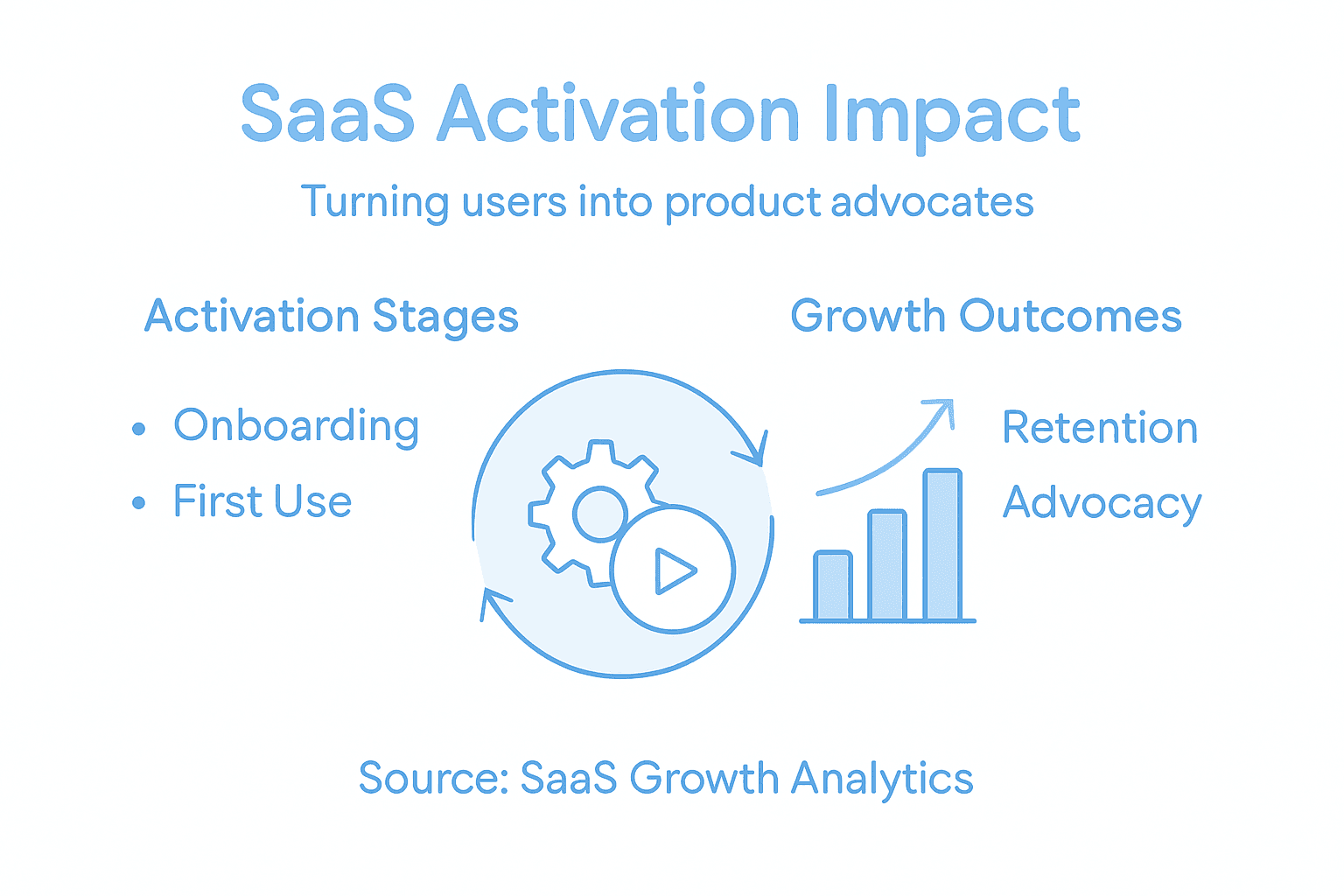
Customer activation directly influences revenue growth by creating a pathway from initial interest to consistent product engagement. This process is far more than a linear progression - it’s a complex ecosystem of user experience, value demonstration, and strategic retention.
Key growth impacts of effective customer activation include:
- Reducing customer acquisition costs
- Increasing monthly recurring revenue
- Lowering overall customer churn rates
- Expanding product adoption rates
- Creating natural upselling opportunities
- Improving customer lifetime value
- Generating organic product referrals
Successful SaaS companies recognize that activation metrics are fundamental predictors of long-term business health. By continuously refining activation strategies, organizations can create a robust growth mechanism that compounds value with each user interaction.
Here’s a summary of how customer activation influences key SaaS growth metrics:
| Growth Metric | Activation Impact | Long-Term Benefit |
|---|---|---|
| Revenue Growth | Drives user engagement and upsells | Higher monthly recurring revenue |
| Churn Rate | Reduces early user dropout | Greater retention and stability |
| Adoption Rate | Promotes widespread feature use | Increased overall product utilization |
| Customer Lifetime Value | Encourages loyal usage | Boosts total value per customer |
Effective activation transforms users from passive subscribers into active, invested product advocates.
Pro tip: Develop a comprehensive activation dashboard that tracks user progression and identifies potential drop-off points in real-time.
Unlock Seamless Customer Activation With Expert SaaS Design Leadership
The journey from a curious user to an engaged customer is where many SaaS companies struggle to reduce churn and increase activation. As the article highlights, challenges like overly complex onboarding, unclear value demonstration, and delayed time-to-value can stand between your product and its true growth potential. If your SaaS team is seeking to accelerate product adoption and establish clear activation milestones through thoughtful, user-centered design, you are not alone.
At The Good Side, we specialize in embedding senior design leaders who collaborate directly with your product and engineering teams. We move beyond surface-level UI changes by crafting personalized onboarding experiences that minimize friction and deliver immediate value. By aligning design with your business goals, we help you build intuitive customer journeys that accelerate activation rates and fuel long-term revenue growth.
Looking to convert activation insights into measurable growth?
Explore how our fractional design partnership can give your SaaS company the strategic ownership and hands-on execution needed to break through activation barriers today. Visit The Good Side to learn more and get started on reshaping your customer activation experience into a competitive advantage.
Frequently Asked Questions
What is customer activation in SaaS?
Customer activation in SaaS refers to the process where potential users transition from being passive observers to actively engaging with a product. It focuses on guiding users to quickly realize and experience meaningful value from the software.
Why is customer activation important for SaaS companies?
Customer activation is crucial because it transforms casual users into committed advocates. Effective activation strategies enhance user engagement, reduce churn, and ultimately drive revenue growth by demonstrating immediate product value.
What are key metrics for measuring customer activation?
Key metrics for measuring customer activation include activation rates, feature adoption rates, time-to-value, and user engagement levels. These metrics help assess how well users are engaging with the product and whether they are realizing its value.
What common pitfalls should SaaS companies avoid in customer activation?
Common pitfalls include overly complex onboarding processes, lack of clear value demonstration, insufficient user guidance, poor user interface, delayed time-to-value, and inadequate support. Avoiding these issues can enhance user experiences and improve activation rates.
Recommended
- Role of UX in Activation: Driving SaaS User Success | The Good Side Blog
- Role of UX in Activation: Driving SaaS User Success | The Good Side Blog | The Good Side
- Role of UX in Revenue: Driving SaaS Growth | The Good Side Blog
- Product Design: Driving SaaS Growth and Activation | The Good Side Blog | The Good Side