
Strategic UX Audit Guide for SaaS: Boost Engagement Fast
Every SaaS leader faces the challenge of transforming user experience audits into measurable growth. Aligning your UX strategy with core business priorities does more than fix surface issues. It uncovers where real value lies in your user journeys and engagement metrics. By focusing on key business performance indicators and methodically linking user behavior insights to revenue goals, you can set a new standard for product success.
Table of Contents
- Step 1: Define Audit Objectives And Align With Business Goals
- Step 2: Gather Relevant User Data And Usage Analytics
- Step 3: Evaluate Core Workflows And Critical User Journeys
- Step 4: Identify UX Pain Points And Prioritize Improvements
- Step 5: Validate Enhancements Through Testing And Feedback
Quick Summary
| Key Point | Explanation |
|---|---|
| 1. Define Clear Audit Objectives | Align audit goals with measurable business targets for strategic improvement. |
| 2. Gather Comprehensive User Data | Utilize mixed methods to collect both quantitative and qualitative user insights. |
| 3. Evaluate Critical User Workflows | Map user journeys to identify friction points that hinder user progress. |
| 4. Prioritize UX Pain Points | Use a systematic approach to rank issues based on their business impact. |
| 5. Validate Changes through Testing | Test proposed designs rigorously to ensure they enhance user experience effectively. |
Step 1: Define audit objectives and align with business goals
Setting clear objectives transforms your UX audit from a generic review into a strategic business improvement initiative. Your goal is to craft precise, measurable targets that directly connect user experience insights with organizational performance metrics.
To define meaningful audit objectives, start by mapping key business performance indicators that reflect your company’s growth priorities. This means diving deep into metrics like user activation rates, conversion funnels, and customer retention. UX audit research demonstrates that aligning audit objectives with business goals enables organizations to focus efforts on the most valuable engagement opportunities.
Here are practical steps to establish your audit objectives:
- Analyze current user behavior through web analytics
- Review customer support tickets and user feedback
- Identify friction points in your product’s user journey
- Benchmark against competitor user experiences
- Quantify potential revenue impact of proposed improvements
Your objectives should be specific, measurable, and time-bound. Instead of vague goals like “improve usability,” aim for precise targets such as “reduce user onboarding drop-off by 25% within three months” or “increase feature adoption rate by 40% through streamlined interface design.”
Effective UX audit objectives transform user insights into actionable business strategies.
Pro tip: Create a one-page objective summary that translates technical UX findings into clear business value propositions for stakeholders.
Step 2: Gather relevant user data and usage analytics
Successful UX audits require comprehensive data collection that transforms raw information into actionable insights. Your mission is to build a holistic view of user interactions, uncovering the hidden narratives within your product’s usage patterns.

User behavior analytics provide critical intelligence about how customers actually experience your SaaS platform. This means moving beyond surface-level metrics to understand the nuanced journey users take through your product.
Key data collection strategies include:
- Integrate web analytics platforms for quantitative insights
- Implement event tracking to monitor specific user interactions
- Conduct user interviews and surveys for qualitative feedback
- Analyze customer support tickets for recurring pain points
- Review user session recordings and heatmaps
- Track conversion and drop-off rates in critical user flows
When collecting data, focus on metrics that directly connect to business objectives. Key performance indicators like user activation rates, feature adoption, and retention will help you prioritize improvement areas. Pay special attention to moments where users struggle or abandon your product.
Effective data gathering reveals the true story of user experience beyond surface-level statistics.
Pro tip: Combine quantitative analytics with qualitative insights to create a comprehensive understanding of user behavior and potential friction points.
Use this table to understand how qualitative and quantitative UX data complement each other:
| Data Type | Example Methods | Unique Benefit |
|---|---|---|
| Quantitative | Analytics, event tracking | Uncovers patterns and trends |
| Qualitative | Interviews, user feedback | Reveals user motivations |
| Combined Use | Mixed-method analysis | Generates deeper, actionable insights |
Step 3: Evaluate core workflows and critical user journeys
Understanding how users truly interact with your SaaS platform requires a deep, systematic analysis of their entire experience. Your goal is to map out and dissect the most important paths users take through your product, identifying both smooth interactions and potential friction points.
User journey mapping reveals the intricate pathways users navigate while trying to accomplish specific tasks within your platform. This means tracking every click, hesitation, and potential point of confusion from initial signup through long-term engagement.
Key steps in evaluating user workflows include:
- Create comprehensive user journey maps for primary product scenarios
- Document each step a user takes to complete critical tasks
- Identify emotional states and potential frustration points
- Analyze time spent in different product sections
- Highlight areas where users might get stuck or drop off
- Compare actual user paths against your intended design flow
Focus on understanding critical conversion moments that transform casual users into committed customers. Pay special attention to onboarding flows, feature discovery processes, and key interaction points where users might experience confusion or resistance.
Effective workflow evaluation uncovers the invisible barriers preventing smooth user experiences.
Pro tip: Use screen recording tools and annotate user journey maps to capture nuanced interactions that quantitative data might miss.
Step 4: Identify UX pain points and prioritize improvements
Transforming user frustrations into strategic improvements requires a systematic and data-driven approach. Your mission is to uncover the most significant barriers preventing smooth user experiences and prioritize them based on potential business impact.
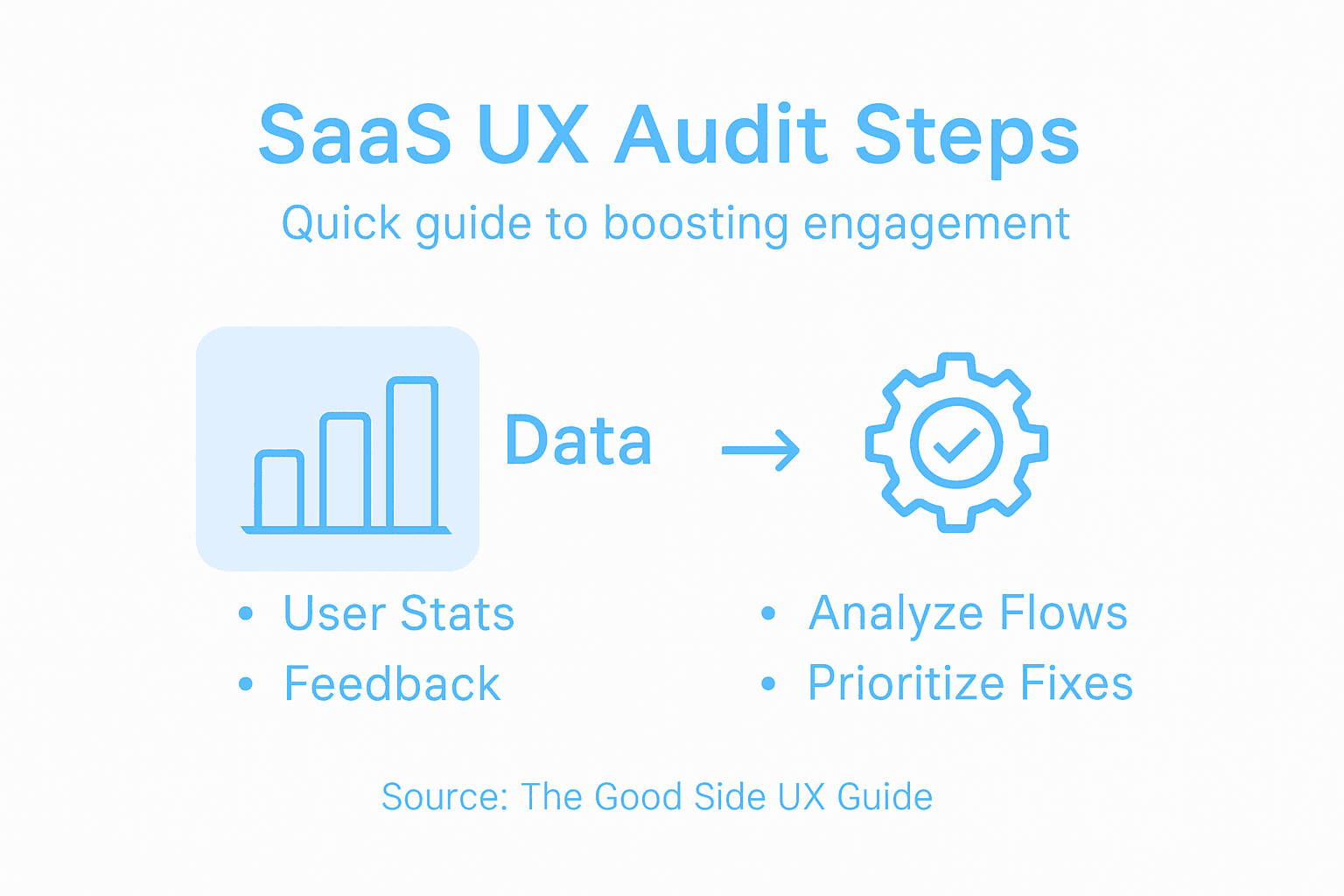
UX audit techniques reveal critical insights into user interaction challenges by combining multiple data sources and evaluation methods. This means going beyond surface-level observations to understand the deeper friction points in your product’s user experience.
Key strategies for identifying and prioritizing UX pain points include:
- Analyze user behavior data from multiple perspectives
- Cross-reference quantitative metrics with qualitative feedback
- Create a severity matrix for identified issues
- Calculate potential business impact for each pain point
- Rank improvements based on effort versus potential value
- Develop a structured remediation roadmap
Focus on critical usability barriers that directly impede user progress. Pay special attention to moments where users experience confusion, frustration, or unexpected complexity in your product’s workflow.
Not all UX problems are created equal. Prioritize improvements that deliver the most significant user and business value.
Pro tip: Weight your UX improvements using a scoring system that considers user impact, implementation difficulty, and potential revenue enhancement.
Step 5: Validate enhancements through testing and feedback
Transforming UX insights into meaningful improvements requires a rigorous validation process that goes beyond theoretical design changes. Your objective is to systematically test and confirm that proposed modifications genuinely enhance user experience and deliver tangible business value.
Systematic usability testing provides critical validation for your proposed UX enhancements. This means designing targeted experiments that empirically measure the impact of design changes across multiple user interaction dimensions.
Key strategies for validation include:
- Conduct A/B testing for proposed interface modifications
- Run structured usability testing sessions
- Collect quantitative and qualitative user feedback
- Track key performance indicators before and after changes
- Use heat mapping and interaction analytics
- Implement incremental rollouts for complex changes
Focus on objective measurement techniques that provide clear, actionable insights. Pay special attention to metrics that demonstrate actual improvements in user efficiency, satisfaction, and engagement.
Validation is not about proving yourself right, but about understanding what truly works for your users.
Pro tip: Design your validation tests with predefined success criteria to ensure objective and measurable outcomes.
Here’s a summary comparing the focus and business impact of each UX audit step:
| Step | Main Focus Area | Expected Business Impact |
|---|---|---|
| Define Audit Objectives | Align goals with business targets | More actionable, measurable improvements |
| Gather User Data & Analytics | Comprehensive user behavior analysis | Pinpoints high-impact improvement areas |
| Evaluate Core Workflows | Map critical user journeys | Identifies key drop-off and conversion points |
| Identify & Prioritize Pain Points | Systematic issue detection and ranking | Prioritizes high-value fixes |
| Validate Enhancements | Test and measure improvements | Confirms real-world user and business gains |
Elevate Your SaaS User Experience with Strategic Design Partnership
The article highlights the challenge of pinpointing critical UX pain points, aligning audit objectives with business goals, and validating improvements to boost engagement fast. If you struggle with transforming raw user data into actionable strategies or prioritizing impactful UX enhancements that drive real business results, you are not alone. Concepts like user journey mapping, quantitative and qualitative analytics, and outcome-driven prioritization require senior design leadership to translate insight into execution.
At The Good Side, we specialize in embedding experienced SaaS-focused design partners who collaborate directly with your product and engineering teams. Our approach goes beyond surface-level UI fixes by integrating strategic ownership, rapid iteration, and measurable results aligned with your business objectives. By working alongside your team, we help accelerate product growth, reduce onboarding friction, and increase feature adoption.
Take the next step toward unlocking your product’s full potential with a fractional design leadership solution tailored for growth-stage SaaS companies.

Explore how our fractional design partnership can transform your UX audit insights into actionable business outcomes. Visit The Good Side now to accelerate your SaaS growth with expert design leadership that makes every interaction count.
Frequently Asked Questions
What are the first steps to define UX audit objectives for my SaaS?
To define UX audit objectives, start by aligning them with your business goals. Identify key performance indicators, such as user activation rates and conversion funnels, then set specific, measurable targets like reducing onboarding drop-off by 25% within three months.
How can I gather relevant user data for a UX audit?
You can gather user data by integrating web analytics, implementing event tracking, and conducting user interviews. Focus on collecting both quantitative metrics and qualitative feedback to build a comprehensive view of user interactions and identify areas for improvement.
What should I focus on when evaluating my SaaS workflows?
When evaluating workflows, create user journey maps to document how users interact with your product. Identify emotional triggers and potential frustration points to reveal critical moments where users may drop off or encounter confusion.
How do I prioritize UX pain points in my audit?
To prioritize UX pain points, analyze user behavior data and cross-reference it with qualitative feedback. Rank issues based on their severity and potential business impact, focusing on those that could significantly improve user satisfaction and conversion rates.
What methods can I use to validate UX improvements after conducting an audit?
You can validate UX improvements by conducting A/B testing, running usability testing sessions, and collecting user feedback. Measure key performance indicators both before and after implementing changes to confirm whether they enhance user experience and lead to better engagement results.
Recommended
- 7 Essential Types of UX Audits Every SaaS Team Should Know | The Good Side Blog
- Complete Guide to the Role of UX in SaaS | The Good Side Blog
- What Is High-Performing UX for SaaS Success | The Good Side Blog
- Why Invest in UI UX: A Complete Guide
- Complete Guide to Website Optimization Strategies – Lind Creative