
Rapid Prototyping: Accelerating SaaS Product Growth
Finding the right balance between speed and precision can often feel like a moving target for SaaS product teams. The demand for quick iterations and real user validation calls for approaches that go beyond conventional development cycles. By embracing rapid prototyping, companies position themselves to efficiently test ideas, refine features, and respond to user needs before large-scale investments are made, setting the foundation for smoother onboarding and stronger engagement.
Table of Contents
- Rapid Prototyping Defined For SaaS Teams
- Core Types And Stages Of Prototyping
- How Rapid Prototyping Drives SaaS Activation
- Costs, Risks, And Common Pitfalls
- Comparing Rapid Prototyping To Traditional Methods
Key Takeaways
| Point | Details |
|---|---|
| Rapid Prototyping Accelerates Development | Enables SaaS teams to validate concepts and reduce time-to-market through iterative models. |
| Focus on User Feedback | Emphasizes capturing real user interactions to refine product features effectively. |
| Strategic Prototype Selection | Different prototype types serve distinct purposes, helping teams address specific goals. |
| Mitigate Risks with Clear Metrics | Establishing success metrics and budget constraints ensures effective prototyping processes. |
Rapid prototyping defined for SaaS teams
Rapid prototyping represents a strategic approach for SaaS teams to accelerate product development by creating fast, iterative models that validate user needs and technical feasibility. In the context of software-as-a-service, it goes beyond traditional product design by emphasizing speed, flexibility, and continuous user feedback.
At its core, rapid prototyping is a methodology that allows product teams to:
- Build quick, functional representations of product features
- Test assumptions with real users
- Minimize development risks
- Reduce time-to-market
- Validate product concepts before significant resource investment
The approach is particularly powerful in SaaS environments where cross-platform mobile application development demands rapid iteration and stakeholder engagement. By using frameworks that support quick modifications, SaaS teams can simulate and test product experiences more efficiently than traditional linear development models.
Effective rapid prototyping in SaaS typically involves creating lightweight, interactive models that demonstrate core functionality without requiring full-scale implementation. These prototypes can range from basic wireframes to functional clickable demos that allow stakeholders to experience potential product features in near-real conditions.
Pro tip: Start your rapid prototyping process by identifying the smallest, most critical user workflow that represents your core value proposition, and build an initial prototype focused exclusively on that experience.
Core types and stages of prototyping
Rapid prototyping in SaaS encompasses multiple approaches designed to transform conceptual ideas into tangible product experiences. Prototyping strategies range from low-fidelity sketches to high-fidelity interactive models, each serving distinct purposes in the product development lifecycle.
The primary types of prototypes for SaaS teams include:
- Conceptual Prototypes: Basic sketches and wireframes exploring initial product concepts
- Functional Prototypes: Interactive models demonstrating core product functionality
- Technical Prototypes: Deeper technical explorations testing specific system architectures
- User Experience (UX) Prototypes: Detailed simulations focusing on user interaction flows
Prototyping typically progresses through critical stages that enable continuous learning and refinement. These stages involve:
- Ideation and initial concept development
- Basic model creation
- User testing and feedback collection
- Iterative refinement
- Validation against product requirements
Understanding the nuanced differences between prototype types allows product teams to select the most appropriate approach for their specific development context. By strategically choosing prototype models, teams can minimize development risks and accelerate product validation processes.
Here’s a comparison of rapid prototyping types and their ideal use cases for SaaS teams:
| Prototype Type | Ideal Use Case | Key Outcome |
|---|---|---|
| Conceptual Prototype | Early-stage idea exploration | Clarifies product vision |
| Functional Prototype | Validating core features | Demonstrates feasibility |
| Technical Prototype | Testing technical architecture | Reduces technical uncertainty |
| UX Prototype | Refining user flows and interactions | Enhances user satisfaction |
Pro tip: Choose your prototype fidelity based on the specific questions you need to answer - start with low-fidelity models for exploratory phases and progressively increase complexity as you gain more insights.
How rapid prototyping drives SaaS activation
Rapid prototyping serves as a critical acceleration mechanism for SaaS product activation, enabling teams to quickly validate and refine user engagement strategies. Mobile service prototype testing demonstrates how iterative approaches can dramatically improve user onboarding and feature adoption rates.
The key ways rapid prototyping drives SaaS activation include:
- Accelerated User Feedback: Capturing real-world user interactions early in development
- Risk Mitigation: Identifying potential activation barriers before full product launch
- Feature Validation: Quickly testing and refining core product functionalities
- User Experience Optimization: Streamlining onboarding and initial user interactions
By implementing rapid prototyping, SaaS teams can create more responsive and user-centric activation strategies. This approach allows for continuous learning and immediate adjustments, ensuring that product features directly address user needs and pain points. The iterative nature of prototyping means teams can quickly pivot, reducing time-to-market and improving overall user engagement metrics.

Successful activation through rapid prototyping requires a systematic approach that balances technical feasibility with user experience design. Product teams must be prepared to collect, analyze, and rapidly implement user insights, creating a dynamic and responsive development cycle that keeps pace with evolving user expectations.
Pro tip: Design your first prototype with a laser focus on solving the single most critical user problem, and use that as your activation cornerstone.
Costs, risks, and common pitfalls
Rapid prototyping in SaaS development is not without significant financial and strategic challenges. Prototype development costs can quickly escalate if teams fail to implement disciplined approaches to resource allocation and design iteration.
Key financial and strategic risks include:
- Unexpected Resource Drain: Prolonged prototyping cycles consuming disproportionate budget
- Premature Complexity: Investing in high-fidelity prototypes too early in development
- Misaligned Objectives: Creating prototypes that do not directly address core user needs
- Technical Debt: Accumulating design compromises that increase future development complexity
Common pitfalls that SaaS teams encounter during rapid prototyping often stem from fundamental misunderstandings about the prototyping process. Many organizations mistakenly view prototyping as a linear progression, when in reality it requires constant recalibration and willingness to abandon initial concepts that do not meet user expectations.
Successful rapid prototyping demands a strategic approach that balances technical feasibility, user experience, and economic constraints. Teams must develop robust frameworks for evaluating prototype effectiveness, ensuring that each iteration brings tangible value and moves the product closer to market readiness.
Pro tip: Establish clear success metrics and budget constraints for each prototype iteration before beginning development, and be prepared to pivot or terminate projects that do not demonstrate clear potential.
Comparing rapid prototyping to traditional methods
Rapid prototyping fundamentally transforms the product development landscape by challenging conventional design and production paradigms. Rapid prototyping technologies represent a revolutionary approach that dramatically accelerates innovation cycles compared to traditional methodologies.
Key differences between rapid prototyping and traditional methods include:
- Iteration Speed: Rapid prototyping enables quick design modifications
- Cost Efficiency: Reduced upfront tooling and manufacturing expenses
- Design Flexibility: Easier exploration of complex product configurations
- Risk Mitigation: Earlier identification of potential design challenges
- Resource Optimization: Minimal material waste compared to traditional approaches
Traditional product development typically follows a linear, sequential process with lengthy design cycles and significant upfront investment. In contrast, rapid prototyping embraces an iterative, adaptive methodology that allows teams to experiment, test, and refine concepts with unprecedented agility. This approach transforms product development from a rigid, time-consuming process into a dynamic, responsive strategy that can quickly adapt to changing market demands.
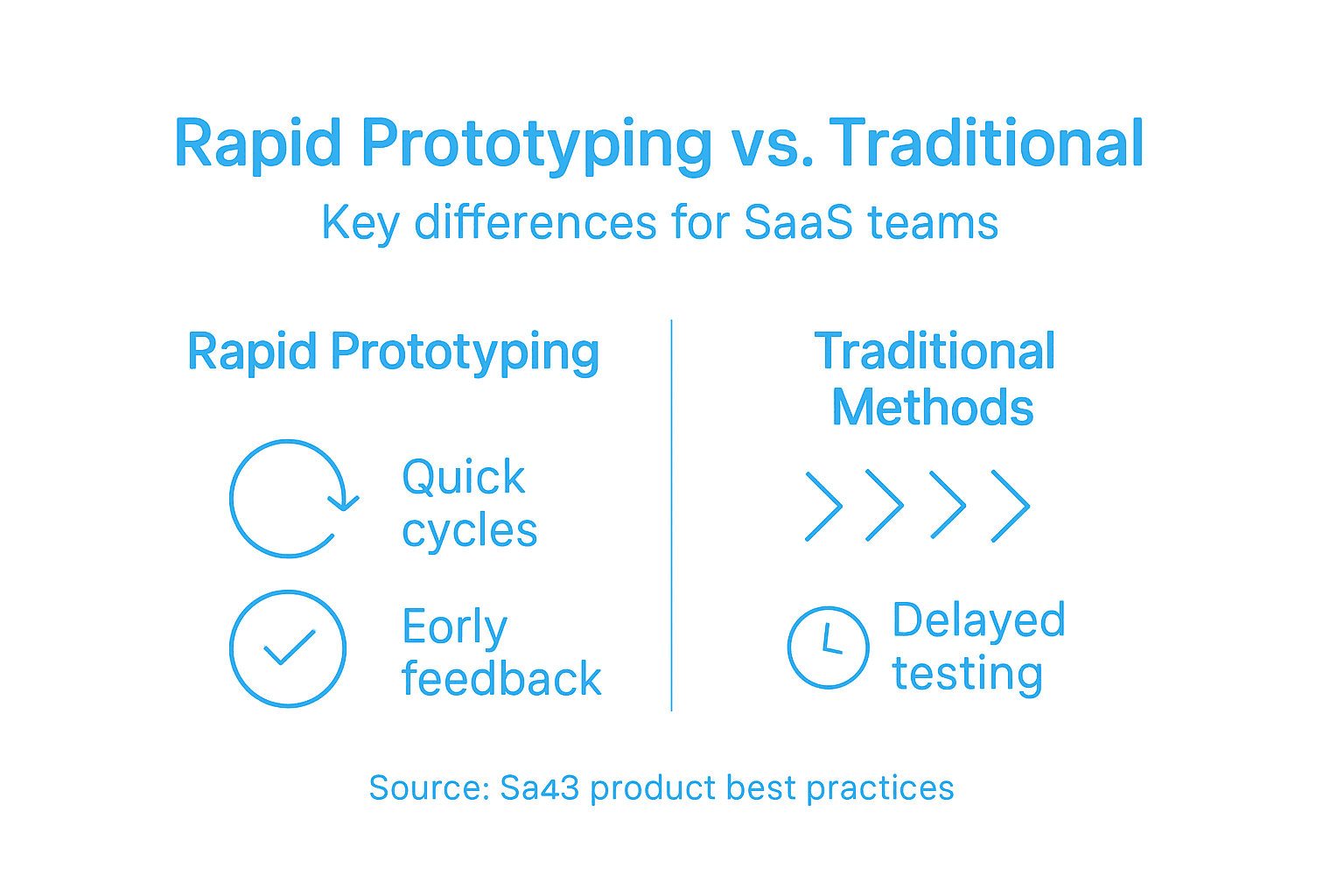
This table summarizes the trade-offs between rapid prototyping and traditional development methods:
| Factor | Rapid Prototyping | Traditional Methods |
|---|---|---|
| Development Speed | Very fast and adaptive | Lengthy and sequential |
| Resource Allocation | Incremental investments | Large upfront commitment |
| Flexibility | High, supports changes | Low, resistant to changes |
| Risk Handling | Early and frequent checks | Late-stage identification |
The most significant advantage of rapid prototyping lies in its ability to compress development timelines and reduce financial risks. By creating low-cost, quickly producible models, teams can validate concepts, gather user feedback, and make informed decisions before committing extensive resources to full-scale production.
Pro tip: Implement a staged prototyping approach, starting with low-fidelity models and progressively increasing complexity based on validated learnings.
Accelerate Your SaaS Growth with Strategic Rapid Prototyping
Rapid prototyping is essential for SaaS teams facing pressure to validate features quickly and reduce costly development risks. If you are struggling with slow iteration cycles or unclear design priorities, embedding experienced design leadership can make the difference. At The Good Side Oy, we partner with growth-oriented SaaS companies to deliver hands-on designers who specialize in aligning product design, user experience, and activation strategies that directly tackle common pitfalls like premature complexity and misaligned objectives.
We help you:
- Build prototypes that focus on critical user workflows
- Drive fast and informed product decisions through collaborative design
- Optimize onboarding and activation for measurable revenue impact
Ready to move beyond surface-level UI work and accelerate your product growth with expert design integration? Discover how our embedded designers bring strategic ownership and SaaS-specific expertise directly to your team. Visit The Good Side Oy to learn more and start optimizing your rapid prototyping process today.
Frequently Asked Questions
What is rapid prototyping in the context of SaaS development?
Rapid prototyping in SaaS development is a methodology that enables teams to create fast, iterative models of product features that validate user needs and technical feasibility. It emphasizes speed, flexibility, and continuous user feedback to accelerate product development.
What are the core types of prototypes used by SaaS teams?
The core types of prototypes include conceptual prototypes (basic sketches), functional prototypes (interactive models), technical prototypes (testing system architectures), and user experience (UX) prototypes (detailed simulations of user interaction flows).
How does rapid prototyping improve user engagement in SaaS products?
Rapid prototyping enhances user engagement by allowing teams to capture real-world user interactions early in development, validate features, and streamline onboarding processes, leading to better user experience and higher feature adoption rates.
What are some common pitfalls organizations face when implementing rapid prototyping?
Common pitfalls include unexpected resource drain from prolonged prototyping cycles, premature complexity by investing in high-fidelity prototypes too early, misaligned objectives, and accumulating technical debt that complicates future development.