
What Is Product Positioning and Its Impact on SaaS Growth
Defining how software stands out in a crowded market often feels like solving a complex puzzle. For product managers at SaaS companies focused on rapid growth, thoughtful product positioning means more than promoting features. It shapes how users perceive value and choose your solution over alternatives. This overview delivers strategic insights on effective positioning frameworks that help drive user adoption, strengthen differentiation, and unlock greater revenue potential.
Table of Contents
- Defining Product Positioning In SaaS
- Types Of Product Positioning Strategies
- How Effective Positioning Drives SaaS Success
- Common Mistakes And Risks To Avoid
- Real-World SaaS Positioning Examples
Key Takeaways
| Point | Details |
|---|---|
| Importance of Continuous Adaptation | SaaS product positioning requires ongoing refinement to align with evolving market dynamics and customer expectations. Conducting regular reviews can maintain relevance. |
| Diverse Positioning Strategies | Various positioning strategies, such as feature differentiation and customer experience positioning, help attract specific customer segments and enhance market appeal. |
| Impact on Market Perception | Clear and effective positioning enhances customer understanding, accelerates acquisition, and improves pricing power, leading to sustained growth. |
| Avoiding Common Pitfalls | SaaS companies should avoid overgeneralization and ensure their messaging aligns with customer pain points to maintain a competitive edge. |
Defining Product Positioning in SaaS
Product positioning in SaaS is the strategic process of defining how your software solution uniquely solves customer problems and differentiates itself from competitors. Unlike traditional product marketing, SaaS positioning requires continuous adaptation and deep understanding of evolving market dynamics.
At its core, product positioning represents a deliberate framework that communicates your software’s core value proposition. Strategic positioning process for SaaS companies involves several critical components:
- Identifying target customer segments
- Understanding specific market pain points
- Defining unique product capabilities
- Articulating clear differentiation from alternative solutions
- Mapping product features to customer needs
Successful SaaS product positioning goes beyond listing technical features. It requires presenting a compelling narrative about how your solution transforms user experiences. According to research on SaaS product strategy development, effective positioning addresses key questions about scalability, customer specificity, and delivery methods.

The positioning process demands ongoing refinement. Markets evolve rapidly, and customer expectations shift continuously. This means your positioning strategy must remain flexible, regularly reassessed through customer feedback, competitive analysis, and performance metrics.
Pro tip: Conduct quarterly positioning reviews to ensure your SaaS offering remains aligned with current market needs and customer expectations.
Types of Product Positioning Strategies
Product positioning strategies in SaaS are diverse, each designed to carve out a unique market space and attract specific customer segments. SaaS product positioning approaches require strategic thinking and deep understanding of market dynamics.
Here are the primary positioning strategies SaaS companies typically employ:
- Feature Differentiation: Highlighting unique technological capabilities
- Price-Based Positioning: Offering competitive or innovative pricing models
- Target Market Specialization: Focusing on niche industry or user segment needs
- Solution-Oriented Positioning: Emphasizing problem-solving capabilities
- Customer Experience Positioning: Showcasing superior user interface and interaction
In feature differentiation, companies leverage unique technological capabilities that set them apart from competitors. This might involve advanced AI integration, more comprehensive analytics, or seamless third-party integrations that solve complex business challenges.
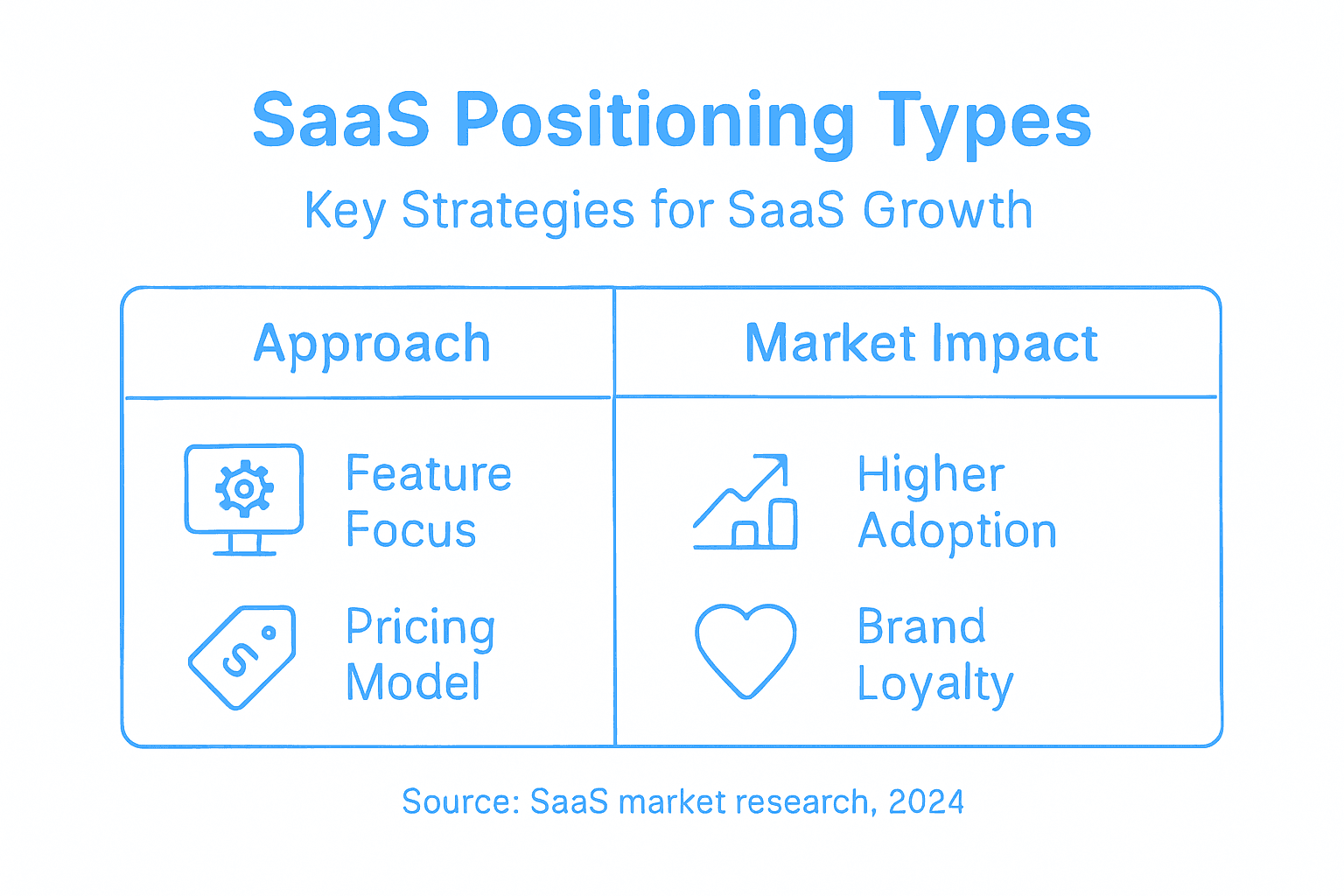
Pricing strategies represent another critical positioning approach. Some SaaS companies distinguish themselves through flexible pricing models like usage-based billing, transparent tier structures, or freemium offerings that lower entry barriers for potential customers.
Here’s how key SaaS positioning strategies compare in terms of focus and market impact:
| Strategy Type | Main Focus | Typical Market Impact |
|---|---|---|
| Feature Differentiation | Unique technical features | Increased product appeal |
| Price-Based Positioning | Cost and pricing structure | Lower entry barrier |
| Target Market Specialization | Niche customer segment | Stronger customer loyalty |
| Solution-Oriented Positioning | Specific problem solving | Faster adoption rates |
| Customer Experience Positioning | Usability and interface | Higher user satisfaction |
Pro tip: Regularly conduct competitive analysis to ensure your positioning strategy remains distinctive and responsive to evolving market needs.
How Effective Positioning Drives SaaS Success
Effective product positioning is the critical engine that propels SaaS companies from competitive obscurity to market leadership. Strategic positioning frameworks demonstrate how precise messaging can transform market perception and drive substantial business growth.
The impact of strategic positioning manifests through several key dimensions:
- Accelerated customer acquisition rates
- Reduced sales cycle complexity
- Enhanced pricing power and perceived value
- Improved customer trust and loyalty
- Clearer competitive differentiation
Market Perception plays a crucial role in driving SaaS success. When companies articulate their unique value proposition clearly, potential customers can quickly understand how the solution addresses their specific challenges. This clarity eliminates confusion and reduces friction in the purchasing decision.
Moreover, effective positioning directly influences financial performance. Companies that communicate their distinctive capabilities can command premium pricing, attract higher-quality customers, and build more sustainable growth trajectories. By precisely targeting market segments and solving specific pain points, SaaS organizations create compelling narratives that resonate deeply with their ideal customer profiles.
Pro tip: Conduct regular positioning audits to ensure your messaging remains aligned with evolving customer needs and market dynamics.
Common Mistakes and Risks to Avoid
SaaS companies frequently stumble in product positioning by making critical strategic errors that can derail growth potential. SaaS positioning pitfalls reveal numerous common mistakes that can significantly undermine market success.
Key positioning mistakes to watch out for include:
- Attempting to appeal to everyone
- Creating overly complex messaging
- Neglecting specific customer pain points
- Failing to differentiate from competitors
- Inconsistent brand communication
- Ignoring market segmentation
Overgeneralization represents one of the most dangerous positioning traps. When SaaS companies try to be everything to everyone, they end up being nothing to anybody. This scattered approach dilutes their core value proposition and makes it challenging for potential customers to understand the specific problem the product solves.
Another critical risk involves misaligning product messaging with actual use cases. Technical capabilities matter less than demonstrating how your solution directly addresses customer challenges. Effective positioning requires deep understanding of target audience needs, communicating solutions in language that resonates with their specific context and challenges.
Pro tip: Conduct regular customer interviews and market research to ensure your positioning remains laser-focused and relevant to your ideal customer profile.
Real-World SaaS Positioning Examples
Effective product positioning transforms abstract concepts into compelling market narratives that drive customer engagement and growth. SaaS positioning strategies reveal powerful approaches that successful companies use to differentiate themselves in crowded markets.
Key positioning examples demonstrate various strategic approaches:
- Problem-Solver Positioning: Highlighting specific pain point resolution
- Innovator Positioning: Emphasizing technological breakthrough
- Efficiency Positioning: Showcasing productivity and cost-saving capabilities
- Expert Positioning: Establishing thought leadership and domain expertise
- User Experience Positioning: Focusing on superior interface and usability
Problem-Solver Positioning stands out as particularly effective. Companies like Slack positioned themselves not just as a communication tool, but as a solution that eliminates email overload and improves team collaboration. By articulating a clear, relatable challenge, they transformed their product from a simple messaging platform into an essential workplace productivity solution.
Another compelling approach involves Innovator Positioning, where companies distinguish themselves through groundbreaking technological capabilities. This strategy works exceptionally well for products that introduce genuinely transformative solutions that fundamentally change how businesses operate.
Compare real-world SaaS positioning approaches in terms of messaging style and perceived value:
| Positioning Approach | Messaging Style | Perceived Value by Customers |
|---|---|---|
| Problem-Solver Positioning | Direct, relatable | Solves urgent challenges |
| Innovator Positioning | Visionary, bold | Leading-edge technology |
| Efficiency Positioning | Practical, concise | Saves time and cost |
| Expert Positioning | Authoritative, trusted | Industry expertise |
| User Experience Positioning | Friendly, accessible | Seamless usability |
Pro tip: Develop positioning statements that focus on tangible outcomes and specific customer benefits rather than generic feature descriptions.
Elevate Your SaaS Product Positioning with Strategic Design Leadership
The article highlights the critical challenges SaaS companies face like avoiding generic messaging, clearly differentiating from competitors, and aligning product positioning with specific customer pain points. If you are struggling to translate your product’s unique capabilities into compelling narratives that accelerate growth and improve market perception then embedding expert design leadership can make all the difference. The Good Side Oy specializes in partnering with growth-oriented SaaS businesses to deliver outcome-driven design that tightens your product positioning and streamlines onboarding, activation, and adoption.
By working with senior designers who co-create with your product and engineering teams, you gain a strategic advantage that eliminates complex or scattered messaging while enhancing user experience and competitive differentiation. This approach directly addresses pain points like inconsistent brand communication and ineffective positioning strategies, driving measurable business impact. Discover how a focused, flexible design partnership can accelerate your SaaS success by visiting The Good Side and explore how our embedded design leadership supports your product growth.
Ready to transform your SaaS positioning and create clearer, more persuasive market narratives that win customers and boost revenue
Take the first step today by connecting with us at The Good Side and start crafting design strategies that shape the future of your product positioning and growth.
Frequently Asked Questions
What is product positioning in SaaS?
Product positioning in SaaS is the strategic process of defining how a software solution uniquely solves customer problems and differentiates itself from competitors while continuously adapting to market dynamics.
How does effective positioning drive SaaS success?
Effective positioning enhances customer acquisition rates, simplifies the sales cycle, increases perceived value, and builds customer trust and loyalty, thereby driving significant business growth.
What are common positioning strategies used by SaaS companies?
Common positioning strategies include feature differentiation, price-based positioning, target market specialization, solution-oriented positioning, and customer experience positioning, each catering to different aspects of market needs.
What mistakes should SaaS companies avoid in their positioning strategy?
SaaS companies should avoid overgeneralization, complex messaging, neglecting specific customer pain points, failing to differentiate from competitors, inconsistent communication, and ignoring market segmentation.