
Minimum Viable Product: Accelerating SaaS Market Fit
Launching a SaaS product without clear validation can waste months of effort and scarce resources. Product managers and CTOs know the stakes are high when trying to achieve early market fit and customer traction. Focusing on a Minimum Viable Product lets teams address urgent user pain points while gathering real-world feedback with minimal investment, providing a foundation for intentional growth and strategic iteration.
Table of Contents
- Defining Minimum Viable Product In SaaS
- Types Of MVPs And Key Distinctions
- Essential Features And Success Metrics
- Role Of MVPs In SaaS Growth Strategies
- Common Pitfalls And How To Avoid Them
Key Takeaways
| Point | Details |
|---|---|
| Minimum Viable Product is Essential | An MVP allows SaaS startups to validate their core product ideas with minimal resources, focusing on solving specific user problems. |
| Feature Prioritization is Key | Essential features should be identified to deliver maximum user value while avoiding unnecessary complexity. |
| Iterate Based on Feedback | Rapid iteration based on user feedback is crucial for improving product fit and understanding market needs. |
| Avoid Common Pitfalls | Recognizing and mitigating common development mistakes, such as feature bloat and ignoring user insights, is vital for success. |
Defining Minimum Viable Product in SaaS
A Minimum Viable Product (MVP) represents a strategic approach for SaaS startups to develop and validate their core product hypothesis with minimal resources. MVP development in SaaS involves creating a stripped-back version of a software product that solves a specific user problem while enabling rapid market validation.
The MVP concept centers on three fundamental principles:
- Core Functionality: Building only the essential features that directly address user pain points
- Rapid Iteration: Designing a product that can be quickly modified based on user feedback
- Market Testing: Validating product-market fit with minimal initial investment
At its essence, an MVP allows product teams to test critical business assumptions without committing extensive resources. By focusing on the most crucial user needs, SaaS companies can quickly understand whether their product concept resonates with potential customers. Lean startup methodology emphasizes this approach as a way to reduce risk and accelerate learning.
The goal isn’t to launch a perfect product, but to create a functional prototype that provides genuine value while enabling continuous improvement. Successful MVPs strike a delicate balance between providing enough utility to attract early adopters and maintaining flexibility for future enhancements.
Pro tip: Start your MVP by identifying the single most critical problem your target users need solved, then design the simplest possible solution that meaningfully addresses that specific challenge.
Types of MVPs and Key Distinctions
SaaS companies can leverage multiple MVP types to validate product ideas and minimize development risks. Low-fidelity and high-fidelity MVPs represent different strategic approaches to product validation, each serving unique market testing objectives.
The primary MVP categories include:
- Video MVP: Demonstrates product concept through visual storytelling before actual development
- Concierge MVP: Manually delivers services to deeply understand customer needs
- Wizard of Oz MVP: Creates automation illusion through manual backend processes
- Landing Page MVP: Tests market interest through targeted web pages
- Single-Feature MVP: Focuses on delivering one core solution exceptionally well
Each MVP type offers distinct advantages for SaaS teams. Validation strategies range from simple prototypes to more complex simulations, enabling product managers to gather critical market insights without extensive resource commitment.
The following table compares various MVP types in SaaS and their ideal use cases:
| MVP Type | Ideal Use Case | Main Benefit |
|---|---|---|
| Video MVP | Early concept validation | Engages visually, low cost |
| Concierge MVP | Understanding nuanced user needs | Deep customer feedback |
| Wizard of Oz MVP | Testing product automation potential | Simulates tech before scaling |
| Landing Page MVP | Gauging initial market demand | Fast user interest data |
| Single-Feature MVP | Focusing on core problem | Rapid value demonstration |
High-fidelity MVPs provide more developed, functional versions that can more accurately test user engagement and product-market alignment. Low-fidelity approaches, conversely, offer quick, cost-effective methods to validate fundamental product hypotheses before significant investment.

Pro tip: Select your MVP type based on your specific validation goals, target audience complexity, and available resources.
Essential Features and Success Metrics
Building a successful SaaS MVP requires strategic feature selection and robust measurement frameworks. Feature prioritization techniques help product teams identify core functionalities that deliver maximum user value with minimal complexity.
Key essential features for a SaaS MVP typically include:
- User Authentication: Secure login and basic account management
- Core Functionality: Primary solution addressing specific user pain points
- Minimal User Interface: Clean, intuitive design enabling immediate value
- Basic Analytics: Fundamental usage tracking and performance metrics
- Scalability Framework: Infrastructure supporting future feature expansion
Success metrics for SaaS MVPs focus on validating critical business hypotheses through quantitative and qualitative measurements. These typically encompass user engagement, retention rates, activation speed, and feedback-driven iteration potential.
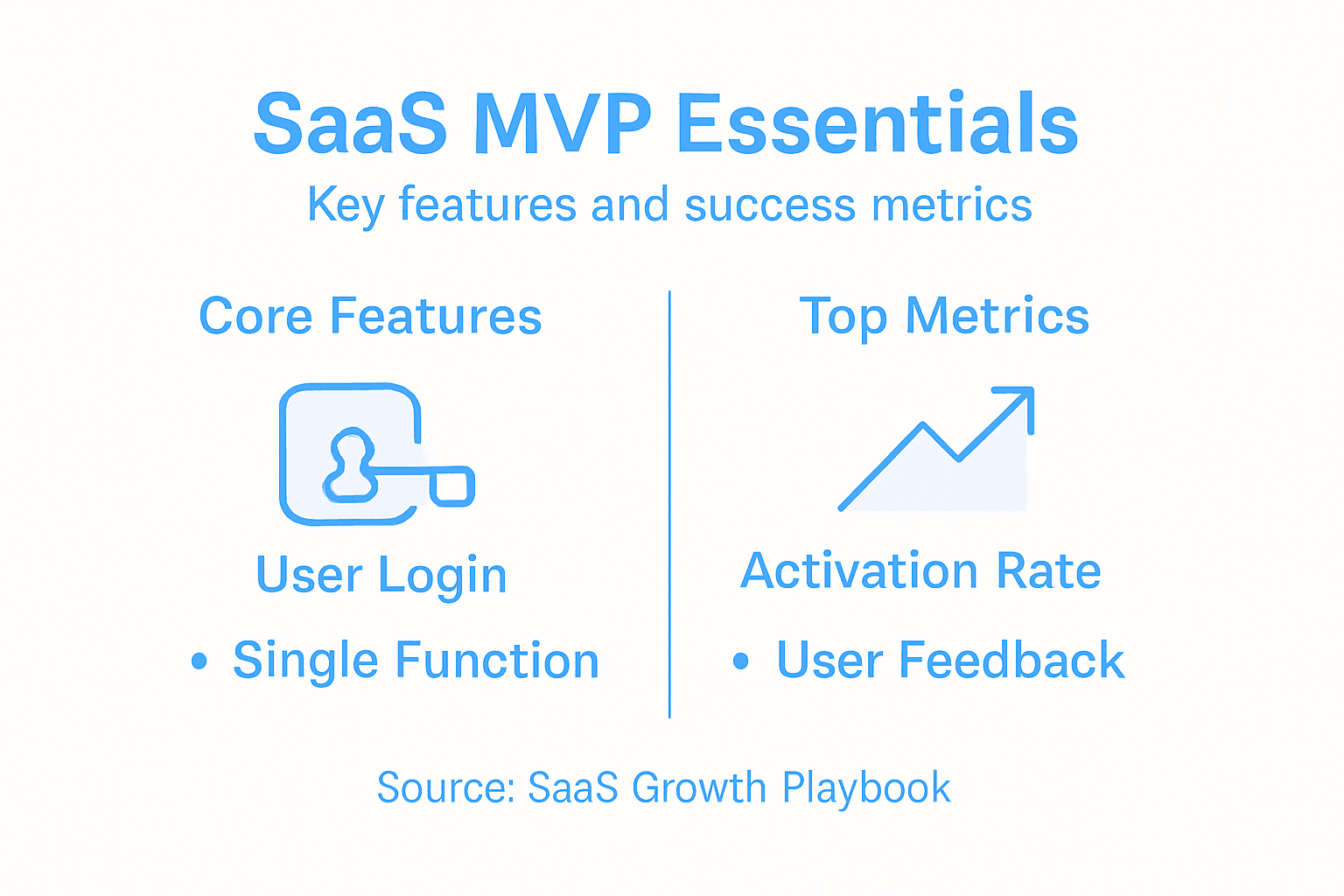
This table summarizes SaaS MVP success metrics and their business implications:
| Metric | What It Measures | Why It Matters |
|---|---|---|
| User Engagement | Frequency of product interaction | Indicates market interest |
| Retention Rate | Percentage of users returning | Reflects product stickiness |
| Activation Speed | Time to first value experience | Reveals onboarding clarity |
| Feedback Volume | Amount of actionable comments received | Guides iteration efforts |
Product teams can leverage multiple prioritization frameworks like MoSCoW (Must-have, Should-have, Could-have, Won’t-have) and RICE (Reach, Impact, Confidence, Effort) to systematically evaluate and rank potential features. The goal is creating a lean, focused product that proves market viability while maintaining flexibility for future development.
Pro tip: Prioritize features that solve a specific, urgent problem for your target users rather than attempting to create a comprehensive solution from the start.
Role of MVPs in SaaS Growth Strategies
Strategic growth mechanisms define the critical role of Minimum Viable Products in accelerating SaaS business development. MVPs serve as powerful validation tools that transform uncertain product concepts into data-driven growth strategies, enabling teams to make informed decisions with minimal initial investment.
Key strategic advantages of MVPs include:
- Market Validation: Quickly test core product hypotheses
- Risk Mitigation: Reduce financial exposure before full development
- User Insight Generation: Capture real-world feedback and usage patterns
- Investor Attraction: Demonstrate product potential and market understanding
- Rapid Iteration: Enable fast, responsive product refinement
SaaS startups leverage MVPs to accelerate time-to-market and systematically validate their core value proposition. By focusing on essential features and maintaining flexible development approaches, companies can efficiently navigate early-stage challenges and build products that genuinely resonate with target users.
The iterative nature of MVPs transforms traditional product development from a high-risk, high-cost endeavor into a strategic, data-informed process. This approach allows SaaS companies to progressively build complex solutions by continuously testing, learning, and adapting their product based on real user interactions and market feedback.
Pro tip: Design your MVP with precise metrics and feedback mechanisms that allow you to objectively evaluate product potential and user engagement.
Common Pitfalls and How to Avoid Them
SaaS MVP development mistakes can significantly derail product success, making strategic awareness critical for startup teams. Understanding common pitfalls allows product managers to navigate early-stage challenges more effectively and maintain development momentum.
Key MVP development pitfalls to watch for include:
- Feature Bloat: Adding unnecessary complexity before market validation
- Premature Scaling: Investing in infrastructure before proving core value
- Unclear Validation Goals: Lacking specific hypotheses to test
- Perfectionism: Delaying launch while seeking unrealistic polish
- Ignored User Feedback: Failing to incorporate early customer insights
Successful SaaS teams mitigate these risks by implementing structured validation frameworks. This involves setting clear success criteria, prioritizing essential features using methodologies like MoSCoW, and maintaining flexible development approaches that emphasize learning and rapid iteration.
The most effective MVP strategies focus on function over form, enabling teams to quickly test core value propositions and gather meaningful user data. By embracing an experimental mindset and remaining adaptable, product teams can transform potential pitfalls into opportunities for strategic refinement and market understanding.
Pro tip: Create a detailed hypothesis document before MVP development that explicitly outlines your key assumptions, measurable success metrics, and potential pivot strategies.
Accelerate Your SaaS MVP Success with Expert Design Partnership
Navigating the challenges of building a Minimum Viable Product demands clear focus on core functionality, rapid iteration, and meaningful user feedback as highlighted in the article “Minimum Viable Product: Accelerating SaaS Market Fit.” If you find yourself struggling to prioritize essential features or seeking to align product design with critical success metrics like user activation and retention, The Good Side Oy offers a proven solution tailored for growth-oriented SaaS companies. Our embedded senior designers bring strategic ownership and SaaS-specific expertise that ensures your MVP delivers measurable business outcomes rather than just surface-level UI improvements.
Unlock accelerated product growth by integrating design leadership focused on improving onboarding, engagement, and go-to-market experiences. Learn how we help SaaS teams move faster and smarter with clear prioritization and seamless collaboration at The Good Side. Ready to transform your MVP validation into a scalable growth engine Explore our approach and request a consultation today at https://goodside.fi and see how embedding experienced design partners can give your SaaS startup the competitive edge it needs.
Frequently Asked Questions
What is a Minimum Viable Product (MVP) in SaaS?
A Minimum Viable Product (MVP) is a version of a software product that includes only the essential features necessary to solve a specific problem for users, allowing for rapid market validation and learning.
What are the key benefits of using an MVP for a SaaS product?
The key benefits of using an MVP include market validation, risk mitigation, user insight generation, faster iterations, and attracting potential investors by demonstrating product viability with minimal investment.
What types of MVPs can SaaS companies use?
SaaS companies can utilize various types of MVPs, including Video MVPs, Concierge MVPs, Wizard of Oz MVPs, Landing Page MVPs, and Single-Feature MVPs, each serving unique testing and validation purposes.
What common pitfalls should I avoid when developing an MVP?
Common pitfalls include feature bloat, premature scaling, unclear validation goals, perfectionism, and ignoring user feedback. It’s crucial to focus on essential features and maintain flexibility during development.