
Design Thinking in SaaS: Accelerating Revenue Growth
Every SaaS product manager knows the challenge of turning new features into steady revenue, especially when adoption stalls and user activation lags. Shifting from product-first thinking to a user-centric design approach can reshape team outcomes, as research shows that real innovation starts with deep empathy and cross-functional collaboration. This guide reveals how design thinking empowers SaaS teams to create products customers actually want, from practical process steps to proven team tactics that drive measurable growth.
Table of Contents
- Defining Design Thinking For SaaS Teams
- Core Principles Behind Design Thinking Methods
- Step-By-Step Design Thinking Process For SaaS
- Real-World Design Thinking Use Cases In SaaS
- Critical Team Roles And Responsibilities
- Risks, Missteps, And How To Avoid Them
Key Takeaways
| Point | Details |
|---|---|
| Emphasize User Needs | Start product development by understanding actual user needs instead of assumptions to drive adoption. |
| Foster Collaboration | Encourage cross-functional teamwork to leverage diverse perspectives and drive innovative solutions. |
| Iterate Rapidly | Use rapid prototyping and testing to gather feedback quickly, refining ideas based on real user insights. |
| Define Problems Clearly | Spend time framing problems accurately to avoid misalignment and ensure that solutions address genuine user pain points. |
Defining Design Thinking for SaaS Teams
Design thinking isn’t a buzzword or a trendy framework your competitor mentioned last quarter. It’s a practical approach that flips how many SaaS teams solve problems. Instead of starting with what your product can do, you begin with what your users actually need.
At its core, design thinking combines user research, rapid prototyping, and iterative testing to uncover solutions that matter. For SaaS teams, this means moving away from assumptions and toward validated insights. You gather real user feedback, test ideas quickly, refine based on what you learn, and repeat. This cycle builds products that users want to activate and use consistently.
What makes design thinking different for SaaS specifically? Your success depends entirely on adoption. A feature nobody understands is a feature nobody pays for. Collaborative innovation processes that emphasize team communication ensure every voice matters, from product managers to engineers to support teams who hear customer pain points daily.
Design thinking also requires psychological safety within your team. People share half-baked ideas. They challenge assumptions without fear. They experiment without catastrophizing failure. This environment accelerates learning because you’re testing hypotheses constantly rather than debating them in meetings.
The practical reality: User-centric design approaches built on cross-functional collaboration drive measurable outcomes. Teams that embrace this see faster product validation, shorter time to customer activation, and clearer alignment on what matters most. The investment isn’t in another tool or process layer. It’s in shifting how your team thinks about problems.
Pro tip: _Start with one cross-functional team acting as your design thinking pilot. Give them permission to challenge the status quo for 30 days, measure what changes in their activation metrics, and scale what works.
Core Principles Behind Design Thinking Methods
Design thinking works because it follows a set of foundational principles that keep teams grounded in reality rather than speculation. These principles aren’t abstract ideas. They’re the backbone of how your team should operate when building products that actually solve customer problems.
The first principle is human-centeredness. You don’t design for yourself or your assumptions about what users need. Human-centered approaches require immersion in actual user needs, behaviors, and pain points. This means spending time with customers, observing how they work, listening to what frustrates them. For SaaS product managers, this translates directly into activation metrics because features built on genuine user needs get adopted faster.
The second principle is iterative prototyping and rapid testing. You don’t wait for perfection before getting feedback. You build rough versions, test them with users, learn what works, and iterate immediately. This cycle compresses learning time and prevents costly mistakes downstream. Small experiments beat big launches when you’re validating assumptions.
The third principle centers on collaboration across disciplines. Design thinking requires diverse perspectives. Engineers think differently than customer support teams. Product managers see different patterns than designers. When these perspectives collide in a psychologically safe environment, better solutions emerge. Creative problem-solving depends on structured team processes that balance individual expertise with collective intelligence.
The final principle is learning to frame problems clearly before rushing to solutions. Many teams skip this step. They see a symptom and jump to fixing it. Design thinking forces you to ask why repeatedly. Why are users not activating? Why are they churning? Why do support tickets spike after a release? Proper problem framing prevents building solutions to the wrong problems.
Pro tip: Document your assumptions about user problems before any design work begins, then validate or invalidate each one through direct user conversations within your first two weeks.
Step-by-Step Design Thinking Process for SaaS
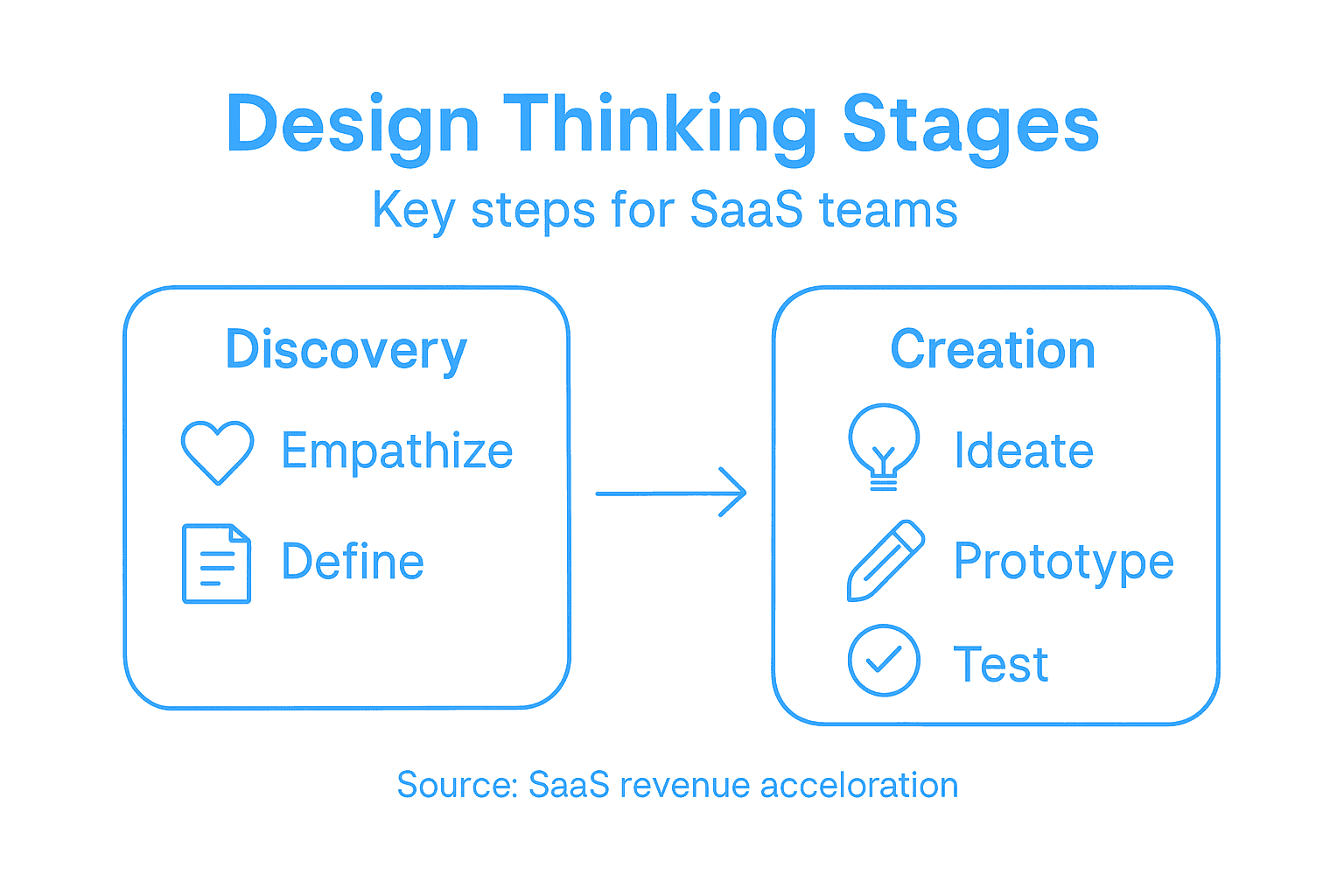
The design thinking process follows a predictable sequence that keeps your team moving from problem discovery to validated solutions. It’s not rigid. You’ll loop back frequently. But the stages themselves provide clarity when everything feels messy.
Stage 1: Empathize with your users. This isn’t about assumptions. You observe how customers actually work, what obstacles they face, and what they’re trying to accomplish. Spend time in their environment. Watch them struggle. Ask why repeatedly. For SaaS, this means sitting with users during onboarding, shadowing support calls, reviewing churn interviews. The goal is genuine understanding, not checking a box.

Stage 2: Define the real problem. Armed with empathy data, you reframe what you thought the problem was. Users say they need feature X, but your observation revealed they really need to accomplish Y. The design thinking stages require data-driven decision-making based on patterns you’ve seen across multiple users. This is where many teams stumble. They skip from empathy straight to solutions. Strong problem definition prevents wasted engineering effort.
Stage 3: Ideate possibilities. Generate many potential solutions without filtering. Use brainstorming sessions with your cross-functional team. Visualization tools and brainstorm sessions are integral to expanding thinking beyond obvious answers. Quantity matters here. Aim for breadth before narrowing down.
Stage 4: Prototype quickly. Build rough versions of your top ideas. These aren’t polished. They’re testable. A clickable wireframe beats a perfect design mockup when you need user feedback fast. Prototyping reveals assumptions and saves weeks of development time.
Stage 5: Test and iterate. Get prototypes in front of real users immediately. Measure what works. Kill what doesn’t. Refine based on feedback. Then loop back to earlier stages as needed. This cycle repeats until activation metrics improve and users clearly understand your product.
Pro tip: Map the entire five-stage process onto a 12-week sprint cycle, dedicating two weeks per stage with one week buffer for iteration loops, then measure how activation rates shift compared to your pre-design-thinking baseline.
Real-World Design Thinking Use Cases in SaaS
Design thinking isn’t theoretical. It solves concrete problems that impact your revenue. Let’s look at how real SaaS teams applied these principles and what changed.
Onboarding Complexity in B2B Tools
Many B2B SaaS products have confusing onboarding flows. Users activate at 20 percent when they should be activating at 60 percent. One team applied empathy research and discovered users didn’t understand what problem the product solved until after they’d spent thirty minutes clicking through setup screens. They redesigned the onboarding to show value immediately, then guided setup afterward. Activation jumped to 52 percent within two months. The key was listening before building.
Regulatory Compliance in Enterprise SaaS
Enterprise SaaS teams often face regulatory challenges that seem impossible to design around. User-centric design in complex industries like energy and technology reveals that compliance doesn’t require bad user experience. One team empathized with compliance officers and discovered they needed transparency, not complexity. Redesigning compliance workflows to show exactly what data was being collected and why dropped support tickets by 35 percent while maintaining full regulatory adherence.
Feature Adoption in Crowded Products
Product managers watch features ship, but users ignore them. This happens when teams skip the empathy stage. One product team spent weeks building an advanced analytics feature that sales swore customers wanted. Design thinking uncovered that customers actually needed simpler dashboards to show their own clients, not deeper internal analytics. They pivoted the feature and adoption went from 8 percent to 67 percent in their target segment.
Scalability and Platform Decisions
SaaS companies growing from mid-market to enterprise face scalability questions. One platform team used design thinking to map how different customer segments worked. They discovered that enterprise customers needed workflow customization while mid-market customers needed speed. Rather than building one complex system, they created two focused experiences. Revenue from enterprise grew 183 percent the following year.
These cases share a pattern. Teams that empathized first, defined problems clearly, and tested with users before major investments outperformed teams that skipped those steps.
Pro tip: Pick your lowest activation cohort, run the five-stage design thinking process specifically for them over four weeks, measure the activation lift, then scale this approach to your other struggling cohorts.
Critical Team Roles and Responsibilities
Design thinking fails when roles are unclear. Someone needs to push the team forward. Someone needs to challenge assumptions. Someone needs to make decisions. Without clarity, conversations become circular and momentum dies.
The facilitator keeps the process moving and protects psychological safety. This person isn’t necessarily a designer. They could be your product lead or even an engineer who’s comfortable managing group dynamics. Their job is simple: ensure everyone participates, prevent one voice from dominating, and keep the team focused on the current stage. During ideation, facilitators prevent premature criticism. During testing, they ensure feedback gets heard without defensiveness. Structured team roles help use design thinking tools productively and prevent the process from becoming theater.
The user researcher owns empathy gathering and problem definition. They conduct interviews, observe workflows, and synthesize patterns. For SaaS teams, this might be your product manager or a dedicated designer. They’re not building prototypes yet. They’re answering: What do users actually need? What obstacles block them? What do they currently do instead of using your product? This role’s findings should shock the team. If empathy data confirms what everyone already believed, the researcher probably didn’t dig deep enough.
The ideation lead pushes creative thinking during brainstorming. They encourage wild ideas, build on others’ suggestions, and prevent the team from settling for obvious solutions. This person needs confidence and playfulness. They make it safe to propose half-baked concepts knowing they won’t be immediately shot down.
The prototype builder translates ideas into testable forms. They create clickable wireframes, simple prototypes, or even paper mockups. Speed matters more than polish. The goal is learning, not perfection. This role might be your designer, product manager, or even a developer comfortable working rough.
The decision maker approves resource allocation and removes blockers. They’re typically your product leader or engineering lead. Flexible roles that encourage experimentation and active participation maximize innovation outcomes. This person shouldn’t dictate design choices. They should enable the team to move fast and protect time for testing.
One person can hold multiple roles. What matters is clarity about who owns what and explicit permission to challenge across boundaries.
Here’s how each team role supports the design thinking process:
| Role | Main Responsibility | Business Impact |
|---|---|---|
| Facilitator | Guides process, ensures participation | Faster decision making |
| User Researcher | Uncovers real user needs | Reduces costly misalignments |
| Ideation Lead | Sparks diverse idea generation | Increases innovation potential |
| Prototype Builder | Rapidly creates test versions | Accelerates user feedback cycles |
| Decision Maker | Removes roadblocks, allocates resources | Maintains momentum and focus |
Pro tip: Document your five team roles before starting design thinking, assign each role to a specific person, then rotate roles every quarter so people develop broader capabilities and prevent single points of failure.
Risks, Missteps, and How to Avoid Them
Design thinking sounds perfect in theory. Teams get excited. Then reality hits. Common missteps derail projects before they deliver revenue impact. Understanding these risks helps you navigate them.
Misstep 1: Skipping authentic user engagement. Some teams call it design thinking while conducting zero real user research. They interview three people they already know or run surveys with leading questions. This isn’t empathy. It’s confirmation bias dressed up as methodology. You’ll build solutions nobody wants and waste months. Fix this by spending time with actual customers. Watch them work. Let them surprise you. If empathy feels obvious and confirms your assumptions, you haven’t done it right.
Misstep 2: Rushing from empathy to solutions. Teams feel pressure to move fast, so they skip problem definition. They hear a user pain point and immediately start ideating solutions. Problem definition matters because it reframes what you’re actually solving. The user says they need better reporting. The real problem is they need to convince their boss to keep using your product. These are different solutions. Mitigating common risks requires disciplined use of process steps and clear problem statements before ideation begins.
Misstep 3: Inadequate collaboration and siloed communication. One department owns the process. Marketing doesn’t get involved. Engineering feels disconnected. When people don’t understand why decisions were made, they don’t execute them well. Design thinking demands cross-functional participation. Everyone sees user data. Everyone contributes ideas. Everyone has psychological safety to challenge assumptions.
Misstep 4: Prototyping too polished. Teams spend weeks perfecting prototypes before testing. They get attached to the design work. Users provide feedback that contradicts the prototype, and suddenly the team becomes defensive instead of curious. Prototypes are learning tools, not finished products. Low-fidelity is better. Paper sketches work fine. Speed beats perfection.
Misstep 5: Testing with the wrong users. Existing customers are easier to access, so teams test with them. But existing customers are biased. They’re already invested in your product. Test with people who haven’t decided yet. Test with people using your competitor. Their feedback is more honest.
Here is a summary of frequent design thinking pitfalls and their consequences:
| Common Misstep | Typical Pitfall | Resulting Risk |
|---|---|---|
| Missing real user engagement | Relying on assumptions | Building unwanted features |
| Skipping clear problem framing | Jumping to solutions | Addressing the wrong need |
| Limited cross-team collaboration | Working in silos | Ineffective product launches |
| Over-polished prototypes | Slow feedback cycles | Resistance to critical input |
| Testing with biased user groups | Non-representative results | Misguided product decisions |
Pro tip: Run a pre-mortem before starting design thinking: ask your team to imagine the project failed completely, then list what went wrong, use those predictions to build guardrails that prevent those specific failures.
Unlock SaaS Growth with Expert Design Thinking Leadership
Many SaaS teams struggle to fully embrace the core principles of design thinking such as authentic user engagement, clear problem framing, and cross-functional collaboration. These challenges often lead to slow activation rates and missed revenue opportunities. If your product development feels stuck in assumptions rather than validated insights, you need senior design leadership that integrates seamlessly into your team to spark real change.
At The Good Side Oy, we specialize in embedding experienced design partners who co-create with your product, engineering, and support teams. Our designers bring strategic ownership and SaaS-specific expertise directly into your workflows so you can accelerate user activation and adoption. Don’t let unclear user needs or siloed collaboration hold your product back. Explore how our fractional design leadership can transform your team’s approach to user-centric innovation by visiting The Good Side. Start building products that are easier to understand, easier to use, and easier to grow today.
Frequently Asked Questions
What is design thinking in the context of SaaS?
Design thinking in SaaS is a user-centered approach to problem-solving that prioritizes understanding users’ actual needs through research, rapid prototyping, and iterative testing to create products that users want to adopt and utilize.
How does design thinking improve product adoption for SaaS companies?
By focusing on user needs and experiences, design thinking helps teams develop features that resonate with customers, ultimately increasing product adoption rates and enhancing overall user satisfaction.
What are the core principles of design thinking for SaaS teams?
The core principles include human-centeredness, iterative prototyping and testing, collaboration across disciplines, and clearly framing problems before rushing to solutions, all aimed at effectively addressing real user needs.
What common missteps should teams avoid when implementing design thinking?
Teams should avoid skipping authentic user engagement, rushing from empathy to solutions, inadequate collaboration, creating over-polished prototypes, and testing with biased user groups to ensure effective design thinking processes.