
What Is Value Proposition: Driving SaaS Growth
Choosing the right narrative for your SaaS product can feel daunting when competitors across North America, Europe, and Asia constantly refine their pitch. Getting your value proposition right matters because it shapes why customers select your software and how quickly users reach those key activation milestones that drive recurring revenue. This guide breaks down the critical elements, practical structures, and common errors to help you clarify your brand promise and inspire deeper product engagement.
Table of Contents
- Defining Value Proposition In SaaS Markets
- Types Of Value Propositions For SaaS
- Key Elements Of A Strong Value Proposition
- Role In Product Activation And Revenue Growth
- Common Mistakes When Shaping Value Propositions
Key Takeaways
| Point | Details |
|---|---|
| Clear Value Proposition is Essential | A strong value proposition articulates the unique benefits and solutions your SaaS product offers, differentiating it from competitors. |
| Types of Value Propositions Matter | Understanding whether your solution drives revenue, reduces costs, or enhances productivity can tailor your messaging to target specific business needs. |
| Continuous Validation is Key | Regularly validate your value proposition through customer feedback to ensure it remains aligned with market demands and user expectations. |
| Focus on Customer Outcomes | Shift your emphasis from technical features to how your software addresses specific customer pain points and drives meaningful results. |
Defining Value Proposition In SaaS Markets
A value proposition is the strategic cornerstone that defines why customers should choose a specific SaaS product over alternatives. At its core, it communicates the unique problem-solving capabilities and competitive advantages that set a software solution apart in increasingly crowded technology markets.
In SaaS contexts, a value proposition goes far beyond simple product descriptions. Value proposition fundamentals reveal it as a concise, compelling statement that articulates the distinctive benefits a product delivers. It answers critical customer questions:
- What specific problems does this software solve?
- How is this solution different from competitors?
- What tangible outcomes can customers expect?
Effective value propositions in SaaS markets typically address three key dimensions:
- Functional Value: The core problems solved by the software
- Emotional Value: How the solution makes customers feel
- Economic Value: Quantifiable benefits and cost savings
Successful SaaS companies understand that customers don’t just buy features - they invest in solutions that transform their workflows, reduce complexity, and drive meaningful business outcomes. A well-crafted value proposition acts as a strategic narrative that connects product capabilities directly to customer aspirations.
Pro tip: Validate your value proposition through direct customer interviews and iterate based on real-world feedback to ensure it genuinely resonates with your target market’s needs.
Types Of Value Propositions For SaaS
SaaS companies develop value propositions that fundamentally address different strategic business needs, categorized into distinct types that align with core organizational objectives. Understanding these variations helps software providers craft more targeted and compelling market positioning.
Traditionally, SaaS value propositions can be classified into three primary categories:
- Revenue-Increasing Solutions: Software designed to directly drive business growth
- Cost-Reduction Tools: Technologies focused on operational efficiency
- Productivity Enhancement Platforms: Systems that optimize workflow and performance
Revenue-increasing software represents the most attractive value proposition for most businesses. These solutions demonstrate a clear, measurable financial impact by helping companies generate more income, expand market reach, or unlock new revenue streams. Potential customers are typically most receptive to tools that promise tangible top-line growth.

Cost-reduction solutions focus on minimizing expenses and streamlining operations. These value propositions appeal to organizations seeking to optimize their financial performance by reducing overhead, eliminating redundant processes, or automating expensive manual tasks. While less immediately exciting than revenue growth, these solutions offer compelling long-term economic benefits.
Productivity-enhancement platforms represent a more nuanced value proposition. These tools aim to improve organizational effectiveness by reducing friction, enabling better collaboration, and helping teams work more intelligently. Though their financial impact might be less direct, they deliver significant intangible benefits like improved employee satisfaction and more efficient workflows.
The most powerful value propositions demonstrate multiple types of value simultaneously - connecting revenue potential, cost savings, and productivity improvements.
Successful SaaS companies often craft multi-dimensional value propositions that blend these approaches, creating a more comprehensive narrative about their solution’s potential business impact.
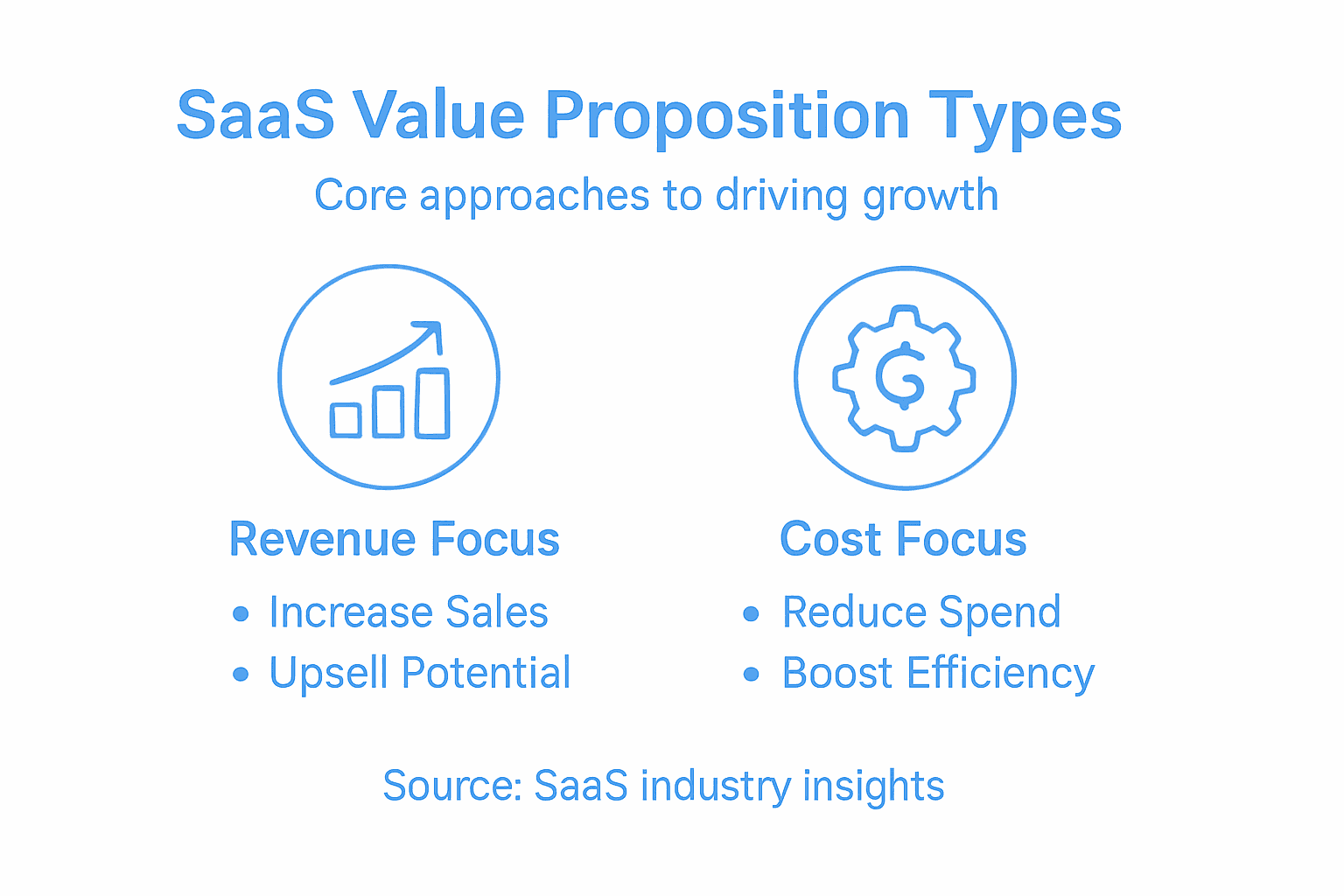
Here’s a concise comparison of the three primary SaaS value proposition types and their unique business impact:
| Value Proposition Type | Core Focus | Business Impact | Example Benefit |
|---|---|---|---|
| Revenue-Increasing Solutions | Driving top-line growth | Expands income, market share | New sales channel |
| Cost-Reduction Tools | Cutting operational costs | Improves financial efficiency | Reduced staffing expenses |
| Productivity Enhancement | Optimizing workflows | Boosts employee effectiveness | Faster project completion |
Pro tip: Develop a value proposition that quantifies potential benefits using specific, measurable metrics to make your software’s impact tangibly clear to potential customers.
Key Elements Of A Strong Value Proposition
Crafting a compelling value proposition requires a strategic approach that goes beyond simple product descriptions. Key components must be carefully considered to create a message that resonates deeply with potential customers and differentiates the software solution in a crowded marketplace.
The most effective value propositions typically include several critical elements:
- Clarity: A crystal-clear message that eliminates industry jargon
- Audience Understanding: Precise targeting of specific customer needs
- Unique Benefit: A clear articulation of the Onlyness Factor
- Measurable Impact: Quantifiable outcomes for potential customers
At the core of a powerful value proposition is an unwavering focus on the customer’s perspective. This means moving beyond technical features to demonstrate how the software directly solves specific business challenges. The most successful approaches translate complex technological capabilities into tangible business outcomes that speak directly to the customer’s pain points.
A comprehensive value proposition typically comprises three key structural components:
This summary table outlines critical structural components of a strong SaaS value proposition and their specific purpose:
| Component | Purpose | Typical Format |
|---|---|---|
| Headline | Main value statement | Single concise sentence |
| Subheadline | Explains target audience and utility | 1-2 sentences, specific details |
| Supporting Visuals | Enhances clarity and engagement | Diagrams, screenshots, icons |
- Headline: A concise statement of the primary value
- Subheadline: Detailed explanation of target customer and product utility
- Supporting Visuals: Graphical elements that reinforce the core message
The most effective value propositions transform complex software capabilities into simple, compelling narratives that immediate resonate with potential customers.
Beyond the basic structure, successful value propositions distinguish themselves by highlighting a unique Onlyness Factor - the specific, measurable advantage that no competitor can easily replicate. This might involve addressing a niche market need, offering a more streamlined user experience, or providing a solution that solves problems in a fundamentally different way.
Pro tip: Validate your value proposition through direct customer interviews and A/B testing to ensure it genuinely captures your target market’s most pressing needs and desires.
Role In Product Activation And Revenue Growth
Value propositions play a critical role in driving product activation and sustainable revenue growth for SaaS companies. SaaS growth models fundamentally depend on transforming initial user interest into meaningful, long-term engagement and monetization.
The activation journey in SaaS involves several key strategic elements:
- Rapid Value Realization: Helping users achieve meaningful product milestones quickly
- User Onboarding: Designing intuitive pathways to product understanding
- Engagement Acceleration: Creating habitual usage patterns
- Conversion Optimization: Turning trial users into paying customers
Successful product activation requires a nuanced approach that goes beyond traditional marketing tactics. It demands a deep understanding of user psychology, product design, and strategic user experience mapping. The most effective SaaS companies create activation frameworks that seamlessly guide users from initial curiosity to comprehensive product adoption.
The revenue growth mechanism in SaaS is directly tied to activation effectiveness. Companies must focus on:
- Acquisition Channel Analysis: Understanding where high-quality users originate
- Onboarding Optimization: Reducing friction in initial user experiences
- Retention Strategy: Creating compelling reasons for continued product usage
- Monetization Pathways: Designing clear upgrade and expansion opportunities
Activation is not a single moment, but a continuous process of demonstrating ongoing product value and user empowerment.
Ultimately, value propositions serve as the critical bridge between initial user curiosity and sustained product engagement. They must clearly communicate the transformative potential of the software, making the path to value immediate and compelling.
Pro tip: Implement micro-conversion tracking to identify and optimize the specific moments where users transition from interested prospects to committed product users.
Common Mistakes When Shaping Value Propositions
Crafting an effective value proposition requires strategic precision and deep market understanding. Common pitfalls can derail even the most well-intentioned SaaS product positioning efforts.
The most frequent mistakes SaaS companies make when developing value propositions include:
- Feature Fixation: Overemphasizing technical capabilities instead of customer outcomes
- Feedback Neglect: Developing propositions without direct customer input
- Complexity Overload: Creating convoluted messaging that confuses potential users
- Premature Commitment: Failing to iterate and adapt value propositions
Many organizations mistakenly treat their value proposition as a static marketing asset rather than a dynamic communication tool. This approach leads to propositions that quickly become outdated or disconnected from actual customer needs. Successful SaaS companies view their value proposition as a living document that evolves with market dynamics and user feedback.
The core errors in value proposition development typically manifest in several critical areas:
- Misalignment with Customer Language: Using internal jargon instead of customer-centric terminology
- Lack of Specificity: Creating vague statements that could apply to any product
- Ignoring Competitive Context: Failing to differentiate from alternative solutions
- Overlooking Emotional Value: Focusing solely on rational benefits
A value proposition is not a tagline, slogan, or generic marketing statement - it’s a precise articulation of unique customer value.
Effective value propositions require continuous refinement, deep customer empathy, and a willingness to challenge existing assumptions. They must transcend surface-level descriptions and communicate the transformative potential of the product.
Pro tip: Conduct regular customer interviews and use voice-of-customer data to continuously validate and refine your value proposition.
Elevate Your SaaS Value Proposition with Strategic Design Leadership
The challenge of creating a clear, compelling value proposition that drives product activation and revenue growth is one many SaaS companies face. The article highlights how effective value propositions must connect functional, emotional, and economic dimensions to resonate deeply with customers. Many teams struggle with feature fixation and complexity overload, which dilute messaging and stall adoption. Strong onboarding and activation journeys depend on seamless alignment between product design, user experience, and business goals.
At The Good Side, we specialize in embedding senior design leaders directly into your SaaS team. Our experienced fractional designers partner with your product and engineering groups to co-create outcomes that improve activation and adoption while crystallizing your unique value proposition. By aligning product design, onboarding flows, and go-to-market experiences we help you avoid common pitfalls like vague messaging and ineffective user engagement. The result is a sharper narrative that accelerates customer activation and sustains growth.
Ready to transform your SaaS product growth with outcome-driven design expertise?
Discover how our embedded design leadership can help your SaaS company craft clear, differentiated value propositions that drive faster user activation and increase long-term revenue. Visit The Good Side to explore flexible engagement options and start accelerating your product growth today.
Frequently Asked Questions
What is a value proposition in the context of SaaS?
A value proposition in SaaS is a strategic statement that outlines why customers should choose a particular software solution, highlighting its unique problem-solving capabilities and competitive advantages.
How do I create an effective value proposition for my SaaS product?
To create an effective value proposition, focus on clarity, understanding your audience, articulating unique benefits, and quantifying measurable impacts that directly address customer pain points.
What are the different types of value propositions used in SaaS?
In SaaS, value propositions can generally be categorized into three types: revenue-increasing solutions, cost-reduction tools, and productivity enhancement platforms, each addressing specific business needs.
Why is a strong value proposition important for SaaS growth?
A strong value proposition is essential for SaaS growth as it drives product activation, helps convert users into paying customers, and establishes ongoing engagement by clearly communicating the transformative value of the software.
Recommended
- Value Proposition Design: Driving SaaS Product Growth | The Good Side Blog
- Value Proposition Design: Driving SaaS Product Growth | The Good Side Blog | The Good Side
- What Is Scalable SaaS Design? Complete Overview
- SaaS Positioning - Strategic Product Positioning for SaaS Companies | The Good Side
- Digital Presence Explained: Why It Matters for SMEs - ResponsiveWebsiteDesign