
What Is Usability Testing and Why SaaS Needs It
Deploying robust digital solutions can be challenging when even subtle navigation issues frustrate users and stall product growth. For SaaS companies, understanding actual user interactions quickly reveals where users struggle and where the experience shines. By prioritizing usability testing, product managers and CTOs gain direct, actionable feedback that shapes more intuitive platforms, paving the way for higher product adoption and strong user retention. Bold insights from usability testing help transform honest feedback into product improvements that matter.
Table of Contents
- Defining Usability Testing For SaaS
- Major Usability Testing Methods Explained
- Step-By-Step Usability Testing Process
- How Usability Testing Drives SaaS Growth
- Common Usability Testing Mistakes To Avoid
Key Takeaways
| Point | Details |
|---|---|
| Usability Testing Importance | It evaluates user interaction with SaaS products, identifying key design flaws and enhancing user experience. |
| Diverse Testing Methods | Employ various methods like moderated in-person and unmoderated remote testing for comprehensive insights. |
| Steps for Effective Testing | Follow a structured process, including planning, user recruitment, and data analysis, to improve usability outcomes. |
| Avoid Common Pitfalls | Clearly define objectives and participant criteria to ensure reliable and actionable insights from usability tests. |
Defining Usability Testing for SaaS
Usability testing is a systematic research method designed to evaluate how easily users can interact with a digital product, specifically focusing on understanding user experience and identifying potential design challenges. For SaaS companies, this approach provides critical insights into product design, functionality, and user satisfaction.
At its core, usability testing involves observing real users interacting with a product to uncover potential friction points, navigation difficulties, and areas that might impede smooth user engagement. The process goes beyond simple aesthetic assessments, diving deep into practical user interactions and experiences.
Key objectives of usability testing for SaaS platforms include:
- Identifying design flaws and user pain points
- Measuring task completion rates and efficiency
- Understanding user satisfaction and emotional responses
- Gathering direct feedback from actual product users
- Improving overall user interface and experience
Usability testing differs from other research methods by providing direct, observable data about how users truly interact with a product. Unlike surveys or interviews that rely on retrospective feedback, this approach captures real-time user behaviors, struggles, and successes.
Usability testing reveals how users genuinely experience your product, not how you assume they might experience it.
SaaS companies can leverage usability testing throughout their product development lifecycle - from initial prototype stages to ongoing product iterations. Identifying usability issues early helps minimize expensive redesigns and ensures a more intuitive, user-friendly product.

Pro tip: Schedule usability testing sessions at multiple stages of product development to capture evolving user needs and continuously refine your SaaS platform’s user experience.
Major Usability Testing Methods Explained
Usability testing encompasses several distinct methodological approaches that SaaS companies can leverage to gain deep insights into user experience and product design. Three primary testing methods have emerged as standard practices in the digital product development landscape.
The main usability testing methods include:
- Moderated In-Person Testing: Researchers directly observe and interact with users in a controlled physical environment, allowing for immediate feedback and detailed observation of user interactions
- Moderated Remote Testing: Similar to in-person testing, but conducted via video conferencing tools, enabling broader geographic participation
- Unmoderated Remote Testing: Users complete tasks independently using digital platforms, providing quantitative data about user behaviors
Each method offers unique advantages depending on the specific research objectives and product development stage. Diverse evaluation techniques such as think-aloud protocols, cognitive walkthroughs, and A/B testing provide additional nuanced insights into user experience.
Here’s how the primary usability testing methods compare for SaaS teams:
| Method | User Involvement | Data Collected | Typical Use Case |
|---|---|---|---|
| Moderated In-Person | High, direct contact | Detailed observations | Early prototypes, in-depth UX |
| Moderated Remote | Moderate, virtual | Behavioral and verbal | Broad access, iterative testing |
| Unmoderated Remote | Low, independent use | Quantitative, large-scale | Quick feedback, live products |
The most effective usability testing combines multiple methods to create a comprehensive understanding of user interactions.
SaaS teams can enhance their testing strategies by combining different approaches. For instance, starting with moderated in-person testing during early prototype stages and transitioning to unmoderated remote testing for broader user feedback can provide comprehensive insights into product usability.
Critical considerations when selecting a usability testing method include:
- Project budget and resource constraints
- Geographic distribution of target users
- Complexity of the product interface
- Specific research questions being investigated
- Desired depth of user interaction data
Pro tip: Mix multiple usability testing methods to gain a holistic understanding of your SaaS product’s user experience and uncover nuanced insights that a single approach might miss.
Step-by-Step Usability Testing Process
Usability testing requires a structured approach to effectively evaluate and improve digital product experiences. Systematic research methods provide SaaS teams with a comprehensive framework for conducting meaningful user experience assessments.
The typical usability testing process involves several critical stages:
- Planning and Preparation
- Define specific testing objectives
- Identify target user personas
- Select appropriate testing methodology
- Develop realistic task scenarios
- Prepare testing environment and materials
- User Recruitment
- Screen participants matching target user demographics
- Ensure representative sample of potential product users
- Establish clear participant selection criteria
- Determine appropriate participant compensation
- Test Session Execution
- Brief participants on testing protocols
- Guide users through predefined tasks
- Encourage think-aloud feedback
- Observe and document user interactions
- Capture quantitative and qualitative data
Comprehensive usability studies typically focus on measuring three key performance indicators:
- Efficiency: How quickly users complete assigned tasks
- Effectiveness: Users’ ability to successfully accomplish objectives
- Satisfaction: Emotional response and perceived ease of use
Successful usability testing transforms user frustrations into design opportunities.
After conducting test sessions, SaaS teams must carefully analyze collected data, identifying patterns, pain points, and potential improvements. This process involves synthesizing observational notes, user feedback, performance metrics, and qualitative insights to drive meaningful product enhancements.
Pro tip: Record and timestamp user interactions during testing to enable precise retrospective analysis and share nuanced insights with your design and development teams.
How Usability Testing Drives SaaS Growth
Usability testing is a strategic approach that directly impacts a SaaS company’s growth trajectory by transforming user insights into measurable business outcomes. Early identification of design challenges enables companies to create products that not only meet but exceed user expectations.
The growth impact of usability testing manifests in several critical dimensions:
- User Retention: Reducing friction points that cause customer churn
- Customer Acquisition: Improving product intuitiveness to attract new users
- Support Cost Reduction: Minimizing user confusion and support tickets
- Conversion Rate Optimization: Streamlining user pathways to key actions
- Competitive Differentiation: Creating more engaging product experiences
Improving product usability directly correlates with key business performance metrics. Companies that invest in systematic user experience research typically see significant improvements in:
- Faster user onboarding
- Higher engagement rates
- Increased customer lifetime value
- More efficient product development cycles
- Enhanced brand reputation
Usability testing transforms user frustration into a strategic growth opportunity.
By understanding and addressing user pain points early, SaaS companies can create more intuitive, user-friendly products that naturally attract and retain customers. This approach shifts product development from a guessing game to a data-driven strategy that aligns closely with actual user needs and expectations.
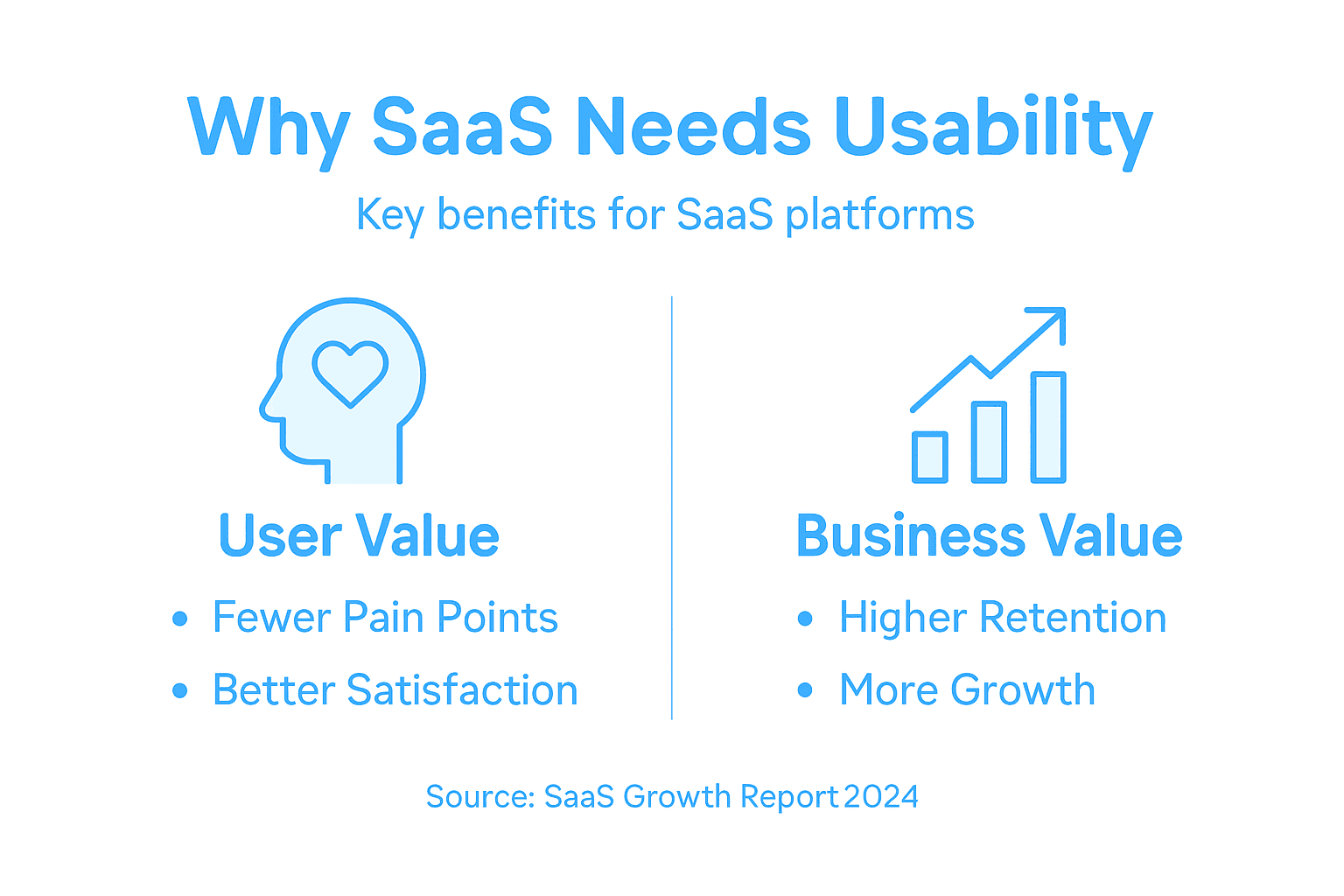
Quantifiable Growth Indicators from effective usability testing include:
Below is a summary of measurable business benefits from effective usability testing:
| Performance Metric | Typical Improvement Range | Strategic Business Value |
|---|---|---|
| Support Inquiries | 20-30% reduction | Lower operational costs |
| Conversion Rates | 15-25% increase | Higher sales and adoption |
| Onboarding Time | 40-50% faster | Users become productive sooner |
| Customer Satisfaction | Noticeable rise | Stronger retention, referrals |
- 20-30% reduction in customer support inquiries
- 15-25% improvement in user conversion rates
- 40-50% faster user onboarding
- Increased customer satisfaction scores
Pro tip: Integrate usability testing insights directly into your product roadmap, treating user feedback as a strategic asset for continuous improvement and growth.
Common Usability Testing Mistakes to Avoid
Usability testing requires precision and strategic planning to generate meaningful insights. Avoiding common research pitfalls can significantly improve the quality and reliability of user experience research.
Key mistakes SaaS teams frequently encounter include:
- Unclear Testing Objectives
- Failing to define specific research goals
- Lacking measurable success criteria
- Not aligning tests with product strategy
- Sampling and Participant Errors
- Recruiting non-representative user groups
- Using inadequate sample sizes
- Overlooking demographic and behavioral diversity
- Testing Environment Problems
- Creating artificial or unnatural testing scenarios
- Introducing moderator bias
- Neglecting participant comfort and psychological safety
Honest user feedback requires careful preparation to ensure participants feel comfortable providing genuine insights. Testers must create an environment that encourages open, constructive communication.
Effective usability testing transforms potential friction into actionable product improvements.
SaaS teams should approach usability testing as a nuanced, strategic process that goes beyond surface-level observations. Critical considerations include:
- Designing realistic test scenarios
- Training moderators in neutral facilitation
- Creating psychological safety for participants
- Developing comprehensive documentation protocols
- Implementing rigorous data analysis frameworks
Potential Consequences of poor usability testing include:
- Misguided product development
- Wasted engineering resources
- Increased customer churn
- Decreased competitive positioning
- Reduced user satisfaction
Pro tip: Conduct pilot testing of your usability testing protocol to identify and eliminate potential biases or methodological weaknesses before full-scale implementation.
Elevate Your SaaS Usability Testing with Expert Design Leadership
Usability testing uncovers critical user challenges that can block adoption, increase churn, and stall growth. This article highlights the importance of observing real users, gathering direct feedback, and addressing pain points early to drive better business outcomes. If your SaaS product struggles with unclear user experiences or costly redesigns, embracing strategic usability insights is vital. At The Good Side, we embed experienced SaaS design leaders directly into your product teams to help translate usability testing findings into powerful design solutions. Our approach moves beyond surface-level UI work, aligning product design and user onboarding to accelerate activation and long-term revenue impact.
Stop guessing and start designing with clarity. Discover how our senior design partners at The Good Side turn usability testing insights into actionable growth strategies. Explore our unique model that blends strategic ownership and hands-on execution at https://goodside.fi, and see how embedded design leadership can transform your product development and accelerate your SaaS success. Take the next step towards a user-centered product that improves satisfaction and drives measurable growth now.
Frequently Asked Questions
What is usability testing in the context of SaaS?
Usability testing is a systematic research method used to evaluate how easily users can interact with a digital product, focusing on user experience and identifying design challenges, particularly for SaaS platforms.
Why is usability testing important for SaaS companies?
Usability testing provides critical insights into product design, functionality, and user satisfaction, helping SaaS companies identify pain points, improve user interface, and ultimately drive growth by enhancing user retention and acquisition.
What are the main methods of usability testing?
The primary methods of usability testing include moderated in-person testing, moderated remote testing, and unmoderated remote testing, each offering unique advantages depending on the research objectives and product development stage.
How does usability testing contribute to SaaS product development?
Usability testing contributes to SaaS product development by identifying design flaws early, streamlining user pathways, reducing support costs, and ultimately enhancing customer satisfaction and retention rates.