
7 Essential Types of User Research Every SaaS Leader Must Know
Choosing the right user research method can feel overwhelming when every decision shapes your SaaS product’s success. You want insights that are not just accurate but also actionable, so each step forward is based on real user experience instead of guesswork. Making the wrong choice could mean overlooking critical feedback or wasting precious resources.
The effective user research methods shared here will help you capture both the big picture and the small details that drive real improvement. Whether you need quick answers or deep insights, these approaches equip you to understand users and confidently guide your product strategy. Get ready to discover practical techniques that will reveal exactly what your users want, where they get stuck, and how to design solutions they truly value.
Table of Contents
- Surveys And Questionnaires For Quick Insights
- User Interviews To Uncover Deep Needs
- Usability Testing For Real-World Interaction Feedback
- Contextual Inquiry To Observe Users In Action
- A/B Testing To Evaluate Design Choices
- Analytics And Behavior Tracking For Data-Driven Insights
- Customer Journey Mapping To Expose Pain Points
Quick Summary
| Takeaway | Explanation |
|---|---|
| 1. Use Surveys for Quick Insights | Surveys efficiently gather targeted user feedback, revealing their needs and preferences while minimizing time investment. |
| 2. Conduct User Interviews for Depth | User interviews provide rich qualitative insights by exploring user motivations and challenges through direct conversations. |
| 3. Implement Usability Testing | Usability testing highlights real-world interaction challenges, allowing teams to observe users navigating the product and detect design flaws. |
| 4. Utilize Analytics for Data-Driven Decisions | Analytics track user behavior systematically, offering quantifiable insights that inform strategic product improvement efforts. |
| 5. Create Customer Journey Maps | Journey mapping visualizes every user interaction, identifying pain points and emotional experiences to drive user-centered design improvements. |
1. Surveys and Questionnaires for Quick Insights
Surveys and questionnaires are powerful tools that help SaaS leaders quickly understand user perspectives with minimal time investment. These structured research methods enable teams to gather quantitative and qualitative data efficiently from large user populations.
The goal of user surveys is to uncover actionable insights by asking targeted questions that reveal user needs, preferences, and pain points. By designing well-crafted academic surveys with clear objectives, product managers can capture meaningful feedback to drive strategic decisions.
Key benefits of using surveys in SaaS product development include:
- Rapid data collection across diverse user segments
- Cost-effective research method with broad reach
- Ability to collect both numerical and descriptive insights
- Standardized feedback that allows for easy comparative analysis
- Low-friction way to engage users in product improvement
The most effective surveys strike a balance between depth of inquiry and user convenience.
When creating surveys, focus on crafting questions that are:
- Specific and unambiguous
- Directly related to your research objectives
- Easy to answer within 5-10 minutes
- Designed to minimize response bias
To maximize survey response rates, keep questions concise and provide clear value proposition for participants. Use a mix of multiple-choice, rating scales, and open-ended questions to capture comprehensive user perspectives.
Pro tip: Pilot test your survey with a small group of users to identify and resolve potential confusion or friction points before full deployment.
2. User Interviews to Uncover Deep Needs
User interviews are a powerful qualitative research method that allows SaaS leaders to dive deep into user motivations, challenges, and unspoken needs. By engaging users in direct conversations, product teams can uncover insights that quantitative data cannot reveal.
These structured qualitative research conversations provide rich context about user behaviors and experiences that go beyond surface-level feedback. Unlike surveys, interviews enable dynamic exploration of user perspectives through open-ended dialogue.
Key advantages of user interviews include:
- Capturing nuanced emotional and contextual user insights
- Understanding complex user workflows and decision-making processes
- Identifying unmet needs and potential product improvements
- Developing deeper empathy with your user base
- Validating or challenging existing product assumptions
The most valuable insights often emerge from listening more than asking.
To conduct effective user interviews, follow these steps:
- Define clear research objectives
- Recruit diverse and representative participants
- Prepare a flexible interview guide
- Practice active listening techniques
- Create a comfortable, non-threatening environment
Successful interviews require careful planning and an approach that encourages users to share candidly. Avoid leading questions and instead use open-ended prompts that invite detailed responses.
Pro tip: Record and transcribe interviews to enable thorough analysis and allow multiple team members to review user insights without being present during the original conversation.
3. Usability Testing for Real-World Interaction Feedback
Usability testing represents a critical research method that puts real users directly into interaction with your product to uncover authentic usage challenges and opportunities. By observing how users actually navigate and experience your software, you gain invaluable insights that go far beyond theoretical design assumptions.
This research approach focuses on evaluating product ease of use through systematic observation of user interactions, revealing critical design flaws and user experience barriers that might otherwise remain hidden.
Key benefits of usability testing include:
- Identifying specific user interaction obstacles
- Understanding real-world product usage patterns
- Detecting unexpected user behavior and navigation challenges
- Validating design decisions with empirical evidence
- Reducing potential user frustration before product launch
The most powerful insights emerge when you watch users interact without interference.
To conduct effective usability testing, follow these strategic steps:
- Define clear testing objectives
- Recruit representative user participants
- Create realistic task scenarios
- Develop a consistent observation protocol
- Capture both qualitative and quantitative feedback
Successful usability testing requires careful participant selection and structured observation techniques. Avoid leading users or interrupting their natural interaction flow during the testing process.
Pro tip: Record usability testing sessions with screen capture and participant consent to enable deeper team analysis and preserve nuanced user interaction details.
4. Contextual Inquiry to Observe Users in Action
Contextual inquiry is a powerful user research method that goes beyond traditional interviews by observing users directly in their natural work environments. This approach provides unfiltered insights into how users actually interact with products and solve problems in real-world contexts.
By adopting a master-apprentice research model, researchers can capture nuanced user behaviors and unexpected workarounds that would never emerge in formal interview settings. The goal is to understand the authentic user experience without artificial constraints.
Key advantages of contextual inquiry include:
- Revealing genuine user workflows and challenges
- Capturing unscripted user problem-solving strategies
- Understanding environmental factors affecting product use
- Identifying unarticulated user needs and pain points
- Providing rich context beyond surface-level feedback
True user understanding emerges through observation, not just conversation.
To conduct effective contextual inquiry, follow these strategic steps:
- Identify and recruit representative users
- Obtain necessary permissions and consent
- Prepare a flexible observation framework
- Minimize researcher intervention
- Document both verbal and non-verbal user interactions
Successful contextual inquiry requires minimal researcher interference and maximum user comfort. Create an environment where users feel natural and unrestricted in their typical work processes.
Pro tip: Bring multiple observation team members and compare notes to reduce individual bias and capture a more comprehensive understanding of user interactions.
5. A/B Testing to Evaluate Design Choices
A/B testing represents a powerful data-driven approach that allows SaaS leaders to make objective design decisions by systematically comparing two different versions of a product element. This method transforms subjective design debates into quantitative experiments that reveal which variant truly performs better.
By implementing controlled experimental methods, product teams can empirically validate design hypotheses and reduce the risks associated with intuition-based decision making. A/B testing provides concrete evidence about user preferences and behaviors.
Key advantages of A/B testing include:
- Eliminating guesswork in design choices
- Reducing potential user experience friction
- Providing statistically significant performance insights
- Minimizing risks of major design changes
- Supporting data-driven product iterations
Small variations can lead to significant performance differences.
To conduct effective A/B testing, follow these strategic steps:
- Define clear, measurable success metrics
- Create two distinct design variants
- Randomly assign user segments
- Collect comprehensive performance data
- Analyze results using statistical significance testing
Successful A/B testing requires precise experimental design and unbiased data collection. Ensure your test conditions are controlled and your sample size is representative.
Pro tip: Test only one variable at a time to isolate the specific design element’s impact and avoid confounding experimental results.
6. Analytics and Behavior Tracking for Data-Driven Insights
Analytics and behavior tracking transform raw user interaction data into actionable insights that drive strategic product decisions. By systematically capturing and analyzing user behaviors, SaaS leaders can uncover hidden patterns and opportunities for product optimization.
This research method leverages AI-powered behavioral analysis techniques to provide deep understanding of how users truly interact with digital products. Unlike subjective feedback, analytics offer objective, quantifiable evidence of user engagement and performance.
Key advantages of analytics and behavior tracking include:
- Revealing precise user interaction patterns
- Identifying potential friction points in user journeys
- Enabling data-driven product improvements
- Supporting personalized user experience strategies
- Quantifying user engagement and satisfaction
Data speaks louder than assumptions.
To implement effective analytics tracking, follow these strategic steps:
- Define clear measurement objectives
- Select appropriate tracking tools
- Configure comprehensive event tracking
- Establish baseline performance metrics
- Regularly analyze and interpret data trends
Successful analytics tracking requires continuous monitoring and strategic interpretation. Focus on metrics that directly impact user experience and business goals.
Pro tip: Combine quantitative analytics with qualitative research methods to create a holistic understanding of user behavior and motivation.
7. Customer Journey Mapping to Expose Pain Points
Customer journey mapping is a strategic research method that illuminates the complete user experience by tracking every interaction a customer has with your product. By visualizing the entire user journey, SaaS leaders can uncover hidden friction points and design more intuitive, user-centered solutions.
This approach goes beyond surface-level analytics by revealing qualitative user experiences and understanding the emotional landscape of user interactions. It transforms complex user behaviors into actionable insights that drive product improvements.
Key benefits of customer journey mapping include:
- Identifying unexpected user pain points
- Understanding emotional user experiences
- Revealing gaps in product design
- Prioritizing strategic improvement areas
- Aligning product features with user needs
Every interaction tells a story about user experience.
To create an effective customer journey map, follow these strategic steps:
- Define clear user personas
- Outline all potential touchpoints
- Document user emotions and expectations
- Identify friction and success points
- Develop targeted improvement strategies
Successful journey mapping requires holistic and empathetic observation. Look beyond data points to understand the human experience behind each interaction.
Pro tip: Involve cross-functional teams when creating journey maps to ensure diverse perspectives and comprehensive insights.
Below is a comprehensive table summarizing the main methods and key takeaways for user research strategies discussed in the article.
| Research Method | Description | Key Benefits | Implementation Steps |
|---|---|---|---|
| Surveys and Questionnaires | Structured tools for gathering user insights through targeted questions | Cost-efficient data collection, captures both quantitative and qualitative data, provides actionable insights | Focus on clear objectives, ensure concise questions, pilot-test for effectiveness |
| User Interviews | In-depth qualitative discussions for exploring user motivations and challenges | Unveils deep emotional and contextual insights, fosters user empathy, identifies unmet needs | Define objectives, prepare flexible guides, actively listen, avoid leading questions |
| Usability Testing | Observing real users interact with the product to identify usability challenges | Highlights design flaws, validates decisions, prevents user frustration | Recruit participants, use realistic scenarios, record sessions, minimize researcher interference |
| Contextual Inquiry | Observing users in their natural environment to understand real-world interactions | Reveals authentic workflows, identifies unspoken needs, provides rich context | Minimize intervention, record observations, focus on natural user behaviors |
| A/B Testing | Comparing two design variants through controlled experiments | Validates design decisions, provides data-driven results, supports incremental improvements | Define metrics, ensure unbiased setup, analyze with statistical significance |
| Analytics and Behavior Tracking | Analyzing usage data to discern patterns and optimize user experience | Quantifies engagement, identifies friction, informs personalization strategies | Set objectives, select comprehensive tools, establish baseline metrics, integrate findings |
| Customer Journey Mapping | Visualizing all interactions a user has with the product to uncover pain points | Illuminates user experiences, reveals design gaps, guides priority setting | Develop personas, outline touchpoints, map emotions and feedback, create strategies |
Accelerate Your SaaS Growth with Strategic User Research and Design Leadership
Understanding and implementing the 7 essential types of user research is vital for uncovering real user needs and designing products that truly resonate. If you are struggling to move beyond surface-level UI tweaks or want to embed deep user insights into your product development, The Good Side Oy is your trusted fractional design partner. We help established, growth-oriented SaaS companies translate user research findings like usability testing, customer journey mapping, and analytics into clear business outcomes with hands-on senior design leadership.
Gain real impact by:
- Aligning product design with onboarding and go-to-market strategies
- Embedding experienced designers who co-create with your product and engineering teams
- Accelerating activation, adoption, and long-term revenue growth
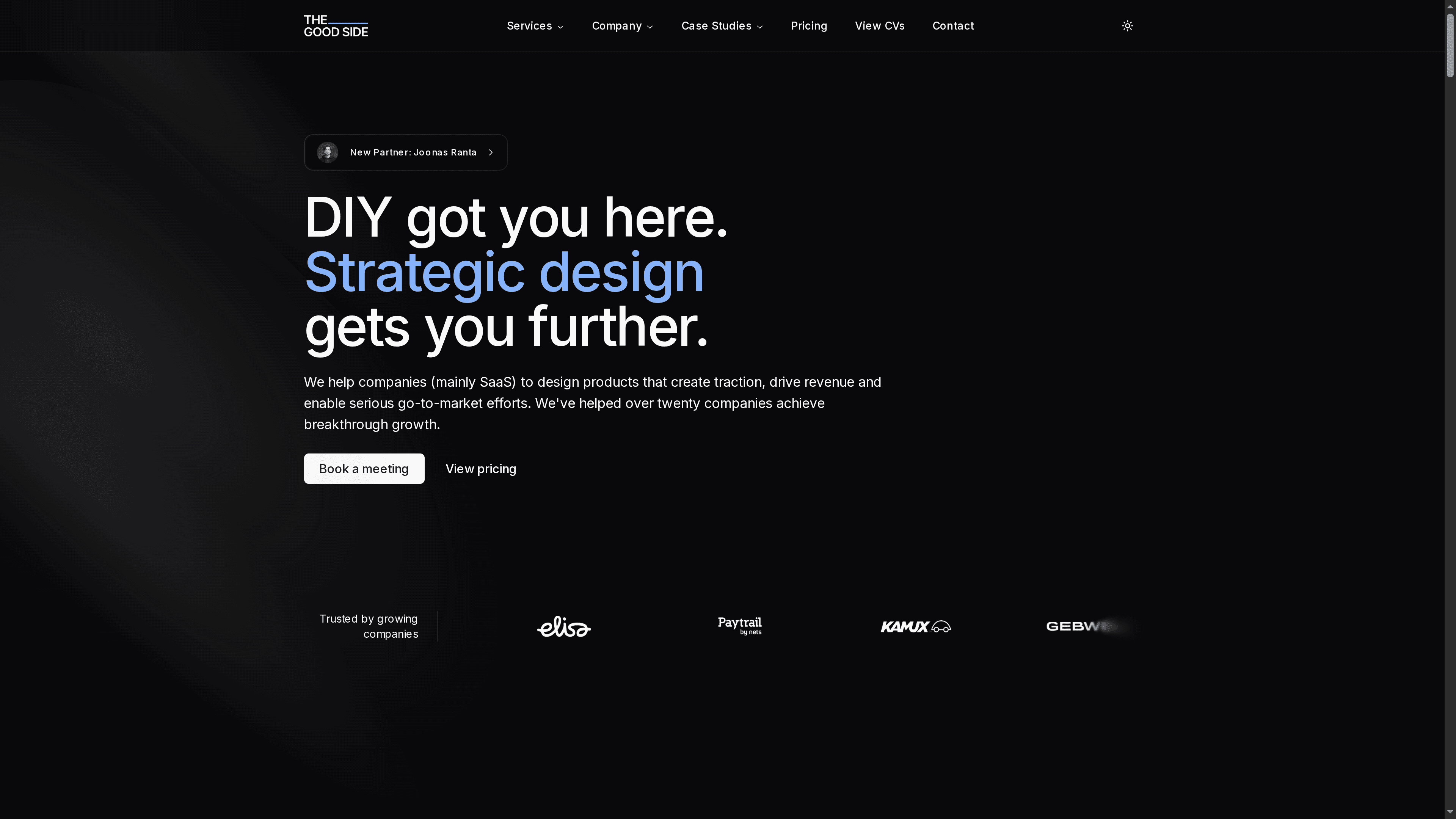
Ready to transform user research insights into powerful design decisions that drive growth? Visit The Good Side today to explore how we provide flexible, outcome-driven design partnerships tailored for SaaS success. Don’t wait to unlock your product’s full potential with embedded senior design leadership that understands your user research needs from day one. Learn more and start your journey at The Good Side Oy.
Frequently Asked Questions
What are the key types of user research for SaaS leaders?
User research for SaaS leaders includes surveys, user interviews, usability testing, contextual inquiry, A/B testing, analytics and behavior tracking, and customer journey mapping. Focus on using these methods to uncover user needs and improve product design.
How can I effectively conduct user surveys?
To conduct effective user surveys, design clear and concise questions that require 5-10 minutes to answer. Aim for a mix of multiple-choice and open-ended questions to gather both quantitative data and qualitative insights.
What is the purpose of usability testing in SaaS?
Usability testing aims to identify user interaction challenges with your software by observing real users as they navigate your product. Conduct usability tests with distinct task scenarios to uncover pain points and improve user experience.
How can customer journey mapping enhance our understanding of user experiences?
Customer journey mapping provides a visual representation of the entire user experience across various touchpoints. Create a map by outlining user emotions and behaviors to identify friction points and prioritize areas for improvement.
What steps should I take to implement A/B testing effectively?
To implement A/B testing, define clear success metrics and create two versions of a product element to compare. Randomly assign user segments to each variant and collect data to analyze which version performs better in achieving your goals.