
Transparent Pricing: Building Trust in SaaS Design
Every SaaS leader has faced the challenge of earning customer trust while simplifying buying decisions. Transparent pricing is more than just clear numbers—it is a strategic design choice that builds mutual confidence, reduces friction, and drives faster product adoption across global markets. By providing easy-to-understand pricing frameworks and clear feature breakdowns, companies transform complexity into competitive advantage, empowering teams to collaborate and grow without hidden surprises.
Table of Contents
- Defining Transparent Pricing In SaaS Design
- Core Types And Models Of Transparent Pricing
- How Transparent Pricing Strengthens Collaboration
- Risks And Challenges For SaaS Companies
- Best Practices For Implementing Transparent Pricing
Key Takeaways
| Point | Details |
|---|---|
| Transparent Pricing Builds Trust | Openly communicating pricing structures fosters trust and reduces friction in the purchasing process. |
| Flexible Pricing Models Enhance Clarity | Diverse models like Freemium and Tiered Pricing allow for easy comprehension and alignment with customer needs. |
| Collaboration is Strengthened by Transparency | Clear pricing leads to open communication and stronger partnerships between providers and customers. |
| Regular Review Mitigates Risks | Periodic audits of pricing structures ensure alignment with market expectations and strategy, minimizing risks. |
Defining Transparent Pricing in SaaS Design
Transparent pricing represents a strategic approach in SaaS design where companies openly communicate their pricing structure, costs, and value proposition to potential customers. This method goes beyond simply listing prices—it involves creating a clear, understandable framework that builds trust and reduces friction in the purchasing process.
According to comprehensive research on SaaS pricing practices, transparent pricing encompasses several critical elements:
- Clear presentation of subscription tiers
- Upfront disclosure of potential additional costs
- Easy-to-understand pricing models
- No hidden fees or complicated billing structures
- Immediate visibility into features associated with each pricing level
Effective transparent pricing strategies recognize that modern SaaS customers demand clarity and predictability. By removing ambiguity, companies can significantly reduce potential customer hesitation and streamline the decision-making process. This approach transforms pricing from a potential obstacle into a competitive advantage.
Pricing Transparency Principles:
- Provide detailed feature breakdowns
- Show exact costs without complicated calculations
- Offer flexible, scalable options
- Enable easy comparison between different plans
- Include clear upgrade/downgrade pathways
Companies that embrace transparent pricing demonstrate respect for their customers’ time and financial considerations. They recognize that trust is built through honest, straightforward communication about value and cost.
Pro tip: Conduct periodic customer surveys to ensure your pricing structure remains aligned with user expectations and perceived value.
Core Types and Models of Transparent Pricing
SaaS companies have developed multiple transparent pricing models to meet diverse customer needs and market demands. Academic research on SaaS pricing architectures reveals four primary pricing strategies that enable clear, upfront communication about value and cost.
Transparent Pricing Models:
- Freemium Model: Basic features available free, premium features require payment
- Tiered Pricing: Multiple service levels with progressively increasing capabilities
- Usage-Based Pricing: Customers pay precisely for resources consumed
- Flat-Rate Pricing: Single price for comprehensive service package
Each model offers unique advantages in creating transparency. SaaS architecture studies demonstrate how different pricing approaches can significantly impact customer understanding and engagement.

Here’s a comparison of the main transparent pricing models used in SaaS:
| Model | Ideal Customer Type | Pricing Predictability | Example Business Impact |
|---|---|---|---|
| Freemium | Small teams, startups | Moderate | Drives user adoption quickly |
| Tiered Pricing | SMBs, growing enterprises | High | Scales revenue as needs grow |
| Usage-Based Pricing | High variability users | Variable | Aligns costs with consumption |
| Flat-Rate Pricing | Stable, low-complexity | Very high | Simplifies billing and support |
Detailed Model Characteristics:
- Freemium Model
- Low-risk entry point for potential customers
- Clear upgrade paths
- Demonstrates product value before purchase
- Tiered Pricing
- Flexible options for different business sizes
- Predictable cost scaling
- Transparent feature differentiation
Companies implementing these models must prioritize clarity, ensuring customers understand exactly what they’re purchasing. Transparent pricing isn’t just about listing prices—it’s about creating a comprehensive, easily digestible value proposition that builds customer confidence.
Transparent pricing transforms financial transactions from opaque exchanges into clear, mutually understood agreements.
Key Transparency Principles:
- Communicate all potential costs upfront
- Provide detailed feature comparisons
- Offer simple, understandable pricing structures
- Enable easy plan comparisons
- Allow flexible scaling options
Pro tip: Regularly audit your pricing model to ensure continued alignment with customer expectations and market dynamics.
How Transparent Pricing Strengthens Collaboration
Transparent pricing is a powerful catalyst for building stronger, more collaborative relationships between SaaS providers and their customers. Research on SaaS pricing dynamics reveals that clear pricing strategies fundamentally transform how businesses interact and communicate.
Collaboration Benefits of Transparent Pricing:
- Reduces misunderstandings about costs
- Creates predictable financial expectations
- Enables more open communication
- Builds mutual trust
- Facilitates smoother decision-making processes
The collaborative potential of transparent pricing extends far beyond simple cost disclosure. Case studies in SaaS interactions demonstrate that when pricing is clear, customers feel more empowered to provide meaningful feedback and engage in constructive dialogues with service providers.
Collaboration Mechanisms:
- Open Cost Structures
- Eliminate hidden fee concerns
- Encourage honest discussions
- Create shared understanding
- Predictable Pricing Frameworks
- Enable better budget planning
- Reduce negotiation friction
- Support long-term partnerships
Transparent pricing transforms transactional relationships into genuine collaborative partnerships.
By removing financial opacity, companies create an environment where customers feel respected and understood. This approach shifts the dynamic from a purely monetary exchange to a strategic collaboration focused on mutual success.
Key Collaboration Enablers:
- Communicate pricing rationale
- Offer flexible adjustment options
- Provide clear upgrade/downgrade paths
- Maintain consistent, predictable pricing
- Invite customer feedback on pricing models
Pro tip: Implement regular pricing review sessions with customers to continuously refine and align your transparent pricing strategy.
Risks and Challenges for SaaS Companies
Comprehensive research on SaaS pricing challenges reveals that transparent pricing, while beneficial, presents significant strategic risks for companies. SaaS organizations must carefully navigate a complex landscape of potential pitfalls that can undermine their pricing strategies.
Primary Pricing Transparency Risks:
- Exposing competitive pricing strategies
- Potential revenue vulnerability
- Complexity in pricing model design
- Risk of customer misinterpretation
- Potential reduction in negotiation flexibility
The delicate balance between openness and strategic protection becomes critical. Academic investigations of SaaS pricing highlight the nuanced challenges companies face when implementing transparent pricing models.
Detailed Risk Categories:
- Competitive Intelligence Risks
- Competitors can easily analyze pricing
- Potential loss of strategic pricing advantage
- Reduced market differentiation potential
- Operational Complexity Risks
- Increased administrative overhead
- Complex pricing model management
- Higher system integration challenges
Transparency is a double-edged sword that requires strategic, careful implementation.
Companies must recognize that pricing transparency is not a one-size-fits-all solution. Each organization needs a tailored approach that balances openness with strategic business protection.
The following table summarizes risks of transparent pricing and corresponding mitigation strategies:
| Risk Category | Example Challenge | Effective Mitigation Approach |
|---|---|---|
| Competitive Intelligence | Competitor price analysis | Use differentiated value messaging |
| Operational Complexity | Difficult model management | Invest in pricing automation tools |
| Customer Misinterpretation | Confusion over plan details | Offer clear, visual plan comparisons |
| Revenue Vulnerability | Margin erosion from transparency | Create value-added premium features |
Mitigation Strategies:
- Implement flexible pricing frameworks
- Develop nuanced communication strategies
- Create adaptable pricing models
- Regularly review and update pricing structures
- Maintain strategic pricing flexibility
Pro tip: Conduct periodic competitive analysis to ensure your transparent pricing strategy remains both open and strategically advantageous.
Best Practices for Implementing Transparent Pricing
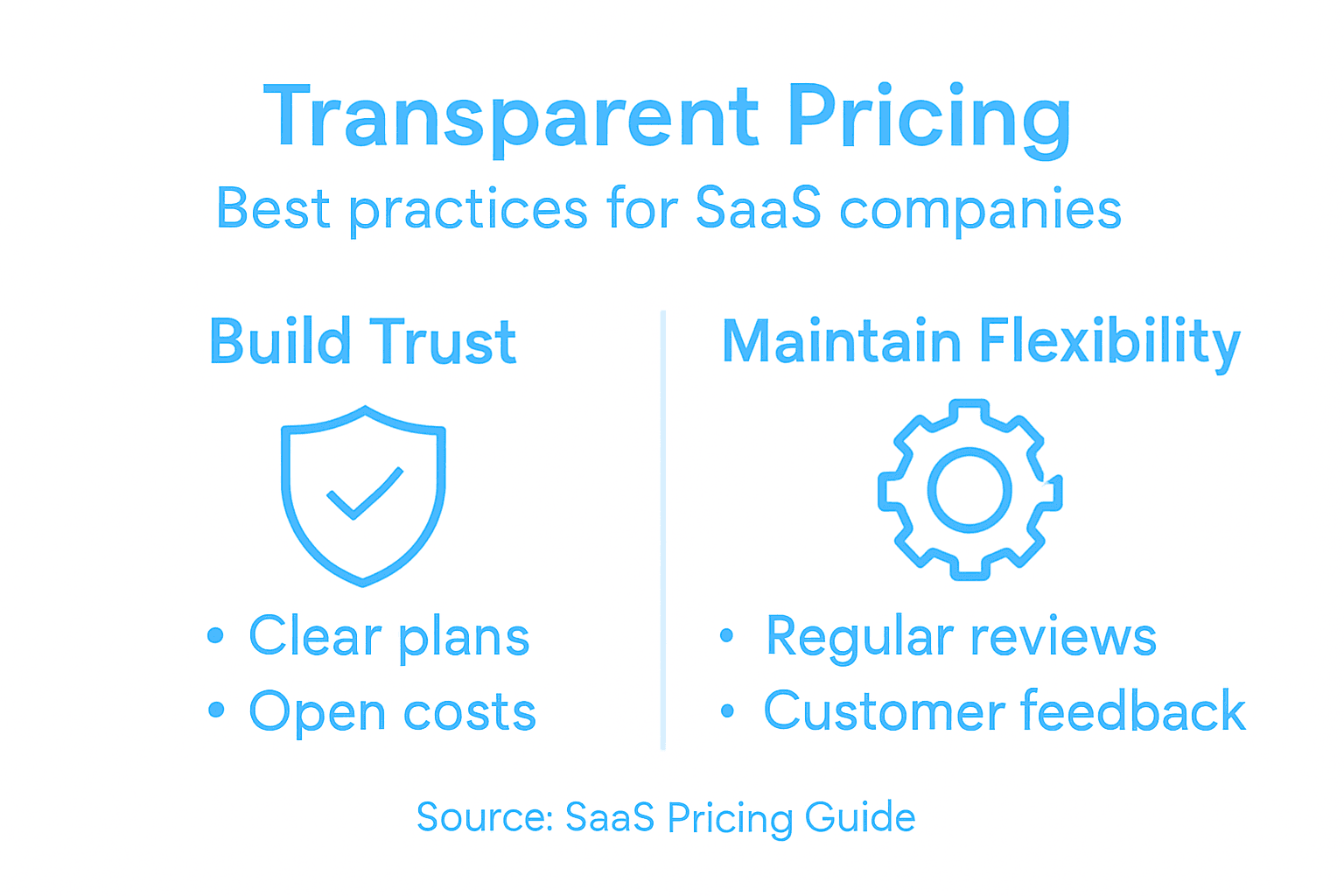
Research on SaaS pricing transparency reveals that successful implementation requires a strategic, multifaceted approach. SaaS companies must move beyond simple price listing to create a comprehensive, customer-centric pricing ecosystem.
Core Implementation Strategies:
- Design clear, intuitive pricing structures
- Eliminate hidden fees and complex calculations
- Provide immediate feature visibility
- Enable easy plan comparisons
- Support flexible customer decision-making
Transparency is more than just showing numbers—it’s about creating a meaningful pricing narrative that resonates with potential customers. This means explaining the value behind each pricing tier and demonstrating how different options meet specific business needs.
Transparency Implementation Framework:
- Digital Pricing Presentation
- Use interactive pricing calculators
- Offer real-time cost projections
- Provide clear feature breakdowns
- Customer Education Approach
- Explain pricing rationale
- Show value-based pricing logic
- Highlight potential cost savings
Transparent pricing transforms complex financial information into a clear, trustworthy customer experience.
Recommended Communication Techniques:
- Use plain, jargon-free language
- Create visual price comparison charts
- Offer detailed feature explanations
- Provide case studies demonstrating value
- Include customer testimonials about pricing
Pro tip: Develop a pricing FAQ section that proactively addresses potential customer questions and concerns.
Enhance Your SaaS Growth with Transparent, Trust-Building Design
Transparent pricing is essential for SaaS companies striving to build trust and simplify customer decision-making. The article highlights challenges such as communicating clear feature breakdowns, avoiding hidden fees, and creating predictable, scalable pricing models. If your team struggles to make pricing strategies easy to understand and wants to improve the collaboration and trust between product, engineering, and customers The Good Side Oy offers precisely what you need. Our senior design leaders specialize in embedding deeply with SaaS teams to co-create user-centric experiences that align product design, onboarding, and go-to-market efforts with transparent pricing principles.
We help your company turn complex pricing information into clear, compelling stories that drive activation, adoption, and long-term revenue growth. By prioritizing straightforward communication and measurable business outcomes we remove the ambiguity your customers face and foster genuine collaboration. Discover how our fractional design leadership can empower your team to implement transparent pricing models confidently while accelerating product execution. Visit The Good Side to learn how we partner with growth-oriented SaaS companies to bring strategic design ownership to the core of your product development.
Looking to make pricing clarity and customer trust your competitive advantage?

Connect with expert SaaS design leadership today at The Good Side. Explore how our embedded, outcome-driven designers can help you build products that are easier to understand and easier to grow. The moment to act is now—position your SaaS product for lasting success with transparent design that fuels real business results.
Frequently Asked Questions
What is transparent pricing in SaaS design?
Transparent pricing is a strategy where SaaS companies openly communicate their pricing structure, including subscription tiers, potential additional costs, and features associated with each plan, promoting trust and reducing friction in the purchasing process.
What are the benefits of transparent pricing for SaaS customers?
Transparent pricing builds trust, reduces misunderstandings about costs, and enables better budgeting. Customers can make informed decisions without hidden fees or complicated billing structures, leading to smoother purchasing experiences.
What are the main transparent pricing models in SaaS?
The main transparent pricing models include freemium, tiered pricing, usage-based pricing, and flat-rate pricing. Each model has distinct advantages that cater to different customer needs and preferences.
How can SaaS companies implement transparent pricing effectively?
SaaS companies can implement transparent pricing by designing clear and intuitive pricing structures, eliminating hidden fees, providing real-time cost projections, and offering customer education on the value behind each pricing tier.
Recommended
- What Is Scalable SaaS Design? Complete Overview
- What Is Scalable SaaS Design? Complete Overview | The Good Side Blog
- What Is Scalable SaaS Design? Complete Overview | The Good Side Blog | The Good Side
- Design Thinking in SaaS: Complete Guide for Teams | The Good Side Blog
- What is Software as a Service (SAAS): Definition and Examples - MaxCloudON