
Strategic Positioning: Driving SaaS Product Success
Standing out in the crowded SaaS market can feel like a never-ending challenge. Product managers and growth teams know that staying competitive means more than having a great feature set. Strategic positioning is what distinguishes products that win market share from those that fade into the background. This guide explains how aligning product strengths, market insights, and value propositions creates clarity for users and drives long-term customer engagement.
Table of Contents
- Defining Strategic Positioning for SaaS
- Types of Strategic Positioning in SaaS
- Key Elements and How It Works
- Benefits of Clear Positioning for Growth
- Risks and Common Positioning Mistakes
Key Takeaways
| Point | Details |
|---|---|
| Importance of Strategic Positioning | Strategic positioning is essential for SaaS companies to differentiate themselves and achieve long-term market success. |
| Types of Positioning Strategies | Companies can leverage cost leadership, differentiation, or focus strategy to meet market needs and enhance their competitive advantage. |
| Benefits of Clear Positioning | Effective positioning accelerates sales, improves lead generation, and boosts customer retention, ultimately driving growth. |
| Risks and Mistakes | Common pitfalls include static positioning and misalignment with market demands, which can hinder competitiveness in rapidly evolving environments. |
Defining Strategic Positioning for SaaS
Strategic positioning in the SaaS landscape represents a critical framework for establishing competitive differentiation and long-term market success. At its core, strategic positioning involves developing a comprehensive approach that aligns product capabilities, market understanding, and customer value propositions to create a distinctive competitive advantage.
Effective strategic positioning goes far beyond simple marketing tactics. Developing competitive advantages requires SaaS companies to understand their unique strengths, market dynamics, and potential technological disruptions. This process involves multiple interconnected strategic elements:
- Identifying specific market segments and customer needs
- Analyzing competitors’ strengths and weaknesses
- Continuously innovating product features
- Developing targeted marketing strategies
- Creating compelling value propositions
Successful SaaS companies recognize that strategic positioning is not a static concept but a dynamic process of continuous adaptation. The most effective organizations maintain flexibility, regularly reassessing their market position and proactively adjusting their strategies to maintain competitive relevance.
Understanding market dynamics requires deep insights into customer behaviors, technological trends, and competitive landscapes. By establishing sustainable competitive advantages, SaaS companies can create robust frameworks that enable long-term growth and customer engagement.
Pro tip: Conduct quarterly strategic positioning reviews to ensure your product remains aligned with evolving market demands and customer expectations.
Types of Strategic Positioning in SaaS
Strategic positioning in SaaS encompasses diverse approaches that enable companies to differentiate themselves and create sustainable competitive advantages. Strategic positioning taxonomies reveal three primary strategic positioning models that SaaS companies can leverage for market success.
The three fundamental strategic positioning types include:
- Cost Leadership: Positioning the product as the most affordable solution in the market
- Differentiation: Creating unique features or experiences that set the product apart
- Focus Strategy: Targeting specific market segments with specialized solutions
Each positioning strategy offers distinct advantages and challenges for SaaS companies. Cost leadership requires operational efficiency and scalable infrastructure, allowing companies to compete primarily on price. Differentiation demands continuous innovation and deep understanding of customer pain points, enabling products to stand out through superior functionality or user experience.
Here’s a comparison of the main strategic positioning models and their business implications:
| Positioning Model | Core Focus | Key Challenges | Potential Benefits |
|---|---|---|---|
| Cost Leadership | Lowest price, efficiency | Margin pressure | Fast customer acquisition |
| Differentiation | Unique features/experience | High R&D investment | Strong customer loyalty |
| Focus Strategy | Niche market specialization | Limited scalability | Higher pricing potential |
The focus strategy represents a nuanced approach where SaaS companies target niche markets with highly specialized solutions. This strategy allows organizations to develop deep expertise in specific industries or customer segments, creating tailored products that address unique requirements more effectively than generalist competitors.

Pro tip: Regularly assess your current positioning strategy and be prepared to pivot as market dynamics and customer needs evolve.
Key Elements and How It Works
Strategic positioning is a complex methodology that requires careful analysis and deliberate decision-making. Strategic choices about value delivery fundamentally determine a SaaS company’s competitive landscape and potential for success.
The key elements of strategic positioning in SaaS include:
- Clear market segmentation and target audience identification
- Comprehensive competitive landscape analysis
- Unique value proposition development
- Continuous product and market alignment
- Scalable customer acquisition strategies
Successful strategic positioning operates through a dynamic process of understanding customer needs, analyzing market opportunities, and creating distinctive competitive advantages. Companies must continuously evaluate their positioning by examining factors such as product features, pricing strategies, customer experience, and technological capabilities.
Implementing strategic positioning requires a holistic approach that integrates multiple organizational capabilities. This means aligning product development, marketing, sales, and customer success teams around a unified strategic vision. The goal is to create a cohesive narrative that resonates with target customers and differentiates the product in a crowded marketplace.
Pro tip: Develop a positioning statement that clearly articulates your unique value proposition and consistently communicate it across all customer touchpoints.
Benefits of Clear Positioning for Growth
Clear strategic positioning provides SaaS companies with a powerful framework for accelerating business growth and market differentiation. Improving pipeline quality and sales cycles becomes significantly more achievable when organizations develop precise, targeted positioning strategies.
The key benefits of strategic positioning include:
- Faster sales cycle acceleration
- Higher quality lead generation
- Reduced customer acquisition costs
- Enhanced market perception
- Improved customer retention rates
- More effective competitive differentiation
Strategic positioning enables SaaS companies to communicate their unique value proposition more effectively, creating a clear narrative that resonates with target customers. By articulating specific benefits and differentiators, organizations can quickly cut through market noise and attract ideal customers who recognize the precise value of their solution.
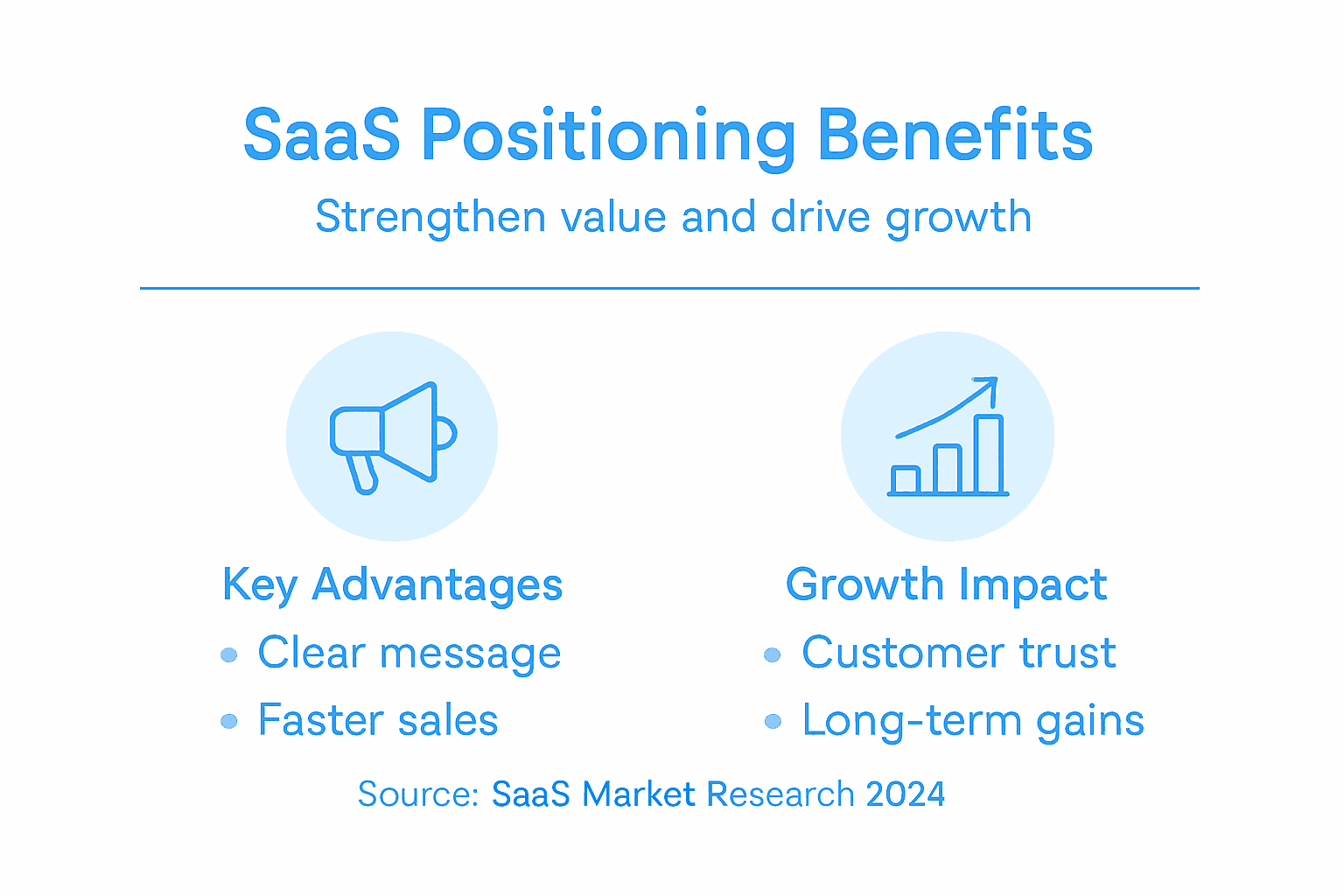
The following table summarizes how strategic positioning supports SaaS growth:
| Growth Area | Impact of Strategic Positioning | Long-term Advantages |
|---|---|---|
| Lead Generation | Attracts ideal customers | Improves conversion rates |
| Sales Cycle | Streamlines qualification process | Reduces time-to-close |
| Customer Retention | Aligns with user needs | Builds lasting relationships |
| Market Perception | Clarifies product strengths | Enhances brand reputation |
Beyond initial customer acquisition, clear positioning plays a critical role in long-term growth strategies. Standing out in crowded markets becomes easier when companies can succinctly explain their product’s distinctive advantages, leading to more predictable revenue streams and sustainable competitive positioning.
Pro tip: Regularly review and refine your positioning statement to ensure it remains relevant and compelling in rapidly evolving market conditions.
Risks and Common Positioning Mistakes
Strategic positioning in SaaS is fraught with potential pitfalls that can undermine a company’s competitive potential. Static positioning in dynamic markets represents one of the most significant risks facing technology companies today, where rapid technological shifts can quickly render existing strategies obsolete.
The most critical positioning mistakes include:
- Misaligning product capabilities with market expectations
- Failing to continuously update positioning strategies
- Overlooking emerging competitive threats
- Developing overly generic value propositions
- Neglecting customer feedback and market signals
- Underestimating internal capability gaps
Companies often fall into the trap of creating positioning statements that sound impressive but lack substantive differentiation. This approach leads to blending into the competitive landscape rather than standing out, making it difficult to attract and retain customers in increasingly crowded markets.
Understanding and mitigating these risks requires a proactive and dynamic approach to strategic positioning. Organizations must develop robust mechanisms for continuous market intelligence gathering, regularly reassessing their competitive positioning, and maintaining flexibility in their strategic frameworks.
Pro tip: Conduct quarterly competitive landscape reviews to identify emerging threats and opportunities for repositioning.
Elevate Your SaaS Growth with Strategic Design Partnership
Navigating the complexities of strategic positioning requires more than understanding your market or customer needs. The biggest challenge SaaS companies face is aligning product design and go-to-market strategies to create clear, distinctive value that drives faster sales cycles and lasting customer loyalty. If you struggle to translate your strategic vision into tangible product growth or worry about staying relevant in a dynamic market, you are not alone.
At The Good Side, we specialize in embedding senior design leadership that co-creates with your product and engineering teams to accelerate your strategic positioning efforts. Our outcome-driven designers go beyond surface-level UI work to help you craft aligned onboarding experiences, sharpen your product’s value proposition, and improve activation and adoption. By integrating deeply into your workflows, we ensure your SaaS solution stands out with clear, compelling differentiation that resonates with your ideal users.
Elevate your SaaS product with senior design expertise that drives measurable business impact.
Ready to turn your strategic positioning into competitive advantage and growth? Partner with the design experts at The Good Side to embed nimble, flexible design leadership tailored for SaaS companies ready to win. Explore how we can help you improve product clarity, accelerate adoption, and maximize revenue at https://goodside.fi. Act now to outpace the competition and create products that are easier to understand, easier to use, and easier to grow.
Frequently Asked Questions
What is strategic positioning in the SaaS industry?
Strategic positioning in the SaaS industry involves developing a unique framework that differentiates a company from competitors, aligning product capabilities with market needs and customer value propositions.
Why is strategic positioning important for SaaS companies?
Strategic positioning is crucial as it helps SaaS companies communicate their unique value clearly, accelerates sales cycles, reduces customer acquisition costs, and enhances overall market perception.
What are the main types of strategic positioning available to SaaS companies?
The main types of strategic positioning are Cost Leadership, Differentiation, and Focus Strategy, each offering unique advantages and challenges depending on the target market and product characteristics.
How can a SaaS company evaluate its strategic positioning?
A SaaS company can evaluate its strategic positioning by conducting a thorough analysis of market segments, competitive landscape, and customer needs, and by regularly reassessing its product features and marketing strategies to ensure alignment with market demands.