
Step by Step SaaS Redesign for Product Growth Success
Solving persistent user friction in SaaS products can define the difference between steady churn and high engagement. For Senior Product Managers at growth-driven companies, a thorough evaluation of current experiences and workflow challenges is essential to achieve lasting adoption gains. By focusing on detailed user behavior analytics and collaborative design leadership, this step-by-step guide offers actionable strategies for identifying pain points, aligning business goals, and driving transformative growth across global teams.
Table of Contents
- Step 1: Assess Existing SaaS Product And User Pain Points
- Step 2: Define Measurable Redesign Objectives And Business Goals
- Step 3: Embed Senior Designers To Co-Create With Product Teams
- Step 4: Refine Workflows And Redesign Core User Journeys
- Step 5: Validate Redesigns With Real User Feedback And Analytics
- Step 6: Launch Improvements To Drive Activation And Growth
Quick Summary
| Main Insight | Description |
|---|---|
| 1. Assess user pain points | Analyze existing user experiences to identify friction points and optimize product engagement strategies. |
| 2. Define clear objectives | Set SMART goals that align with business outcomes for targeted redesign initiatives and measurable growth. |
| 3. Foster design collaboration | Embed senior designers in product teams for continuous feedback and strategic input, enhancing design outcomes. |
| 4. Validate with user feedback | Implement a robust validation strategy using both qualitative and quantitative metrics to refine redesigns effectively. |
| 5. Launch strategically | Use a phased or soft launch approach to gather user feedback and maximize engagement with new features. |
Step 1: Assess existing SaaS product and user pain points
Understanding your SaaS product’s current performance starts with a comprehensive analysis of existing user experiences and potential friction points. This critical assessment helps identify where users struggle and what improvements can drive product growth. By systematically evaluating user behavior analytics, you can uncover insights that transform user engagement strategies.
Begin by gathering quantitative and qualitative data through multiple channels. Track product usage metrics like feature adoption rates, time spent on specific screens, and user flow drop-off points. Conduct user interviews, distribute targeted surveys, and analyze customer support tickets to understand real-world challenges. Pay special attention to areas where users spend excessive time, encounter repeated errors, or abandon key workflows. Look for patterns in user feedback that indicate deeper usability issues or misaligned product expectations.
The goal is not just collecting data but translating insights into actionable design improvements. Create detailed user journey maps that highlight friction points, emotional experiences, and potential optimization opportunities. Segment your user base to understand how different user groups interact with your product and where their specific pain points diverge.
Pro tip: Use session recording and heatmap tools to capture unfiltered user interactions and reveal hidden usability challenges that traditional analytics might miss.
Step 2: Define measurable redesign objectives and business goals
Transforming your SaaS product requires setting precise, strategic objectives that align with broader business outcomes. Defining clear product management strategies enables teams to create targeted redesign initiatives that drive meaningful growth.

Start by conducting a comprehensive analysis of your current business metrics and user performance indicators. Identify specific areas where the product needs improvement such as user activation rates, feature adoption, customer retention, and revenue generation potential. Develop SMART objectives that are specific, measurable, achievable, relevant, and time-bound. These might include increasing user engagement by 25% within six months, reducing customer churn by 15%, or improving onboarding completion rates by 30%. Ensure each objective directly connects to a tangible business outcome and can be tracked through quantifiable data points.
Collaborate with cross functional teams to validate and refine these objectives. Analyze pricing strategies and competitive positioning to ensure your redesign goals support long term financial viability. Break down broader objectives into specific, actionable initiatives that different team members can own and execute. Create a measurement framework that allows for continuous tracking and allows flexibility to adjust strategies based on emerging insights.
Pro tip: Prioritize objectives that have the most significant potential impact on user experience and business performance, focusing on high leverage improvements that can create compounding positive outcomes.
Step 3: Embed senior designers to co-create with product teams
Successful SaaS redesign hinges on creating deep collaborative partnerships between design and product teams. Bridging design and development teams transforms product innovation by integrating specialized expertise across organizational boundaries.
To effectively embed senior designers, establish clear communication channels and collaborative workflows that allow seamless interaction. Create cross functional workshops where designers work directly with product managers, engineers, and stakeholders to understand technical constraints, business objectives, and user needs. These collaborative sessions should focus on co-creating solutions rather than presenting completed designs. Encourage designers to participate in sprint planning, product strategy meetings, and user research sessions to develop a holistic understanding of the product ecosystem.
Designers should be positioned as strategic partners who bring specialized expertise in user experience, interaction design, and product vision. Implement mechanisms for continuous feedback and iteration, such as regular design reviews, collaborative prototyping sessions, and joint problem solving workshops. Ensure senior designers have direct access to user research data, performance metrics, and technical documentation to make informed design decisions that balance user needs with technical feasibility.
Pro tip: Create a shared digital workspace that allows real time collaboration and transparent documentation, enabling designers and product teams to track design evolution and maintain alignment throughout the redesign process.
Step 4: Refine workflows and redesign core user journeys
Transforming your SaaS product requires a strategic approach to understanding and optimizing user interactions. Uncovering user research methods enables teams to map complex user experiences and identify critical friction points that impact product usability.
Begin by conducting comprehensive user journey mapping that tracks every interaction and touchpoint within your product. Analyze user behavior through a combination of qualitative methods like user interviews and usability testing, and quantitative approaches such as heat maps, click tracking, and conversion funnel analysis. Identify specific moments where users experience confusion, frustration, or unnecessary complexity. Focus on reducing cognitive load by simplifying navigation paths, streamlining multi step processes, and creating more intuitive interaction flows that align with user mental models and expectations.
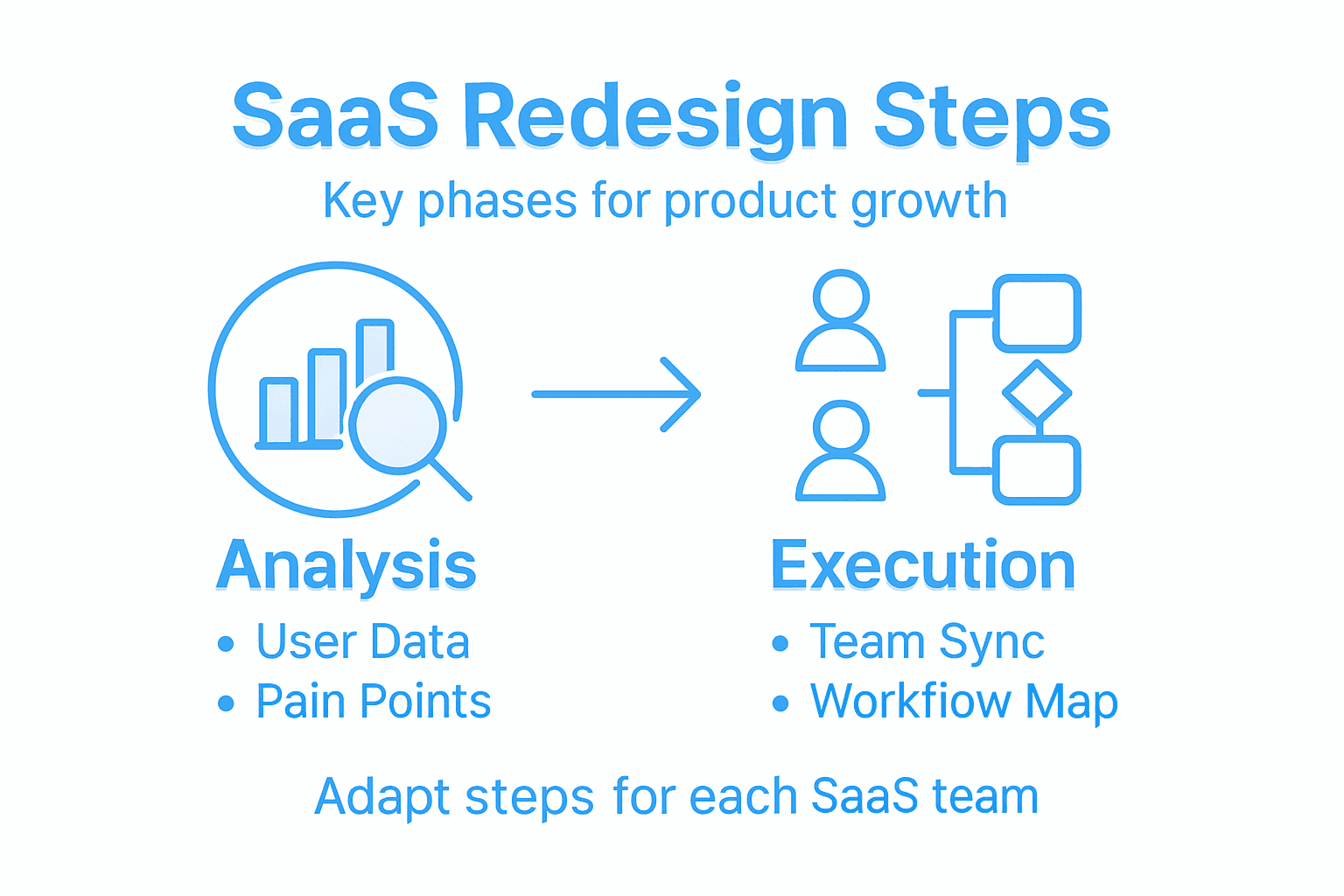
Prioritize workflow refinements based on their potential impact on user engagement and business metrics. Break down complex user journeys into smaller, more manageable interaction sequences. Implement progressive disclosure techniques that reveal information and functionality incrementally, reducing overwhelm and helping users understand the product more naturally. Create alternative workflow options that accommodate different user skill levels and preferences, ensuring your redesign provides flexibility without compromising core functionality.
Pro tip: Continuously validate redesigned workflows through iterative user testing, tracking key metrics like task completion time, error rates, and user satisfaction to ensure your refinements genuinely improve the product experience.
Step 5: Validate redesigns with real user feedback and analytics
Successful SaaS product redesigns demand rigorous validation through comprehensive user insights and performance data. Leveraging user behavior data helps teams transform initial design concepts into measurable, user-validated improvements.
Implement a multi-dimensional validation approach that combines quantitative metrics and qualitative feedback. Utilize advanced analytics tools to track user interactions, measuring key performance indicators such as task completion rates, time spent on specific features, and user flow progression. Conduct structured user testing sessions with representative audience segments, gathering detailed feedback through moderated usability tests, screen recordings, and in depth interviews. Pay special attention to how users navigate new workflows, identifying any unexpected friction points or areas of confusion that might have been overlooked during initial design iterations.
Create a systematic feedback loop that continuously monitors user sentiment and product performance. Develop comprehensive tracking mechanisms that capture both explicit user feedback through surveys and support tickets, and implicit signals from behavioral analytics. Compare new design iterations against baseline metrics to quantify improvements in user experience, engagement, and overall product effectiveness. Be prepared to make incremental adjustments based on real world usage data, ensuring your redesign remains responsive to actual user needs and expectations.
Here is a summary of key validation metrics for SaaS product redesigns:
| Metric Type | Example Metric | Purpose |
|---|---|---|
| User Engagement | Feature adoption rate | Tracks new feature popularity |
| Usability | Task completion time | Measures ease of completing actions |
| Retention | Customer churn rate | Identifies changes in user loyalty |
| Satisfaction | User satisfaction score | Assesses perceived product quality |
| Error Rate | Workflow error frequency | Pinpoints usability trouble spots |
Pro tip: Implement a rolling validation strategy that treats each design iteration as a hypothesis to be tested, using statistically significant user data to drive evidence based product improvements.
Step 6: Launch improvements to drive activation and growth
Successful SaaS product launches require strategic planning and precise execution to maximize user engagement and drive meaningful growth. Effective product management strategies enable teams to transform redesign efforts into tangible business outcomes.
Deploy your improvements through a carefully orchestrated rollout strategy that minimizes user disruption and maximizes adoption potential. Start with a phased release approach targeting initial user segments who can provide valuable early feedback. Develop comprehensive onboarding materials that clearly communicate new features and their direct benefits. Create targeted messaging that highlights how specific improvements solve user pain points, using clear language that connects technical updates to real world problem solving. Monitor key activation metrics closely during the initial launch period, tracking user engagement rates, feature adoption speed, and overall system performance.
Establish a robust post launch tracking mechanism that allows for rapid iteration and continuous improvement. Addressing scaling challenges requires maintaining a flexible approach that balances user experience with technical performance. Create feedback channels that enable users to share insights quickly, and develop internal processes for rapidly interpreting and acting on user data. Prioritize improvements that demonstrate immediate value and align closely with user expectations, ensuring your product continues to evolve responsively.
Here is a comparison of SaaS rollout strategies and their typical business impact:
| Rollout Strategy | Key Characteristics | Business Impact |
|---|---|---|
| Phased Release | Gradual rollout to users | Minimizes risk, allows feedback |
| Soft Launch | Limited user segment | Identifies critical issues fast |
| Full Deployment | All users at once | Maximizes reach, higher risk |
| Beta Program | Volunteer testers only | Early insights, fosters loyalty |
Pro tip: Implement a soft launch strategy with a select group of engaged users who can provide detailed feedback before full platform deployment, allowing you to identify and resolve potential issues proactively.
Accelerate Your SaaS Redesign with Strategic Design Leadership
Redesigning your SaaS product to drive growth success involves overcoming complex challenges like identifying real user pain points and embedding senior designers to co-create with your product and engineering teams. This article highlights critical steps such as refining workflows and validating redesigns with real user feedback which are often difficult to execute without experienced design leadership focused on clear business outcomes. If you are aiming to boost activation, adoption, and long-term revenue impact while avoiding costly and slow full-time hires, you need a partner who understands how to move beyond surface-level UI fixes.
Discover how The Good Side acts as your fractional design partner delivering embedded senior designers who integrate directly into your team. We specialize in aligning product design, onboarding, and go-to-market experience to accelerate measurable product growth. With strategic ownership and SaaS-specific expertise, our designers help you refine user journeys, reduce churn, and increase feature adoption quickly and effectively. Take the first step to transform your redesign efforts into lasting business results by learning more about our fractional design services today.
Frequently Asked Questions
What are the first steps to assess my existing SaaS product before redesign?
Start by evaluating user experiences and identifying pain points through user behavior analytics. Gather quantitative and qualitative data by tracking usage metrics, conducting user interviews, and analyzing feedback to pinpoint areas needing improvement.
How do I set measurable objectives for my SaaS redesign?
Define clear, actionable objectives using the SMART framework, focusing on specific areas like user engagement and customer retention. Aim to increase metrics such as onboarding completion rates by a target percentage within a specific timeframe, like 30% within six months.
What role do senior designers play in the SaaS redesign process?
Senior designers should be embedded within product teams to foster collaboration and co-create solutions. Encourage them to participate in design reviews and user research sessions to ensure designs align with both user needs and technical feasibility.
How can I effectively refine workflows and user journeys in my SaaS product?
Conduct comprehensive user journey mapping to identify key friction points and simplify navigation paths. Prioritize making small adjustments based on user feedback to enhance ease of use, aiming for improved task completion rates over time.
What is the best way to validate my redesign with real user feedback?
Implement a multi-dimensional validation strategy combining quantitative metrics and qualitative user insights. Monitor key performance indicators regularly and conduct usability testing to ensure your redesign genuinely addresses user needs and expectations.
How should I approach launching improvements after a redesign?
Employ a phased release strategy to minimize disruption and gather early feedback from a specific user segment. Track key activation metrics closely during the rollout and be prepared to make adjustments based on user engagement data.