
SaaS Conversion Optimization Workflow for Product Growth
What separates a stagnant SaaS product from one that drives exponential growth often comes down to how well conversion goals and user journeys are defined and optimized. Senior product managers face daily pressure to improve onboarding, reduce friction, and unlock true funnel potential. This guide delivers advanced techniques for mapping user journeys and setting measurable conversion milestones that reveal actionable opportunities, supporting scalable product success while keeping user motivations at the center of every workflow decision.
Table of Contents
- Step 1: Define Key Conversion Goals And User Journeys
- Step 2: Map Data Sources And Gather Baseline Metrics
- Step 3: Identify And Prioritize High-Impact Opportunities
- Step 4: Design Targeted Experiments For Conversion Lifts
- Step 5: Validate Results And Refine Workflow Continuously
Quick Summary
| Key Point | Explanation |
|---|---|
| 1. Define clear conversion goals | Establish specific milestones to guide user progression through the funnel effectively. |
| 2. Track key metrics systematically | Utilize robust analytics tools to gather essential data on user behavior and conversion rates. |
| 3. Identify high-impact opportunities | Focus on stages in the funnel with the most potential for improvement for better results. |
| 4. Design rigorous experiments | Implement structured testing to validate changes and ensure effective optimization. |
| 5. Continuously validate and refine | Adopt an iterative process to assess results and adjust strategies based on user behavior. |
Step 1: Define key conversion goals and user journeys
Defining clear conversion goals and mapping user journeys are fundamental to driving SaaS product growth. This step will help you understand precisely how users move through your product’s funnel and identify critical optimization opportunities.
To create an effective conversion optimization workflow, start by mapping detailed user journeys. Your map should encompass multiple stages of user interaction:
- Awareness Stage: How potential users first discover your product
- Consideration Stage: What triggers their interest and investigation
- Decision Stage: The specific actions leading to signup or purchase
Break down your conversion goals into specific, measurable milestones that align with user progression. These typically include:
- Visitor to trial signup
- Trial signup to product activation
- Activated trial to paid customer
- Paid customer to long-term retention
Each conversion stage requires unique psychological triggers and optimization strategies that resonate with user motivations.
By understanding conversion funnel stages, you can design targeted interventions that address specific user needs and reduce friction. This approach transforms generic user experiences into personalized, conversion-focused journeys.

Here’s a concise summary of each SaaS conversion funnel stage, its goal, and a main optimization focus:
| Funnel Stage | Primary Goal | Key Optimization Area |
|---|---|---|
| Awareness | Attract qualified leads | Enhance marketing and messaging |
| Consideration | Drive interest | Tailor content for relevance |
| Decision | Secure signup or sale | Streamline signup process |
| Activation | Deliver product value | Optimize onboarding experience |
| Retention | Foster long-term use | Improve customer support |
| Expansion | Increase account value | Upsell additional features |
| Advocacy | Encourage referrals | Launch referral programs |
Pro tip: Create user personas that detail demographics, pain points, and motivations to make your journey mapping more precise and actionable.
Step 2: Map data sources and gather baseline metrics
Mapping data sources and establishing baseline metrics are critical steps in creating a comprehensive SaaS conversion optimization strategy. This phase helps you understand your current performance and identify precise areas for improvement.
Begin by tracking key conversion events across your entire SaaS funnel. These critical metrics should include:
- Acquisition Metrics: Signup rates and traffic sources
- Activation Metrics: User onboarding completion rates
- Retention Metrics: User engagement and churn percentages
- Revenue Metrics: Conversion rates and average customer value
Implement robust analytics tools to capture comprehensive data. Set up comprehensive funnel tracking using platforms like Google Analytics, Heap, or Mixpanel to capture user behavior across multiple touchpoints:
- Install advanced analytics tracking
- Configure event tracking for key conversion points
- Create user segments for detailed analysis
- Set up session recording tools
Combining quantitative metrics with qualitative insights provides the most holistic view of user experience and conversion potential.
By systematically collecting and analyzing these metrics, you establish a data-driven foundation for your optimization efforts, enabling targeted improvements that directly impact product growth.
Use this table to compare popular analytics tools for SaaS conversion tracking and optimization purposes:
| Analytics Tool | Strengths | Ideal Use Case |
|---|---|---|
| Google Analytics | Broad integration, free option | Track website traffic and funnels |
| Heap | Automatic event tracking | Analyze user flows and micro-conversions |
| Mixpanel | Advanced segmentation | Behavioral analysis and cohort insights |
| Hotjar | Session replay, heatmaps | Identify UX issues via recordings |
Pro tip: Configure custom dashboards that highlight your most critical conversion metrics to ensure quick, actionable insights at a glance.
Step 3: Identify and prioritize high-impact opportunities
Identifying and prioritizing high-impact conversion optimization opportunities is crucial for driving meaningful SaaS product growth. This step transforms your data insights into strategic actions that can significantly improve your conversion rates.
Full-funnel analysis reveals critical optimization opportunities by examining each stage of your customer journey. Focus on stages with the most significant potential for improvement:
- Visitor to Signup Stage: Typically the highest drop-off point
- Trial to Paid Conversion: Direct revenue impact zone
- User Activation: Critical for long-term retention
- Onboarding Experience: First impression and engagement driver
To effectively prioritize opportunities, use a structured framework that evaluates potential improvements based on multiple criteria:
- Quantify potential revenue impact
- Assess implementation complexity
- Estimate required resources
- Validate with customer insights
Prioritization is not just about numbers—it’s about understanding the strategic value of each potential optimization.
Combine quantitative data with customer segmentation to uncover nuanced insights. This approach helps you move beyond surface-level metrics and identify truly transformative optimization opportunities that align with your growth strategy.
Pro tip: Create a prioritization matrix that scores potential improvements across impact, effort, and strategic alignment to make data-driven optimization decisions.
Step 4: Design targeted experiments for conversion lifts
Designing targeted experiments is a critical strategy for systematically improving your SaaS product’s conversion rates. This step transforms your optimization insights into actionable, measurable tests that can drive significant growth.
Systematic experimentation requires rigorous testing methodology across multiple conversion funnel stages. Your experimental approach should focus on key areas with maximum impact:
- Landing Page Variations: Test headline, design, and call-to-action elements
- Onboarding Flow: Optimize signup process and initial user experience
- Pricing Page: Experiment with pricing presentation and packaging
- Feature Messaging: Refine value proposition communication
To create statistically robust experiments, follow these structured steps:
- Develop clear, measurable hypotheses
- Define precise success metrics
- Determine required sample size
- Control for external variables
- Set confidence interval and significance level
Effective experimentation is about quality of insights, not just quantity of tests.
Implement statistically rigorous A/B testing protocols to ensure your experiments yield reliable, actionable results. This approach helps you make data-driven decisions that incrementally improve conversion performance.
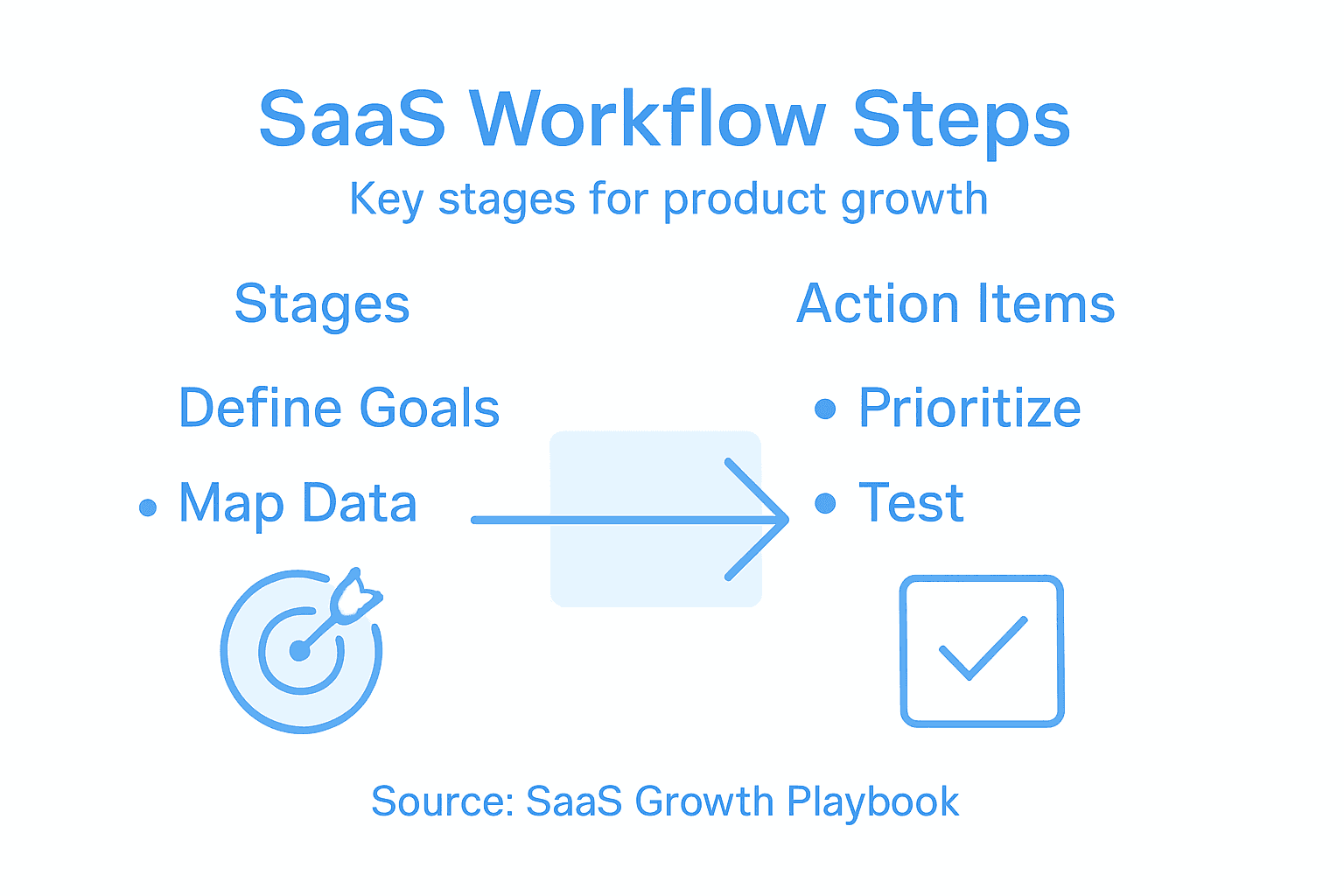
Pro tip: Always run experiments long enough to achieve statistical significance, and resist the temptation to draw conclusions from preliminary or underpowered test results.
Step 5: Validate results and refine workflow continuously
Validating results and continuously refining your conversion optimization workflow is essential for sustained SaaS product growth. This final step transforms your experimental insights into a dynamic, iterative improvement process.
Conversion optimization requires ongoing measurement and adaptation across multiple strategic dimensions. Your validation process should focus on key areas of performance assessment:
- Statistical Significance: Confirm experimental results meet rigorous standards
- Metric Performance: Track changes in key conversion indicators
- User Behavior Analysis: Understand deeper behavioral shifts
- Long-term Impact: Evaluate sustained performance improvements
Implement a systematic approach to continuous refinement:
- Review experimental results comprehensively
- Validate statistical significance
- Document learnings and insights
- Develop next-generation hypotheses
- Integrate findings into product strategy
Successful conversion optimization is a cyclical journey of testing, learning, and incremental improvement.
Create a decision system combining data analysis and experimentation that allows for agile, evidence-based optimization. This approach ensures your conversion strategies remain adaptive and aligned with evolving user needs.
Pro tip: Establish a regular cadence of review and refinement, treating conversion optimization as a continuous process rather than a one-time project.
Drive SaaS Growth With Expert Design Leadership
The challenge of navigating complex conversion funnels and continuously optimizing user journeys can feel overwhelming. This article highlights key pain points like defining measurable conversion goals, prioritizing high-impact opportunities, and executing statistically rigorous experiments. If you find your SaaS product stuck in trial signup drop-offs or struggling to improve activation and retention rates, you are not alone. The Good Side Oy specializes in embedding senior design partners who work deeply within your product and engineering teams to align onboarding flows, feature messaging, and go-to-market experiences that directly boost activation and long-term revenue.
Our experienced designers move beyond surface-level UI fixes to co-create strategic solutions that respond to your unique conversion challenges. Whether you need clear frameworks for mapping user journeys or hands-on leadership to run iterative, data-driven experiments, explore how The Good Side can accelerate your product growth with measurable outcomes.
Ready to transform your SaaS conversion workflow into a growth engine
Visit The Good Side today and partner with fractional design experts dedicated to making your product easier to understand, easier to use, and easier to grow. Discover flexible, fast, and outcome-focused design leadership built for your SaaS growth journey.
Frequently Asked Questions
What are the key conversion goals to focus on for SaaS growth?
To effectively drive SaaS growth, focus on key conversion goals such as increasing trial signups, improving product activation rates, and boosting the conversion from trial users to paying customers. Break down these goals into measurable milestones and prioritize efforts to address each stage of the conversion funnel.
How do I map user journeys for my SaaS product?
Start by identifying key stages in the user experience, including awareness, consideration, decision, activation, retention, and expansion. Create a detailed user journey map that outlines how users interact with your product at each stage, which will help pinpoint areas for improvement.
What metrics should I track to measure SaaS conversion performance?
Track essential metrics across your funnel, including acquisition rates, activation completion, retention percentages, and revenue outcomes. Set baseline metrics for each area to understand your current performance and identify specific opportunities for improvement.
How can I prioritize conversion optimization opportunities?
Evaluate potential optimization opportunities based on their estimated revenue impact, implementation complexity, and required resources. Use a structured prioritization matrix to score each opportunity, ensuring that you focus on actions that will deliver the most significant improvements first.
What steps should I follow to design effective conversion experiments?
Develop clear, measurable hypotheses and identify specific metrics for success before proceeding with your experiments. Use statistical A/B testing protocols to validate your results and ensure you are making data-driven decisions based on reliable insights.
How do I ensure continuous improvement in my conversion optimization process?
Establish a systematic approach to review experimental outcomes regularly and validate their significance. Document insights and integrate findings into your product strategy to create an ongoing loop of learning that continually refines your optimization efforts.