
Why Use Design Research: Complete Guide for SaaS Teams
Most american SaaS companies make product decisions based on intuition rather than proven user insights. With nearly 50 percent of digital products falling short of user expectations, the gap between what teams build and what users need keeps growing. Design research changes this equation by giving companies practical tools to truly understand and solve complex product challenges. You will discover how these evidence-based approaches can transform SaaS products into solutions that stand out for real users.
Table of Contents
- Design Research Defined For SaaS Companies
- Main Types Of Design Research Methods
- How Design Research Improves SaaS Products
- Measuring ROI And Business Impact
- Common Pitfalls And Avoidable Mistakes
Key Takeaways
| Point | Details |
|---|---|
| Design Research Importance | Design research is essential for SaaS companies to understand user needs and enhance user experience through direct insight. |
| Methods Overview | Key design research methods include ethnographic research, prototyping, co-design workshops, and various experimental techniques. |
| Business Impact | Implementing design research can lead to improved user acquisition, retention, and overall product performance, positively affecting ROI. |
| Common Pitfalls | Avoid biases in sampling and data collection to maintain research validity and ensure actionable insights for product development. |
Design Research Defined for SaaS Companies
Design research represents a strategic approach that transforms how SaaS companies understand and solve complex user experience challenges. According to knowway, research design is the comprehensive strategy for studying a problem, outlining how data will be collected, analyzed, and interpreted to answer specific questions.
In the context of SaaS, design research goes beyond traditional market research by blending creative exploration with structured inquiry. writingcommons explains that these methods involve empirical approaches such as:
- Ethnographic research: Understanding users in their natural environment
- Prototyping: Creating early product versions to test concepts
- Co-design workshops: Collaborating directly with potential users to refine solutions
The primary goal of design research in SaaS is to develop user-centered products that not only solve problems but anticipate user needs before they become apparent. By systematically gathering insights through multiple research techniques, product teams can make informed decisions that reduce development risks and increase the likelihood of creating truly impactful software solutions.

As product complexity grows, design research becomes less of an optional strategy and more of a critical competitive advantage. UX Research for SaaS Companies helps teams transform intuition-based guesswork into data-driven design decisions that directly improve user engagement and product performance.
Main Types of Design Research Methods
Design research methods provide SaaS teams with structured approaches to understanding user needs and solving complex product challenges. writingcommons highlights four primary research methods critical for product development: ethnographic research, prototyping and testing, co-design workshops, and design experiments.
According to knowway, research design encompasses several key approaches that can be adapted for SaaS product development:
- Experimental Design: Manipulating variables to establish cause-and-effect relationships
- Survey Design: Collecting comprehensive user insights through structured questionnaires
- Case Study Design: Conducting deep-dive analyses of specific user scenarios
- Mixed Methods Design: Combining qualitative and quantitative research techniques
Each research method offers unique insights. Ethnographic research, for instance, allows teams to observe users in their natural environment, uncovering subtle behavior patterns that traditional surveys might miss. Prototyping enables rapid concept testing, while co-design workshops directly involve users in solution creation. The goal is not just collecting data, but generating actionable insights that drive meaningful product improvements.
Service Design Explained provides additional context on how these research methods translate into holistic user experience strategies, helping SaaS teams create more intuitive and user-centered products.
How Design Research Improves SaaS Products
Design research transforms product development by providing deep insights into user behavior, needs, and pain points that traditional market research often misses. writingcommons illustrates how design research methods can be applied across industries to drive innovation, from smartphone apps to complex software solutions.
The core benefits of design research for SaaS products include:
- Reduced Development Risk: Identifying potential user challenges before full-scale development
- Enhanced User Experience: Creating more intuitive and user-centered product interfaces
- Data-Driven Decision Making: Replacing guesswork with concrete user insights
- Competitive Differentiation: Understanding user needs more deeply than competitors
According to knowway, a well-designed research approach ensures the validity of findings by minimizing bias and increasing the reliability of results. This means SaaS teams can confidently make strategic product decisions based on robust, representative user data rather than assumptions.
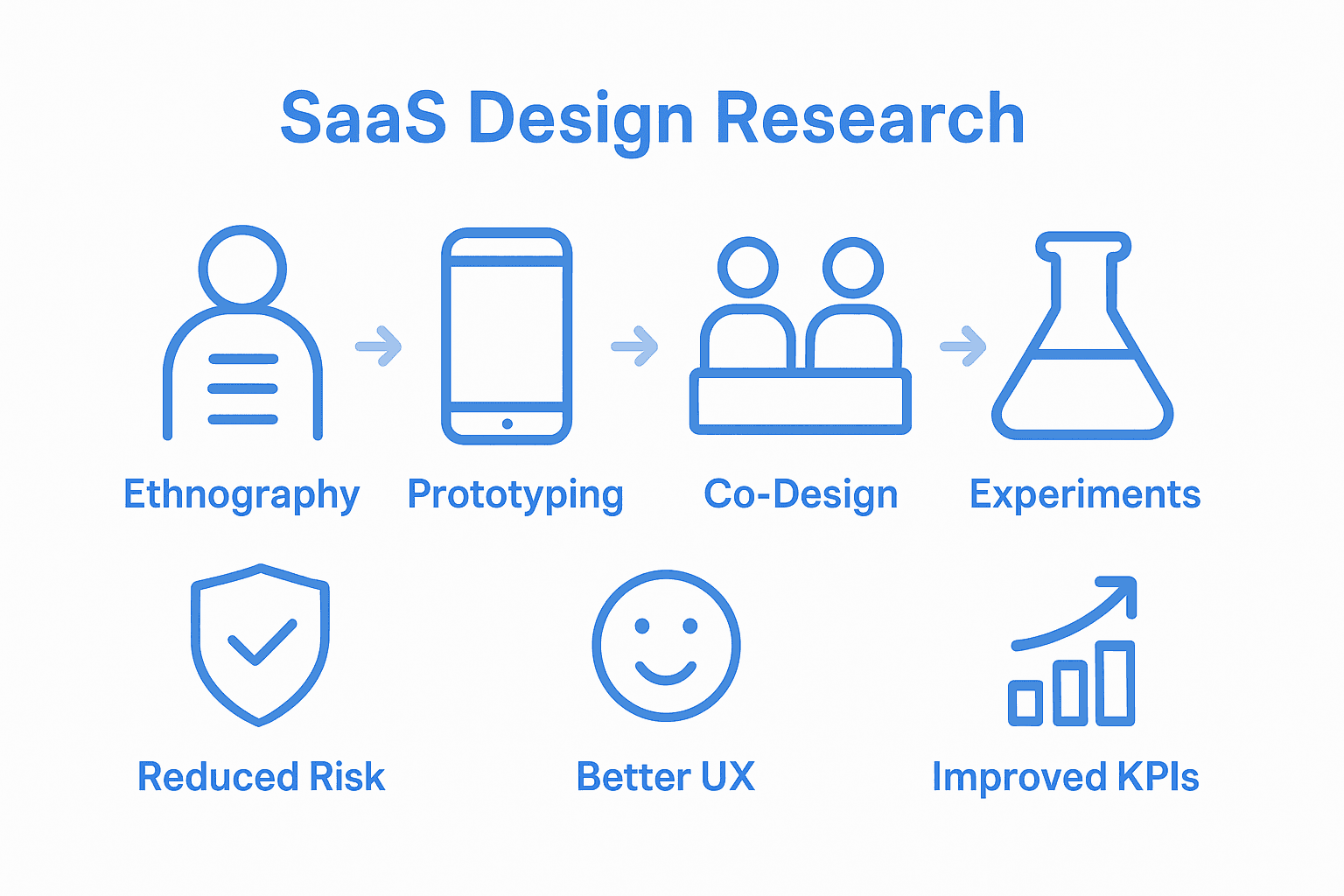
UX Design Best Practices provides additional context on how these research insights translate into tangible product improvements, helping teams create software that not only meets but anticipates user needs.
Measuring ROI and Business Impact
Design research transforms abstract user insights into tangible business outcomes that directly impact a company’s bottom line. writingcommons highlights how empirical research methods can help companies gather real-world feedback that potentially increases return on investment by creating products more precisely aligned with market demands.
Key performance indicators for measuring design research impact include:
- User Acquisition Rate: Changes in new user sign-ups after implementing research insights
- User Retention Metrics: Improvements in customer engagement and reduced churn
- Conversion Rate Optimization: Increased product adoption and feature usage
- Development Efficiency: Reduced time and resources spent on unnecessary features
According to knowway, a robust research approach ensures findings are valid by minimizing bias and increasing result reliability. This means SaaS teams can confidently quantify the economic value of their design research investments through precise, representative data collection and analysis.
Why Improve Product UX provides deeper insights into how strategic design research translates into measurable business performance, demonstrating that thoughtful user research is not just a cost center but a critical driver of sustainable growth.
Common Pitfalls and Avoidable Mistakes
Design research requires strategic planning and careful execution to avoid common traps that can undermine the entire investigation. writingcommons highlights critical ethical and methodological challenges that SaaS teams must navigate carefully, particularly around issues of informed consent, privacy, and research scalability.
Most frequent design research mistakes include:
- Biased Sampling: Collecting insights from too narrow or homogeneous a user group
- Confirmation Bias: Seeking evidence that confirms preexisting assumptions
- Insufficient Data Validation: Failing to cross-reference research findings
- Overlooking Contextual Nuances: Misinterpreting user behaviors without understanding broader contexts
According to knowway, maintaining research validity requires minimizing bias through consistent methods and appropriate sampling techniques. This means carefully selecting representative participants and employing rigorous data collection protocols that reduce potential errors.
Design Systems in SaaS offers additional insights into creating structured approaches that help teams avoid these common research pitfalls and develop more reliable, actionable user insights.
Unlock the Power of Design Research to Transform Your SaaS Product
Design research unlocks deep user insights that your SaaS team needs to reduce development risks and craft intuitive, user-focused products. If you are struggling with disconnected user journeys, unclear positioning, or unprofessional interfaces, these challenges are exactly what targeted design research helps to solve. By blending ethnographic methods, prototyping, and co-design workshops your product can evolve in ways that truly resonate with users.
Don’t leave your product’s success to guesswork. At The Good Side Oy, our senior SaaS-specialized designers and UX researchers partner with you to transform scattered user data into a cohesive strategy. We offer flexible engagements from part-time consulting to fully embedded design teams helping you launch faster, optimize activation, and increase conversions.
Ready to turn your SaaS product into a competitive powerhouse with clear, data-driven design decisions? Visit The Good Side to start with a free design audit, tap into a network of 100+ SaaS experts, and accelerate your go-to-market now. Explore how our strategic design services link user research and product innovation for measurable business growth by checking out Why Improve Product UX and UX Design Best Practices. Take the next step today and see what thoughtful design research can do for your SaaS success.
Frequently Asked Questions
What is design research and why is it important for SaaS companies?
Design research is a strategic approach that helps SaaS companies understand user behaviors and challenges. It combines creative exploration with structured inquiry to develop user-centered products that effectively address user needs.
What are the main types of design research methods used in SaaS development?
The primary design research methods for SaaS include ethnographic research, prototyping and testing, co-design workshops, and design experiments. Each method provides unique insights into user needs and behaviors to inform product development.
How does design research improve the user experience in SaaS products?
Design research enhances user experience by providing deep insights into user behaviors, needs, and pain points. This leads to the creation of more intuitive interfaces and data-driven decisions, ultimately resulting in improved user satisfaction and engagement.
How can SaaS teams measure the ROI of their design research efforts?
SaaS teams can measure the ROI of design research by evaluating key performance indicators such as user acquisition rates, user retention metrics, conversion rates, and overall development efficiency. This allows teams to quantify the economic impact of their research investments.