Master the User Research Process for SaaS Success
Discover the user research process saas companies need with actionable steps to gather insights, optimize UX, and boost product performance for growth.

Over 75 percent of successful American SaaS companies rely on structured user research to shape their products. Understanding the real needs and behaviors of your core audience can determine whether your software delights or disappoints. From defining clear research goals to choosing the right tools, this guide breaks down proven steps for American founders and teams who want actionable insights that truly move the needle.
Table of Contents
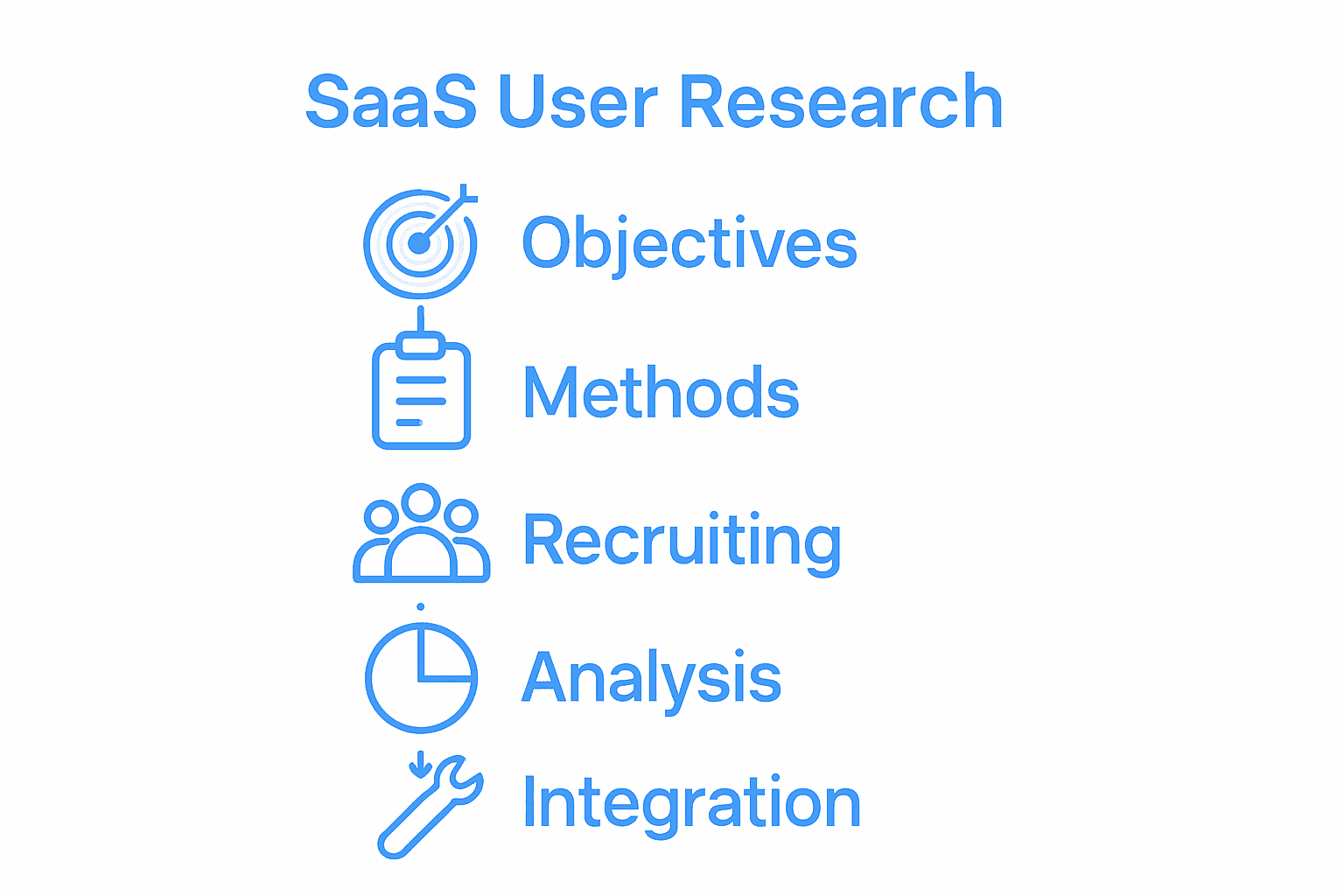
- Step 1: Define Research Objectives And Target Audiences
- Step 2: Select Research Methods And Tools For SaaS
- Step 3: Recruit And Engage Real Users For Feedback
- Step 4: Analyze Insights And Identify Key Opportunities
- Step 5: Integrate Findings To Optimize The SaaS Product
Quick Summary
| Key Point | Explanation |
|---|---|
| 1. Define clear research objectives | Establish specific goals to guide user research, ensuring focused insights that inform product development. |
| 2. Select appropriate research methods | Use a mix of qualitative and quantitative methods to gather comprehensive user insights that drive enhancements. |
| 3. Recruit representative user participants | Engage users who reflect your target audience to collect relevant and trustworthy feedback on your product. |
| 4. Analyze data systematically | Organize findings to identify patterns, prioritizing insights based on user value and implementation feasibility. |
| 5. Transform insights into product improvements | Apply research findings strategically to optimize your product, aligning enhancements with user needs and business goals. |
Step 1: Define research objectives and target audiences
Successful user research begins with crystal clear objectives and a precise understanding of who you’re designing for. By meticulously defining your research goals and target audience, you’ll set the foundation for insights that genuinely transform your product experience.
Start by mapping out what you want to learn through your research. This means identifying specific knowledge gaps about your users that will inform product decisions. Are you trying to understand user pain points? Validate a new feature concept? Improve user onboarding? Specifying your target audience through detailed profiles helps you design research that delivers actionable insights.
To define your target audience effectively, create comprehensive user personas that go beyond basic demographics. Think about behavioral characteristics, motivations, technical skills, and contextual environments where users interact with your product. When developing these personas, consider not just your primary users but also secondary stakeholders who might be impacted by your system.
A practical approach involves breaking down your audience definition into clear segments. Identify your ideal customer profile by considering factors like job role, industry, company size, technical expertise, and specific challenges they face. Remember that a well-defined target audience allows you to design more precise research questions and recruit participants who will provide meaningful feedback.
Pro tip: Create a one-page summary document for each user persona that includes their goals, frustrations, and potential interaction points with your product. This living document will become an invaluable reference throughout your research and design process.
Step 2: Select research methods and tools for SaaS
Choosing the right research methods and tools is critical for generating meaningful insights about your product and users. By selecting strategic approaches that align with your specific research objectives, you’ll uncover actionable data that drives product improvement.

Start by mapping out your research goals and selecting methods that match those objectives. Quantitative methods like surveys and analytics provide numerical data about user behaviors, while qualitative approaches such as interviews and usability tests reveal deeper motivations and experiences. Evaluating SaaS quality through targeted research approaches helps ensure you gather comprehensive insights that go beyond surface level understanding.
Consider a mixed methods approach that combines different research techniques. For SaaS products, powerful tools like UserTesting, Hotjar, and Google Analytics can provide complementary perspectives. Surveys might reveal broad user sentiments, while session recordings can expose specific interaction patterns. User interviews add rich context that helps interpret quantitative data.
When selecting tools, prioritize those that integrate seamlessly with your existing tech stack and provide clear, actionable insights. Look for platforms that offer both breadth of data collection and depth of analysis. Some tools specialize in specific research aspects like user experience tracking, while others provide comprehensive research suites.
Here’s a comparison of common user research methods for SaaS and their main benefits:
| Research Method | Type | Key Benefit |
|---|---|---|
| Surveys | Quantitative | Gathers broad user sentiment |
| Interviews | Qualitative | Reveals deep user motivations |
| Usability Testing | Qualitative | Identifies UI and workflow issues |
| Analytics | Quantitative | Tracks real user behaviors |
| Session Recordings | Mixed | Shows detailed interaction patterns |
Pro tip: Create a research method matrix that maps each research question to specific data collection techniques and tools. This strategic document will help you stay focused and ensure you collect the most relevant user insights efficiently.
Step 3: Recruit and engage real users for feedback
Recruiting and engaging the right users is the critical heart of meaningful user research. Your goal is to connect with individuals who genuinely represent your target audience and can provide authentic, actionable insights about your product.
User-centered techniques like personas and interaction models can help you systematically identify and approach potential research participants. Start by creating detailed user personas that outline specific characteristics such as job roles, technical expertise, and product usage patterns. This approach ensures you recruit participants who will provide the most relevant and meaningful feedback.
When recruiting, leverage multiple channels to reach your ideal users. Professional networks like LinkedIn, industry forums, online communities, and your existing customer base can be excellent sources. Offer meaningful incentives that go beyond monetary compensation consider providing early access to features, exclusive insights, or professional recognition to attract high-quality participants. Remember that the most valuable participants are those who are genuinely interested in helping improve the product.
During engagement, create a comfortable environment that encourages honest and detailed feedback. Use a mix of research methods like structured interviews, usability tests, and open-ended surveys to capture comprehensive insights. Analyzing users’ perceptions of software usability requires a nuanced approach that combines quantitative metrics with qualitative exploration.
Pro tip: Always follow up with participants after research sessions. Send personalized thank you notes, share how their feedback will be used, and consider creating a community of ongoing user research contributors who feel genuinely valued and connected to your product development process.
Step 4: Analyze insights and identify key opportunities
Transforming raw research data into actionable insights requires a strategic and systematic approach. Your goal is to uncover meaningful patterns that reveal genuine opportunities for product improvement and user experience enhancement.
Developing a socio-technical framework for analyzing research findings helps you move beyond surface level observations. Start by organizing your collected data into clear categories such as user behaviors, pain points, feature requests, and interaction patterns. Use visualization techniques like affinity mapping or thematic analysis to identify recurring themes and connections that might not be immediately apparent.
Utilize both quantitative and qualitative analysis methods to create a comprehensive view of your research insights. Quantitative data provides statistical validation, while qualitative feedback adds depth and context. Look for intersections between different data points that reveal underlying user needs. Pay special attention to outliers and unexpected feedback these often highlight unique opportunities for innovation or solving problems your competitors might have missed.
Prioritize your insights based on potential impact and feasibility. Create a matrix that ranks opportunities according to factors like user value, implementation complexity, and alignment with your product strategy. Exploring systematic approaches to user modeling and insight analysis can help you develop a structured method for transforming raw data into strategic product improvements.
Pro tip: Create a visual research insights deck that tells a compelling story. Use clear graphics, concise annotations, and direct quotes to make your findings memorable and actionable for your entire product team.
Step 5: Integrate findings to optimize the SaaS product
Transforming user research insights into tangible product improvements requires a strategic and collaborative approach. Your goal is to translate the rich data you’ve collected into concrete design and functionality enhancements that genuinely address user needs.
Evaluating SaaS quality through systematic assessment models provides a structured framework for integrating research findings. Begin by organizing your insights into clear categories such as user experience improvements, feature refinements, and potential innovation opportunities. Collaborate closely with your product, design, and engineering teams to ensure that research insights are understood and actionable.
Prioritize findings based on their potential impact on user satisfaction, product performance, and business goals. Create a roadmap that breaks down complex insights into manageable implementation steps. Consider both immediate quick wins and long term strategic improvements. Some insights might require minor interface adjustments, while others could demand more significant architectural changes to your SaaS platform.
Below is a summary of ways to prioritize user research findings for effective product optimization:
| Prioritization Factor | Description | Example Application |
|---|---|---|
| User Value | Direct impact on user experience | Improves onboarding flow |
| Implementation Complexity | Technical effort needed for the change | Requires backend refactoring |
| Business Alignment | Supports strategic product/business goals | Drives paid conversion |
| Opportunity Uniqueness | Solves problems rivals have overlooked | Unique feature request |
Establish a continuous feedback loop that allows for ongoing refinement. Schedule regular meetings to review research insights, track implemented changes, and measure their effectiveness. Use metrics like user engagement, satisfaction scores, and feature adoption rates to validate the impact of your research driven optimizations.
Pro tip: Create a research impact dashboard that visually tracks how user insights translate into product improvements. This transparent approach helps maintain team alignment and demonstrates the tangible value of user research.
Elevate Your SaaS User Research Into Actionable Growth
Mastering the user research process is the cornerstone for turning scattered feedback into clear product improvements. This article highlights the challenges of defining precise user personas, selecting optimal research methods, and translating insights into prioritized development opportunities. You may be facing the pain of disconnected user journeys and unclear user needs that slow down your product success.
At The Good Side Oy, we solve these exact challenges by partnering with SaaS companies to deliver expert UI/UX design and strategic user research aligned with business goals. Our senior, SaaS-focused designers specialize in creating cohesive user journeys and actionable insights that drive activation, conversion, and revenue growth. Whether you need flexible consulting, embedded designers, or full project support, we enable fast integration without the delays of traditional hiring.
Unlock the full potential of your product by transforming research insights into measurable results. Learn how a streamlined design process can elevate your SaaS offering by visiting The Good Side.
Start accelerating your product success today.
Discover strategic design solutions tailored for SaaS teams.
Ready to move from research to results? Explore how our UI/UX design and user research expertise can empower your team. Visit The Good Side now to get started with a free design audit and rapid talent matching.
Frequently Asked Questions
How do I define clear research objectives for my SaaS user research?
Start by outlining what specific insights you want to gain, such as identifying user pain points or validating new features. Create a list of key questions that target these objectives to ensure focused research.
What methods should I use to gather user feedback for a SaaS product?
Utilize a mix of quantitative methods like surveys and qualitative methods like interviews to capture comprehensive insights. Balance numeric data with personal experiences for a well-rounded understanding of user needs.
How can I recruit suitable users for my SaaS user research?
Focus on recruiting individuals who fit your user personas by targeting professional networks, industry forums, and your existing customer base. Offer meaningful incentives, such as early access to features, to attract participants who can provide valuable feedback.
What is the best way to analyze user research data for actionable insights?
Organize your data into categories related to user behaviors, pain points, and feature requests, and use visualization techniques to identify trends. By employing both qualitative and quantitative analysis, you can uncover deeper user needs that inform product improvements.
How can I integrate user research findings into my SaaS product development?
Start by prioritizing insights based on potential impact and feasibility to create a clear roadmap for implementation. Schedule regular review meetings to assess the effectiveness of changes and ensure they align with user needs and business goals.