
User-Centric Design: Transforming SaaS Growth
Over 60 percent of American SaaS users abandon new products after a poor first experience. For every product manager and founder, this reality puts user-centric design at the core of building SaaS that stands out. When real American feedback shapes each touchpoint, your software becomes more intuitive, trusted, and valuable. Discover why centering design around real user needs is the missing piece for SaaS companies aiming to drive conversion and deepen customer loyalty.
Table of Contents
- What User-Centric Design Means for SaaS
- Core Principles and Key Stages Explained
- User-Centric Methods in SaaS Product Development
- Impact on Activation, Conversion, and Retention
- Common Pitfalls and How to Avoid Them
Key Takeaways
| Point | Details |
|---|---|
| User-Centric Design Focus | Prioritize user needs and experiences to create intuitive and engaging SaaS products. |
| Ongoing User Feedback | Implement continuous feedback loops to iterate on design and development, adapting to user expectations. |
| Holistic Approach | Emphasize empathy and comprehensive usability testing to understand user pain points and streamline interactions. |
| Avoid Common Pitfalls | Focus on simplifying features, standardizing interfaces, and providing effective onboarding to enhance user trust and satisfaction. |
What User-Centric Design Means for SaaS
User-centric design represents a transformative approach that prioritizes user needs, behaviors, and experiences throughout the entire software development lifecycle. At its core, this methodology shifts the traditional product creation paradigm from technology-first to human-first, ensuring that every interaction, feature, and interface element is meticulously crafted to solve real user problems.
According to a systematic literature review analyzing digital business systems, embedding user-focused approaches into SaaS platforms significantly improves accessibility, adoption, and organizational outcomes. This approach goes beyond superficial aesthetic improvements, diving deep into understanding user psychology, workflow challenges, and cognitive barriers that prevent seamless software interactions. By conducting extensive user research, creating detailed personas, and implementing iterative design processes, SaaS companies can develop products that not only meet functional requirements but also provide intuitive, engaging experiences.
The practical implementation of user-centric design involves multiple strategic components. These include continuous user feedback collection, creating scalable design systems that maintain consistency across platforms, developing empathy-driven user journey maps, and utilizing data-driven prototyping techniques. Successful SaaS products recognize that design is not a one-time activity but an ongoing process of understanding, adapting, and refining user interactions based on real-world usage patterns and evolving user expectations.
Pro tip: Create a dedicated user research panel that provides consistent, diverse feedback throughout your product development lifecycle to maintain a true user-centric approach.
Core Principles and Key Stages Explained
User-centric design is built on a framework of strategic principles that transform how SaaS products are conceptualized, developed, and refined. The foundational principles of user-centered design emphasize empathy, iterative processes, and comprehensive user experience analysis, creating a holistic approach that goes far beyond traditional product development methodologies.

The core principles of user-centric design revolve around four critical stages that form a dynamic, iterative cycle. These stages include understanding the user context, specifying precise user requirements, designing targeted solutions, and continuously evaluating outcomes. Each stage demands deep engagement with user perspectives, requiring product teams to move beyond assumptions and deeply investigate actual user needs, workflows, and pain points. By treating design as an ongoing conversation with users, SaaS companies can create products that feel intuitive and genuinely solve real-world challenges.
Successful implementation of these principles requires robust research methodologies and a commitment to continuous learning. This means developing detailed user personas, conducting extensive usability testing, creating journey maps that reveal complex user interactions, and maintaining flexible design systems that can rapidly adapt to emerging user feedback. Product managers and designers must cultivate a mindset of constant curiosity, viewing each user interaction as an opportunity to refine and improve the product experience.
Pro tip: Implement a quarterly user research sprint that brings together design, product, and engineering teams to review and synthesize user feedback, ensuring a comprehensive and collaborative approach to product evolution.
User-Centric Methods in SaaS Product Development
SaaS product development has evolved dramatically, moving beyond traditional engineering approaches to embrace comprehensive user research methodologies that integrate qualitative involvement and structured feedback loops. This transformation requires a holistic understanding of user needs that goes far beyond surface-level interactions, demanding deep empathy and systematic exploration of user experiences.
The most effective user-centric methods combine multiple research techniques to create a comprehensive view of user requirements. Systematic research reveals key techniques including prototyping, usability testing, user surveys, persona development, interviews, focus groups, and log data reviews. Each method provides unique insights: personas humanize user data, interviews uncover emotional contexts, usability tests reveal practical interaction challenges, and log data offers objective behavioral patterns. By triangulating these approaches, SaaS teams can develop nuanced, data-driven product strategies that genuinely address user needs.
Implementing these methods requires more than just collecting data—it demands a cultural shift toward continuous learning and adaptive design. Successful SaaS organizations create cross-functional teams that include designers, researchers, engineers, and product managers, all committed to understanding and solving user challenges. This approach transforms user research from a periodic activity into an ongoing dialogue, where each interaction becomes an opportunity to refine and improve the product experience. By maintaining curiosity and openness, teams can develop products that not only meet functional requirements but also create meaningful, intuitive experiences that users genuinely appreciate.
Here’s a summary of user-centric research methods and their unique advantages:
| Method | Description | Unique Insight Generated |
|---|---|---|
| Usability Testing | Observes real users interacting with product | Reveals practical interaction issues |
| Persona Development | Constructs archetypes of target users | Humanizes user groups’ motivations |
| Interviews | Direct conversations with users | Uncovers emotional pain points |
| Log Data Review | Analyzes user activity data | Identifies objective behavior trends |
| Focus Groups | Group discussions for feedback | Exposes group perception patterns |
Pro tip: Create a dedicated user insights repository that centralizes research findings, making complex user data accessible and actionable across your entire product development team.
Impact on Activation, Conversion, and Retention
User-centric design transforms SaaS product performance by directly influencing critical business metrics through strategic approaches that prioritize user needs and experiences. By understanding and addressing user expectations at every interaction point, companies can dramatically improve activation rates, streamline conversion processes, and significantly reduce customer churn.
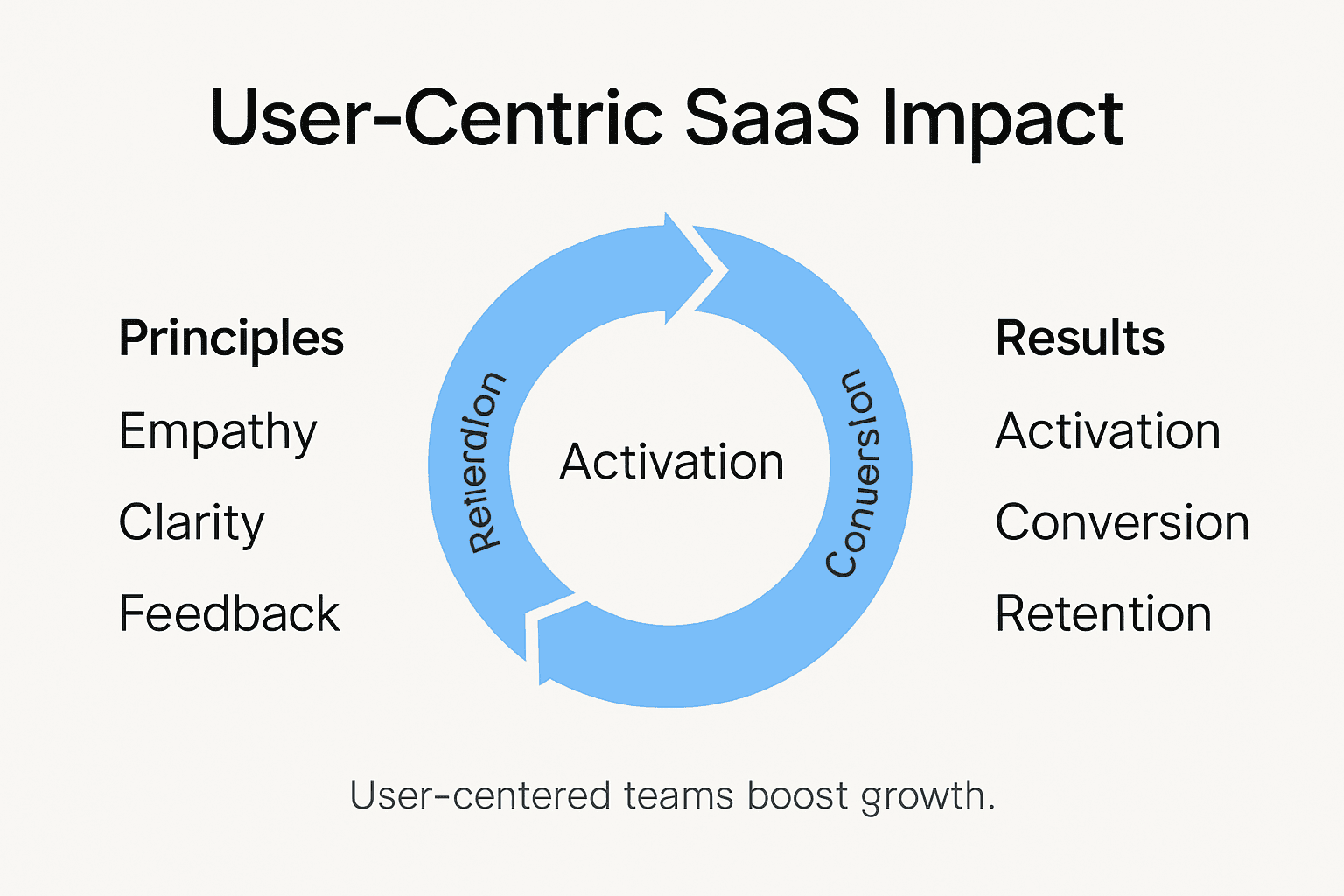
Empirical research demonstrates that intuitive workflows, performance optimization, and personalized interfaces are key strategies for increasing first-use activation and sustaining user engagement. The impact goes beyond aesthetic improvements—these design approaches create measurable business outcomes. Activation rates increase when onboarding experiences feel smooth and purposeful, conversion rates climb as friction is systematically eliminated, and retention becomes a natural consequence of delivering genuine user value. Successful SaaS products recognize that every interaction is an opportunity to demonstrate understanding and build trust.
The most effective user-centric design strategies create a virtuous cycle of continuous improvement. This means developing robust feedback mechanisms, implementing rapid iteration processes, and maintaining a holistic view of the user journey. By treating user experience as a dynamic, evolving ecosystem rather than a static design challenge, SaaS companies can create products that not only meet current user needs but anticipate and adapt to emerging user expectations. The result is a more resilient, responsive product that grows more valuable with each user interaction.
Pro tip: Develop a comprehensive user journey map that tracks key metrics at each interaction stage, enabling your team to identify and address potential friction points before they impact user experience.
Common Pitfalls and How to Avoid Them
SaaS product development is fraught with design challenges that can derail user experience and product growth. Expert analysis reveals several critical mistakes that consistently undermine user-centric design efforts, with many companies falling into predictable traps that compromise their product’s potential.
The most prevalent pitfalls stem from fundamental misunderstandings about user needs and experience design. Overcomplicating features represents a significant risk, where product teams mistakenly believe that adding more functionality equates to providing more value. In reality, this approach often creates cognitive overload, burying core functionalities and making the product feel complex and unintuitive. Similarly, inconsistent interfaces across different product sections can create user confusion, breaking the mental model and reducing overall trust in the product. Neglecting comprehensive onboarding processes further compounds these challenges, leaving new users frustrated and disconnected from the product’s core value proposition.
Successful SaaS teams combat these pitfalls through systematic, user-centered approaches. This means conducting rigorous usability testing, creating detailed user journey maps, and maintaining a relentless focus on simplification. Regularly gathering and incorporating user feedback, prototyping iteratively, and being willing to ruthlessly eliminate features that do not directly contribute to user success are critical strategies. The goal is not to create a perfect product, but a product that continuously adapts to user needs, providing clear, intuitive pathways to solve user problems efficiently.
Below is a comparison of common SaaS design pitfalls and proven solutions:
| Pitfall | Impact on Users | How to Avoid |
|---|---|---|
| Overcomplicated Features | Causes user confusion | Focus on core functionality |
| Inconsistent Interface | Breaks user trust | Standardize design across pages |
| Poor Onboarding | Hampers activation rates | Implement guided user onboarding |
| Ignoring Feedback | Leads to recurring issues | Run regular user reviews |
Pro tip: Implement a monthly user feedback review where your entire product team critically examines user interaction data, identifying and eliminating potential friction points before they become systemic issues.
Unlock SaaS Growth with True User-Centric Design
Many SaaS companies struggle with overcomplicated features, inconsistent user interfaces, and onboarding that fails to activate new users. These challenges, highlighted in the article, reveal how crucial it is to adopt a user-centric design approach that prioritizes empathy, continuous user feedback, and seamless user journeys. If your team faces roadblocks like disconnected workflows or unclear product positioning that hurt activation, conversion, and retention rates, you are not alone.
At The Good Side Oy, we specialize in transforming these exact pain points into high-performing, intuitive SaaS experiences. Our senior, SaaS-focused designers deliver UI/UX design, user research, strategic positioning, and end-to-end user journey optimization that align your product with real user needs. Working flexibly through consulting or embedded design roles, we help you overcome barriers quickly and scale your design support without the delays and risks of traditional hiring.
Act now to start maximizing your product’s growth potential through proven user-centric strategies.
Explore how our expert team can help you simplify complex features, standardize your interface, and create onboarding experiences that truly activate users. Visit The Good Side today to request a free design audit and begin your journey toward a unified product experience that drives measurable SaaS success.
Frequently Asked Questions
What is user-centric design in SaaS?
User-centric design is an approach that prioritizes user needs, behaviors, and experiences during the software development process. It focuses on creating features and interfaces that genuinely solve user problems, moving away from a technology-first mindset.
Why is user feedback important in the design process?
User feedback is crucial as it provides insights into real user experiences, needs, and pain points. This feedback helps teams to refine their designs, improve functionality, and ultimately create more effective and engaging products.
What common pitfalls should SaaS companies avoid in user-centric design?
Common pitfalls include overcomplicating features, maintaining inconsistent interfaces, and neglecting proper onboarding processes. These can confuse users and impair their experience, leading to decreased satisfaction and potential churn.
How can user-centric design improve activation and retention rates?
By creating intuitive workflows and optimized interfaces, user-centric design helps enhance onboarding experiences, streamline conversion processes, and ultimately foster user retention. Satisfied users are likely to engage more deeply with the product, leading to improved business metrics.