
Step by Step Product Redesign for SaaS Growth Success
Product teams often face tough questions about whether design choices genuinely support growth or just add more complexity. For established SaaS companies spanning continents, the challenge is to deliver a product experience that satisfies users while advancing organizational goals. By harnessing UX-driven roadmapping and focused usability audits, you can pinpoint solutions where business strategy and user needs intersect. This guide takes you through proven steps for achieving new levels of user satisfaction and retention through strategic design leadership.
Table of Contents
- Step 1: Align Strategic Goals With User And Business Needs
- Step 2: Audit Product Experience To Identify Redesign Opportunities
- Step 3: Co-Create Redesign Concepts With Core Teams
- Step 4: Validate New Designs Through Expert Feedback And Testing
- Step 5: Launch Improved Product And Measure Impact
Quick Summary
| Key Insight | Explanation |
|---|---|
| 1. Align user needs with business goals | Conduct strategic research that connects user requirements and organizational objectives for holistic product improvement. |
| 2. Perform an in-depth product audit | Systematically assess the user experience to identify obstacles and prioritize redesign opportunities effectively. |
| 3. Foster cross-team collaboration | Organize workshops that leverage diverse perspectives to create innovative design concepts that meet both user and business needs. |
| 4. Validate designs through testing | Use comprehensive usability testing to gather insights that guide final design decisions and improve user experience. |
| 5. Monitor post-launch performance | Implement a strategy to track key metrics, ensuring ongoing assessment and refinement of the redesigned product. |
Step 1: Align strategic goals with user and business needs
Designing a successful product requires more than aesthetic improvements. You need a strategic approach that bridges user experience with concrete business objectives. UX-driven roadmapping provides a systematic method to achieve this critical alignment.
Start by conducting comprehensive research that captures both user perspectives and organizational goals. This involves gathering insights through user interviews, usability tests, and stakeholder discussions. Map out your current product experience against strategic benchmarks to identify gaps and opportunities. Focus on understanding user pain points while simultaneously tracking how addressing these challenges supports broader business outcomes like increasing retention, reducing churn, or expanding market reach.
The key is creating a holistic view where user needs and business strategies become mutually reinforcing. Prioritize product improvements that demonstrably enhance user satisfaction while driving measurable business metrics. This means moving beyond surface level design and developing solutions that create tangible value for both users and the organization.
Pro tip: Develop a scorecard that tracks both user experience metrics and business performance indicators to maintain ongoing strategic alignment.
Step 2: Audit product experience to identify redesign opportunities
A comprehensive product experience audit reveals critical insights that drive meaningful redesign strategies. By systematically examining your current user interface and interaction pathways, you can uncover hidden obstacles preventing optimal user engagement. UX audit services provide a structured approach to identifying precise areas for improvement.
Begin your audit by conducting a holistic assessment across multiple dimensions. This includes analyzing user flow diagrams, reviewing interaction patterns, examining screen layouts, and evaluating overall navigation complexity. Collect quantitative data from analytics platforms and qualitative feedback through user interviews and usability testing. Pay special attention to drop-off points in user journeys, areas of potential confusion, and interactions that require excessive user effort.

Document your findings with surgical precision. Create detailed issue logs that categorize problems by severity and potential impact. Prioritize redesign opportunities based on their potential to enhance user experience and drive business metrics. Look beyond surface level aesthetics and focus on fundamental interaction challenges that may be hindering user adoption and satisfaction.
Pro tip: Establish a consistent scoring system during your audit to objectively rank and prioritize user experience improvements.
Step 3: Co-create redesign concepts with core teams
Successful product redesign demands more than individual brilliance it requires synchronized collaboration across your organization. Cross functional collaboration transforms isolated design efforts into powerful strategic initiatives that align with broader business objectives.
Initiate the co-creation process by organizing collaborative design workshops that bring together product managers, designers, engineers, and key stakeholders. Create an environment where diverse perspectives can emerge freely. Use structured activities like design sprints, where team members simultaneously generate and critique potential redesign concepts. Encourage open dialogue that challenges assumptions and explores innovative solutions. Establish clear communication protocols that allow teams to share feedback constructively while maintaining a shared understanding of overall product goals.
Document all collaborative insights systematically. Develop visual concept maps that capture each team members input and demonstrate how individual contributions connect to the larger redesign strategy. Validate emerging concepts against your initial audit findings and strategic objectives. Ensure that every proposed redesign element serves a specific user experience or business performance improvement.
Pro tip: Create a shared digital workspace where team members can continuously annotate and refine design concepts in real time.
Step 4: Validate new designs through expert feedback and testing
Validating product redesign requires a rigorous and systematic approach that goes beyond surface level impressions. Comprehensive usability testing provides the critical insights needed to transform conceptual designs into user centered solutions.
Begin your validation process by recruiting a diverse group of test participants that accurately represent your target user segments. Design structured testing scenarios that simulate real world interactions with your proposed redesign. Use a combination of quantitative metrics and qualitative feedback mechanisms to capture nuanced user experiences. Track key performance indicators like task completion rates, time to accomplish specific goals, and user satisfaction scores. Encourage participants to think aloud during testing sessions to uncover hidden usability challenges and emotional responses that standard metrics might miss.
Analyze testing results with meticulous attention to detail. Create comprehensive reports that highlight both strengths and potential improvement areas in your redesign. Prioritize findings based on their potential impact on user experience and alignment with strategic objectives. Be prepared to iterate rapidly based on substantive user feedback rather than becoming overly attached to initial design concepts.
Pro tip: Schedule multiple testing rounds with incrementally refined prototypes to progressively validate and improve your design approach.
Step 5: Launch improved product and measure impact
Launching your redesigned product is more than just releasing new features it is about strategically tracking performance and understanding user response. Critical SaaS performance metrics provide the essential insights needed to validate your redesign efforts and guide future improvements.
Implement a comprehensive monitoring strategy that captures both quantitative and qualitative data across multiple dimensions. Track key performance indicators such as user engagement rates, feature adoption speed, customer satisfaction scores, and retention metrics. Use advanced analytics tools to segment user behavior and understand how different user groups interact with your redesigned product. Pay close attention to conversion rates, time spent in product, and user flow completion percentages to gauge the effectiveness of your redesign.
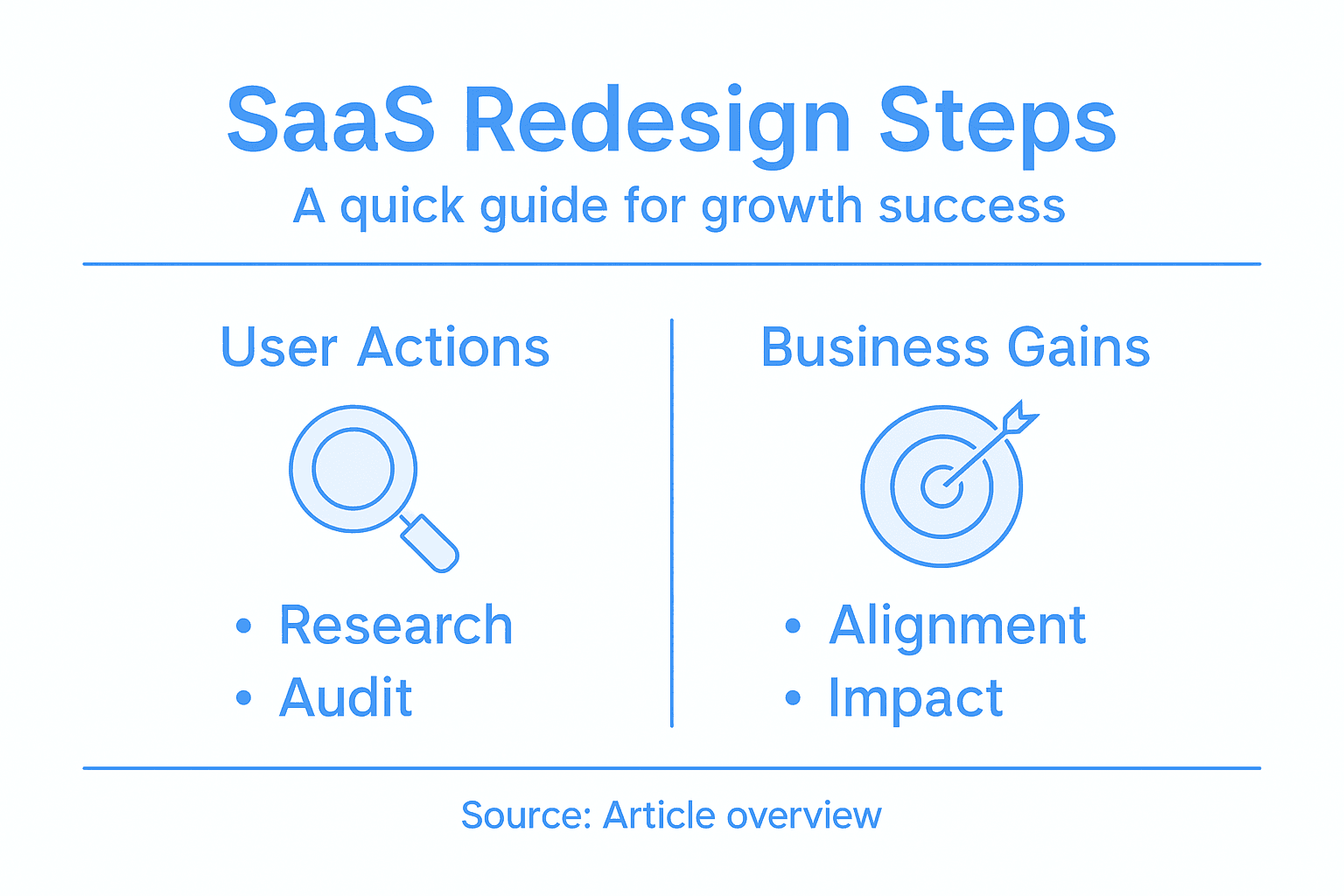
Continuously compare your new product performance against baseline metrics from before the redesign. Create detailed reports that highlight improvements or areas requiring further refinement. Be prepared to make incremental adjustments based on real world user data. Remember that product redesign is an ongoing process of learning and optimization, not a one time event.
Pro tip: Create a dedicated dashboard that tracks your most critical metrics in real time, allowing for rapid insights and quick decision making.
Here’s a quick reference for key performance metrics to track after launching your redesign:
| Metric | Why It Matters | Example Tool |
|---|---|---|
| User Engagement | Reveals usage trends | Mixpanel |
| Feature Adoption | Shows feature value | Amplitude |
| Customer Satisfaction | Indicates loyalty | NPS Surveys |
| Retention Rate | Measures churn risk | Google Analytics |
Here’s a summary of how each step in the redesign process drives both user and business value:
| Step | Main Activity | User Impact | Business Outcome |
|---|---|---|---|
| 1. Align Goals | Conduct strategic research | Solutions address real needs | Retention and market growth |
| 2. Audit Experience | Systematic UX audit | Smoother navigation | Better conversion rates |
| 3. Co-create Concepts | Cross-team workshops | More relevant features | Broader stakeholder buy-in |
| 4. Validate Designs | Usability testing | Fewer usability issues | Informed, risk-reduced changes |
| 5. Measure Impact | Performance monitoring | Constant improvements | Data-driven decisions |
Drive SaaS Growth with Strategic Product Redesign Leadership
Are you facing challenges in aligning your product redesign efforts with both user needs and measurable business outcomes? This article highlights common pain points like disconnected UX audits, lack of cross-functional collaboration, and the struggle to validate designs efficiently. At The Good Side Oy, we specialize in embedding senior designers who partner directly with your product and engineering teams to co-create impactful solutions that boost activation, adoption, and retention. We help you move beyond surface-level UI fixes toward outcome-driven design strategies that accelerate growth.
Our approach mirrors the step-by-step process described in the article by focusing on strategic alignment, thorough auditing, collaborative concept development, rigorous validation, and performance measurement. Discover how to avoid costly redesign missteps by integrating experienced fractional design leadership. Learn more about how we embed into your workflow at The Good Side.
Don’t let redesign initiatives stall or miss their mark. Partner with us to access flexible, senior SaaS design leadership that transforms your product experience and drives real business value. Start your journey toward faster, smarter product growth today by visiting The Good Side and explore our collaborative approach to cross-functional collaboration. Unlock your SaaS product’s potential with design that makes a measurable difference.
Frequently Asked Questions
What are the first steps for a successful product redesign in SaaS?
To kick off a successful product redesign, begin by aligning your strategic goals with user and business needs. Conduct thorough research that includes user interviews and stakeholder discussions to understand pain points—aim to gather insights within 2–4 weeks.
How can I conduct an effective audit of my product experience?
An effective audit involves analyzing user flows, interaction patterns, and screen layouts. Collect both quantitative data from analytics and qualitative feedback through usability testing to pinpoint areas needing improvement; aim to complete this audit in 3–6 weeks.
How do I involve my team in the redesign process?
To involve your team, organize cross-functional workshops that bring together product managers, designers, and engineers for collaborative design sessions. Use structured activities like design sprints to generate concepts and document insights, which can be achieved in about 1–2 weeks.
What methods should I use to validate new design concepts?
Utilize comprehensive usability testing to validate new designs by recruiting diverse participants who represent your user demographics. Design testing scenarios and track key metrics like task completion rates—conduct this validation within 3–4 weeks.
How can I measure the impact of my redesigned product?
Measure the impact by tracking key performance indicators such as user engagement rates and retention metrics after the launch. Implement ongoing monitoring to evaluate these metrics over the first 3–6 months post-launch to identify areas for continuous improvement.
What common mistakes should I avoid during a product redesign?
Avoid frequent pitfalls like neglecting to gather user feedback early on or becoming overly attached to initial design concepts. Regularly prioritize user experience issues based on their potential impact to ensure user satisfaction and business success.