
Role of Designers in Startups: Driving SaaS Growth
Every American SaaS founder has seen how design decisions can make or break a product, but research shows designers do more than create visuals. In fact, strategic design expertise is a top growth factor, with startups investing in design seeing revenue jump by over 30 percent. If your goal is accelerated user adoption and clear business impact, understanding the designer’s true role could be your biggest advantage.
Table of Contents
- Defining the Designer’s Role in Startups
- Types of Design Expertise for SaaS Companies
- Key Impact Areas: User Experience to Revenue
- Collaboration Models and Integration Approaches
- Common Pitfalls and How to Avoid Them
Key Takeaways
| Point | Details |
|---|---|
| Importance of Designers | Designers are essential strategic partners in startups, bridging user needs with business objectives to drive growth and innovation. |
| Specialized Design Roles | SaaS companies require various design specializations, including Product, Interaction, Service, Visual, and Technical Designers, each contributing uniquely to user experience and product development. |
| User-Centric Design | Prioritizing user research and feedback loops is critical to avoid common design pitfalls and ensure alignment between product features and user needs. |
| Effective Collaboration Models | Implementing structured collaboration frameworks for designers, whether part-time or fully integrated, enhances cross-functional innovation and streamlines product development. |
Defining the Designer’s Role in Startups
In the rapidly evolving world of SaaS startups, designers play a transformative role that extends far beyond aesthetic choices. They are strategic problem solvers who bridge user needs with business objectives. Global research reveals that designers are critical catalysts who drive creative problem-solving and business model innovation.
Designers in startups operate as multifaceted professionals who contribute across multiple organizational dimensions. Their responsibilities encompass product conceptualization, user experience strategy, visual branding, and interaction design. By integrating deep user research and iterative design methodologies, they transform abstract concepts into tangible, user-friendly digital solutions. Comprehensive academic studies demonstrate that designers are not merely executors but strategic partners who help define a startup’s competitive positioning and growth trajectory.
Successful startup designers possess a unique blend of skills: technical proficiency, creative thinking, and business acumen. They must rapidly prototype ideas, conduct user testing, iterate designs quickly, and communicate complex concepts effectively to cross-functional teams. Unlike traditional design roles, startup designers work in high-pressure environments where their contributions directly impact product-market fit, user adoption, and ultimately, the company’s survival. They translate user insights into actionable design strategies that reduce friction, enhance usability, and create memorable digital experiences.
Pro tip: When hiring designers for your startup, prioritize candidates who demonstrate adaptability, can articulate their design decisions, and show a clear understanding of how design connects to business outcomes.
Types of Design Expertise for SaaS Companies
Product Design represents the foundational expertise for SaaS companies, focusing on creating user-centered digital solutions. Comprehensive research analyzing design expertise reveals multiple specialized design domains critical for software development and user experience optimization.
SaaS companies typically require several distinct design specializations. Interaction Design focuses on creating intuitive user interfaces and seamless digital interactions, ensuring users can navigate complex software with minimal friction. Service Design takes a holistic approach, mapping entire user journeys and designing comprehensive experiences that extend beyond individual product screens. User Experience (UX) Design encompasses broader strategic considerations, analyzing user behaviors, conducting research, and developing personas that inform product development strategies.
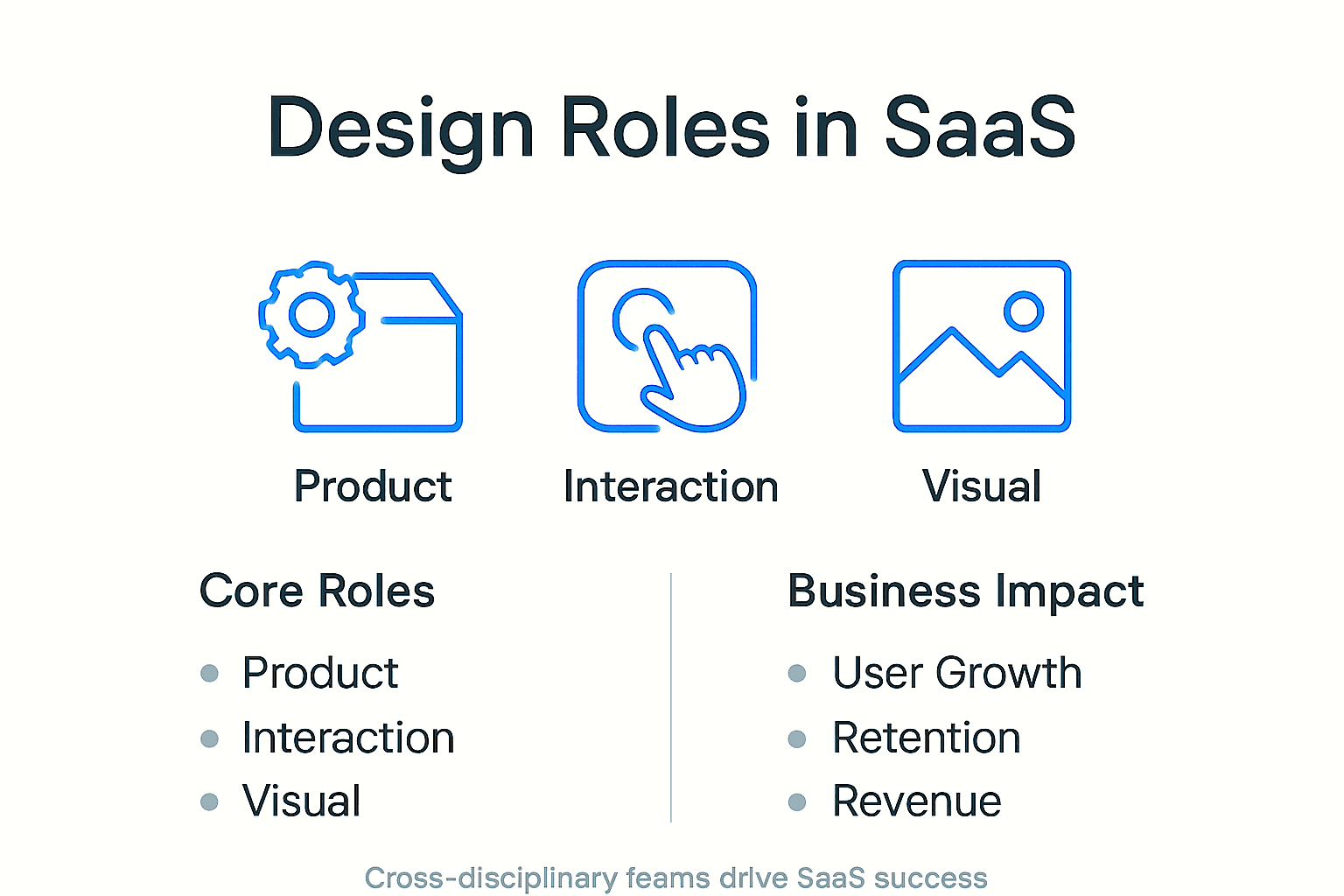
Beyond these core specializations, Visual Design plays a crucial role in creating compelling digital interfaces that communicate brand identity and facilitate user engagement. These designers create visual hierarchies, color schemes, typography, and graphical elements that transform functional interfaces into aesthetically pleasing experiences. Technical designers with software engineering backgrounds bring additional value, bridging communication between design and development teams and understanding the technical constraints and possibilities of digital product creation.
Pro tip: When building a design team for your SaaS startup, seek designers with cross-disciplinary skills who can adapt quickly and understand the interconnected nature of product development.
Here’s a summary of essential design roles and their business impact in SaaS startups:
| Design Role | Core Focus | Key Business Impact |
|---|---|---|
| Product Designer | User-centered digital solutions | Faster product-market fit |
| Interaction Designer | Intuitive workflows and UIs | Lower user friction and churn |
| Service Designer | End-to-end experience mapping | Improved retention, loyalty |
| Visual Designer | Brand-aligned visual interfaces | Stronger user engagement |
| Technical Designer | Design-dev collaboration | Smoother releases, fewer errors |
Key Impact Areas: User Experience to Revenue
Designers play a critical role in transforming user experience directly into measurable revenue growth for SaaS companies. Comprehensive research demonstrates that strategic UX investments can dramatically improve conversion rates and customer retention, creating a direct pathway from design optimization to financial performance.

The impact of user experience spans multiple critical revenue-generating areas. Onboarding Design represents the first crucial touchpoint where designers can significantly reduce user abandonment and accelerate product adoption. By creating intuitive interfaces, clear navigation paths, and engaging initial experiences, designers help convert potential customers into active users. Interaction Design further amplifies revenue potential by reducing friction points, simplifying complex workflows, and creating seamless user journeys that encourage prolonged platform engagement and reduce churn rates.
Beyond immediate conversion metrics, designers contribute to long-term revenue strategies through Customer Retention Design. This involves creating experiences that not only meet but anticipate user needs, build emotional connections, and demonstrate ongoing product value. Advanced design strategies include personalization techniques, predictive user interface adaptations, and continuous experience optimization that transform one-time users into loyal, recurring revenue streams. Technical design elements like performance optimization, responsive layouts, and accessibility features further reinforce user trust and commitment.
Pro tip: Implement ongoing user feedback loops and design iteration processes to continuously refine your product experience and directly correlate design improvements with revenue growth metrics.
Collaboration Models and Integration Approaches
Comprehensive research on startup collaboration models reveals multiple sophisticated approaches for integrating design talent into emerging technology companies. These models range from flexible part-time engagements to fully embedded design teams, each offering unique advantages for SaaS startups seeking to optimize their product development strategies.
Startups typically employ three primary collaboration frameworks. Part-Time Consulting allows companies to access specialized design expertise without full-time commitments, enabling targeted interventions during critical product development stages. Project-Based Engagement provides more intensive collaboration, where designers work closely with core teams to solve specific challenges or transform entire user experiences. Full Integration represents the most comprehensive model, where designers become core team members, participating in strategic discussions, product roadmaps, and cross-functional innovation efforts.
Successful integration requires more than contractual arrangements. Academic-industry collaboration frameworks emphasize the importance of clear communication protocols, shared goal alignment, and cultural compatibility. Effective collaboration models incorporate regular feedback mechanisms, transparent performance metrics, and structured workflows that enable designers to contribute meaningfully while maintaining agile development practices. Technical considerations like design system development, consistent communication tools, and collaborative platforms play crucial roles in bridging potential interdisciplinary gaps.
Pro tip: Create a structured onboarding process that clearly defines expectations, communication channels, and success metrics when integrating external design talent into your startup ecosystem.
Common Pitfalls and How to Avoid Them
Extensive research on SaaS design failures reveals that most startup design challenges stem from fundamental misunderstandings about user needs and product complexity. These pitfalls can dramatically undermine product adoption, user satisfaction, and ultimately, company growth.
The most critical design mistakes typically fall into three primary categories. Feature Overload represents the first major pitfall, where designers and product managers attempt to include every possible functionality, creating overwhelming and complex interfaces that confuse users. Inconsistent User Experience emerges as another significant challenge, where design elements, interaction patterns, and visual languages lack coherence across different product sections. Detailed startup design research) highlights that these inconsistencies create cognitive friction, making users work harder to understand and navigate the product.
The third critical pitfall involves Neglecting User Research. Many startups mistakenly rely on internal assumptions rather than conducting comprehensive user studies. This approach leads to misaligned product features, ineffective onboarding experiences, and design solutions that fail to address genuine user pain points. Successful SaaS companies invest deeply in continuous user research, creating feedback loops that inform iterative design improvements. Technical considerations like usability testing, user journey mapping, and persona development become crucial strategies for mitigating design risks and creating more intuitive, user-centered products.
Explore common SaaS design pitfalls and why they matter:
| Pitfall | Typical Outcome | How It Hurts SaaS Growth |
|---|---|---|
| Feature Overload | Overcomplicated user interface | Drives users away |
| Inconsistent Experience | Unpredictable interactions | Reduces trust, increases churn |
| Neglecting User Research | Misaligned feature development | Poor adoption, wasted resources |
Pro tip: Implement a quarterly design audit process that systematically evaluates your product’s user experience, comparing actual user behavior against initial design hypotheses and making data-driven refinements.
Unlock the Full Potential of Your Startup with Strategic Design Partnerships
The article highlights the crucial role designers play in startups, especially in SaaS companies, where user experience, clear positioning, and seamless user journeys directly impact conversion and revenue growth. If your startup struggles with feature overload, inconsistent user experience, or neglects user research – you are not alone. These challenges can stall product adoption and stunt growth. Designers who understand product-market fit and business alignment are essential to overcome these barriers and drive success.
The Good Side Oy specializes in exactly these challenges. Our senior designers bring deep SaaS expertise in UI/UX design, user research, and strategic positioning to turn disconnected interfaces into cohesive, user-friendly products that accelerate activation and retention. Whether you need part-time consulting, project-based input, or fully embedded design talent, we provide flexible engagement models tailored to your startup’s pace.
Ready to transform your product experience and drive measurable growth? Start with a free design audit to uncover untapped opportunities. Discover how our network of 100+ SaaS-focused designers can quickly integrate with your team. Visit The Good Side now and take the first step toward a streamlined, high-performance product that stands out in the market.
Explore how strategic design empowers SaaS startups at The Good Side and turn your design challenges into growth opportunities.
Frequently Asked Questions
What is the designer’s role in a startup?
Designers in startups act as strategic problem solvers who bridge user needs with business objectives. They contribute to product conceptualization, user experience strategy, visual branding, and interaction design to create user-friendly digital solutions.
How do designers impact revenue growth in SaaS companies?
Designers enhance user experience, optimize onboarding, and reduce friction in workflows, which leads to increased conversion rates and customer retention, ultimately driving revenue growth for SaaS companies.
What design specializations are essential for SaaS companies?
Essential design specializations for SaaS companies typically include Product Design, Interaction Design, User Experience (UX) Design, Service Design, and Visual Design. Each specialization focuses on different aspects of the user experience and product development process.
What are common design pitfalls for startups and how can they be avoided?
Common design pitfalls include feature overload, inconsistent user experiences, and neglecting user research. Startups can avoid these by conducting thorough user research, maintaining design consistency across the product, and focusing on essential features that enhance user experience.
Recommended
- Role of Designers in SaaS: Complete Expert Guide | The Good Side Blog
- Complete Guide to Business Design in SaaS | The Good Side Blog
- Role of Service Designers: Complete SaaS Guide
- Role of Senior Designers in SaaS Growth | The Good Side Blog
- YouTube Thumbnail Agency From New Generation - Professional CTR Optimized Thumbnails For Higher Views | ViewsMachine