
Design Sprint Explained: Fast-Track SaaS Product Success
Almost every American SaaS team faces the pressure to innovate faster with fewer resources. When months of traditional product development drag on, critical opportunities slip away and user needs shift. Design sprints offer a solution by condensing innovation into a single focused week. Discover how this method helps CTOs and product managers minimize risk, gather actionable feedback, and transform user experience—delivering results that even seasoned American tech leaders find impressive.
Table of Contents
- Design Sprint Fundamentals For SaaS Teams
- Core Phases And Step-By-Step Process
- Key Roles And Stakeholder Involvement
- Use Cases And Measurable Outcomes
- Common Pitfalls And How To Avoid Them
Key Takeaways
| Point | Details |
|---|---|
| Design Sprint Benefits | Design sprints accelerate problem-solving by compressing traditional development timelines into a focused process. |
| Core Phases | The six phases (Understand, Diverge, Converge, Prototype, Test, Decide) guide teams through structured innovation. |
| Team Composition | A diverse team of stakeholders and a skilled facilitator are essential for maximizing effectiveness and creativity. |
| Potential Pitfalls | Common pitfalls include participant disengagement and unclear objectives; proactive strategies are needed to prevent these. |
Design Sprint Fundamentals for SaaS Teams
A design sprint represents a powerful methodology for SaaS product teams to rapidly solve complex challenges and validate product concepts. Originally developed at Google Ventures, this structured five-day process compresses months of work into an intensive problem-solving framework. Unlike traditional product development approaches, design sprints enable teams to quickly prototype, test, and iterate ideas with real user feedback.
The core objective of a design sprint is to minimize risk and accelerate innovation by bringing together cross-functional team members who can collectively tackle significant product challenges. During this concentrated workshop, participants move through structured phases including problem definition, ideation, rapid prototyping, and user testing. By condensing complex product development steps into a focused weekly process, SaaS teams can make critical decisions faster and validate product hypotheses without extensive time and resource investment.
Successful design sprints typically require a diverse team comprising product managers, designers, engineers, and key stakeholders. The process demands a skilled facilitator who can guide participants through each stage, ensuring productive collaboration and maintaining forward momentum. Key components include defining a clear challenge, generating multiple solution approaches, creating a high-fidelity prototype, and conducting user validation tests that provide immediate, actionable insights.

Pro tip: Select participants who represent different perspectives and can contribute unique insights to maximize the design sprint’s effectiveness and potential for breakthrough solutions.
Core Phases and Step-by-Step Process
Design sprints are structured around a systematic approach that transforms complex challenges into actionable solutions. The methodology follows a precise six-phase progression designed to maximize team productivity and innovation. These phases are carefully crafted to guide teams from initial problem understanding through to validated prototype, ensuring a comprehensive and strategic approach to product development.
The six core phases of a design sprint include Understand, Diverge, Converge, Prototype, Test, and Decide. During the Understand phase, teams deeply analyze the core problem, mapping out user journeys and identifying critical challenges. In the Diverge stage, participants generate diverse and creative solutions through techniques like individual brainstorming, sketching, and collaborative ideation. The Converge phase involves critically evaluating these ideas, using structured voting and selection methods to identify the most promising concepts.
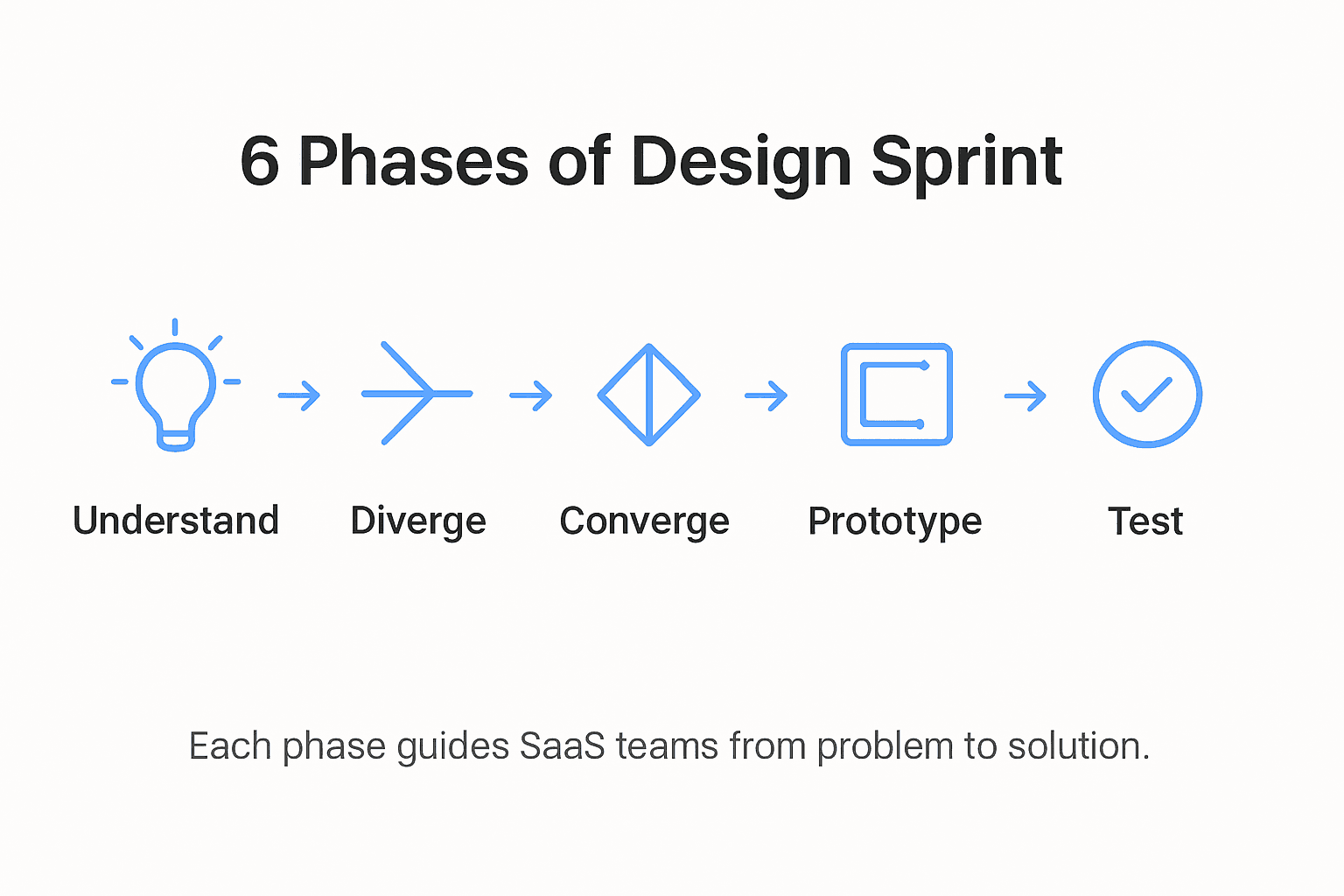
The final three phases focus on tangible product validation. During the Prototype stage, teams rapidly create a high-fidelity representation of the selected solution, typically a clickable digital prototype that looks and feels like a real product. In the Test phase, actual users interact with the prototype, providing unfiltered feedback that reveals potential strengths and weaknesses. The final Decide phase synthesizes all gathered insights, helping teams determine whether to proceed, pivot, or revisit earlier stages of the design process.
Pro tip: Assign specific roles to team members before starting the design sprint to ensure smooth collaboration and maximize each participant’s unique strengths and expertise.
Here’s a quick overview of the six design sprint phases and their primary objectives:
| Phase | Core Activity | Primary Objective |
|---|---|---|
| Understand | Analyze user needs and problems | Define key challenges clearly |
| Diverge | Generate various solution ideas | Encourage creative exploration |
| Converge | Evaluate and select top ideas | Focus on best concepts |
| Prototype | Build interactive prototype | Visualize and simulate solution |
| Test | Gather user feedback | Uncover strengths and flaws |
| Decide | Synthesize insights, define next steps | Inform product direction |
Key Roles and Stakeholder Involvement
Successful design sprints rely on strategic involvement of key stakeholders and team members with complementary skills. Design sprint teams typically comprise a diverse group of professionals who bring unique perspectives and expertise to the innovation process. These core roles include the Project Sponsor, Project Leader, and multidisciplinary team members who collectively drive the sprint’s strategic and creative outcomes.
The Project Sponsor serves as the strategic decision maker, providing high-level guidance and organizational alignment. The Project Leader acts as the facilitator, responsible for coordinating team activities, maintaining momentum, and ensuring the sprint stays focused on its core objectives. Multidisciplinary team members typically include designers, engineers, product managers, and marketing specialists who contribute technical insights, creative solutions, and user-centric perspectives. Each team member plays a critical role in generating, evaluating, and refining potential solutions throughout the design sprint process.
Stakeholder involvement is most effective when strategically integrated throughout the sprint, with dedicated review periods that allow for comprehensive feedback without disrupting the team’s workflow. Expert stakeholders provide valuable external perspectives, helping teams validate assumptions, identify potential challenges, and ensure that proposed solutions align with broader business objectives and user needs. By creating structured opportunities for stakeholder input, teams can leverage diverse expertise and increase the likelihood of developing truly innovative and feasible product solutions.
Pro tip: Create a stakeholder engagement plan before the design sprint, clearly defining when and how different stakeholders will contribute to maximize their impact and minimize potential disruptions.
Use Cases and Measurable Outcomes
Design sprints have proven transformative across multiple industries, demonstrating remarkable versatility in solving complex challenges. Academic and engineering research confirms their effectiveness in enhancing problem-solving efficiency and driving innovation beyond traditional product development contexts. These structured workshops enable teams to rapidly prototype, validate, and iterate solutions across diverse scenarios ranging from software development to educational program design.
In the SaaS domain, design sprints yield tangible outcomes that directly impact product strategy and organizational performance. Typical measurable results include accelerated time-to-market, reduced development risks, and enhanced user experience alignment. Teams often report substantial improvements such as 40-60% reduction in unnecessary feature development, more precise user persona understanding, and increased stakeholder consensus around product direction. The compressed timeline allows companies to validate critical hypotheses within a week, dramatically reducing the potential financial and resource investments associated with traditional development approaches.
The versatility of design sprints extends across multiple use cases, including new product conceptualization, feature optimization, user experience redesign, and strategic problem-solving. Technology companies leverage these workshops to reimagine user interfaces, healthcare organizations develop patient-centric solutions, and educational institutions design innovative learning experiences. By providing a structured yet flexible framework, design sprints enable teams to break through traditional innovation barriers, generate creative solutions, and make data-driven decisions with unprecedented speed and precision.
Pro tip: Document and quantify your design sprint outcomes systematically, tracking both qualitative insights and quantitative metrics to build a compelling case for future innovation investments.
Common Pitfalls and How to Avoid Them
Design sprint challenges can derail even the most well-intentioned innovation efforts if teams fail to recognize and proactively address potential obstacles. The most critical pitfalls emerge from participant skepticism, time management difficulties, and a lack of structured engagement that can quickly undermine the sprint’s effectiveness. Understanding these potential roadblocks is the first step in creating a robust, successful design sprint experience.
One of the most significant challenges teams encounter is participant disengagement and process doubt. Team members may enter the sprint with preconceived notions or resistance to the methodology, potentially creating internal friction that reduces creative output. To combat this, facilitators must establish clear expectations, demonstrate the sprint’s value through concrete examples, and create an environment that encourages open-minded participation and collaborative problem-solving. This involves setting explicit ground rules, managing time ruthlessly, and maintaining high energy levels throughout the workshop.
Technical and logistical pitfalls can also compromise design sprint success. Common issues include insufficient pre-sprint preparation, unclear problem definitions, inadequate stakeholder alignment, and unrealistic expectations about potential outcomes. Successful teams mitigate these risks by conducting thorough preliminary research, clearly defining sprint objectives, selecting the right participants, and establishing measurable success criteria before the sprint begins. Protecting the sprint from external interruptions, maintaining focused communication, and ensuring all participants understand their roles are critical strategies for navigating potential obstacles.
Compare these potential design sprint pitfalls and recommended preventive strategies:
| Pitfall | Impact on Sprint | Prevention Strategy |
|---|---|---|
| Participant disengagement | Stifles collaboration | Set clear expectations early |
| Poor time management | Reduced productivity | Use strict schedules, timeboxes |
| Unclear problem definition | Misaligned solutions | Invest in thorough pre-sprint prep |
| External interruptions | Loss of focus and momentum | Block calendars, set boundaries |
| Lack of stakeholder alignment | Conflicting priorities | Engage stakeholders at checkpoints |
Pro tip: Conduct a brief pre-sprint diagnostic meeting to align expectations, identify potential resistance points, and create a shared commitment to the design sprint process.
Accelerate Your SaaS Design Sprints with Expert Support from The Good Side
Design sprints unlock rapid innovation by bringing teams together to understand challenges, prototype solutions, and test with users all within days. But many SaaS teams struggle with fragmented user journeys, unclear product positioning, and unprofessional interfaces that slow down this crucial process. If you want to avoid common pitfalls like disengaged participants and unclear problem definitions The Good Side is your strategic design partner to turn these barriers into breakthrough opportunities. We specialize in delivering seamless UI/UX design, user research, and end-to-end journey optimization that aligns product vision with user needs.
Ready to fast-track your design sprint outcomes and accelerate your product success Start with a free design audit and connect with our senior SaaS-specialized designers who embed seamlessly within your team. Whether you need part-time consulting or a fully embedded expert The Good Side helps you avoid costly delays and rapidly build high-performing products. Discover how our tailored approach transforms fragmented experiences into unified journeys that boost conversions and revenue Start your journey today and explore how our proven processes create measurable impact with every sprint.
Frequently Asked Questions
What is a design sprint?
A design sprint is a structured five-day process that enables SaaS product teams to rapidly solve complex challenges and validate product concepts by prototyping, testing, and iterating ideas with real user feedback.
How many phases are there in a design sprint?
There are six core phases in a design sprint: Understand, Diverge, Converge, Prototype, Test, and Decide, each designed to guide teams from problem understanding to validated solutions.
What roles are involved in a design sprint?
Key roles in a design sprint include the Project Sponsor, who provides strategic guidance; the Project Leader, who facilitates the process; and a multidisciplinary team of designers, engineers, and product managers who contribute their expertise.
How can I avoid common pitfalls during a design sprint?
To avoid common pitfalls like participant disengagement and unclear problem definitions, establish clear expectations early, conduct thorough pre-sprint preparation, and maintain strict time management throughout the sprint.