
Customer Journey Mapping: Driving SaaS Growth Outcomes
Every SaaS team knows that tracking users from first click to long-term loyalty is never a simple path. As competition intensifies and user expectations evolve, understanding the full story behind every interaction has become more critical than ever. Mastering customer journey mapping gives product managers and growth leads the power to reveal hidden friction points, create targeted onboarding strategies, and drive real gains in user activation and retention.
Table of Contents
- Defining Customer Journey Mapping for SaaS
- Key Stages and Mapping Methodologies
- Benefits and Real-World Applications in SaaS
- Risks, Pitfalls, and Common Misconceptions
- How SaaS Teams Embed Journey Mapping for Growth
Key Takeaways
| Point | Details |
|---|---|
| Customer Journey Mapping | It is essential for SaaS companies to visualize user experiences across various interactions to identify areas for improvement. |
| Data-driven Approach | Utilizing real-time analytics enhances the accuracy and relevance of journey maps, enabling more effective user engagement strategies. |
| Cross-functional Integration | High-performing SaaS teams should embed journey mapping into organization-wide workflows for continuous enhancement of user experiences. |
| Regular Updates | Consistently refreshing journey maps with user feedback is crucial to maintain their effectiveness and adapt to evolving user needs. |
Defining Customer Journey Mapping for SaaS
Customer journey mapping represents a strategic visualization process that tracks a customer’s comprehensive experience across multiple interactions with a SaaS product. At its core, customer experience progression involves understanding how users move through different stages of engagement, from initial awareness to long-term product adoption.
The purpose of customer journey mapping goes beyond simple tracking. It provides product managers and growth leads with a detailed framework for understanding user behavior, identifying potential friction points, and creating more intuitive product experiences. By systematically documenting each touchpoint and interaction, SaaS companies can develop more targeted strategies for improving user activation, retention, and overall satisfaction.
Effective customer journey maps typically include several critical components. These encompass user personas, emotional states, key interactions, pain points, and success metrics. The map creates a chronological narrative that reveals how customers perceive and interact with a product, highlighting opportunities for optimization. By breaking down the journey into distinct stages - such as awareness, consideration, onboarding, active usage, and potential expansion - teams can develop more nuanced approaches to user engagement.
Pro tip: Start your customer journey mapping by interviewing actual users and collecting granular data about their experiences, rather than relying solely on internal assumptions.
Key Stages and Mapping Methodologies
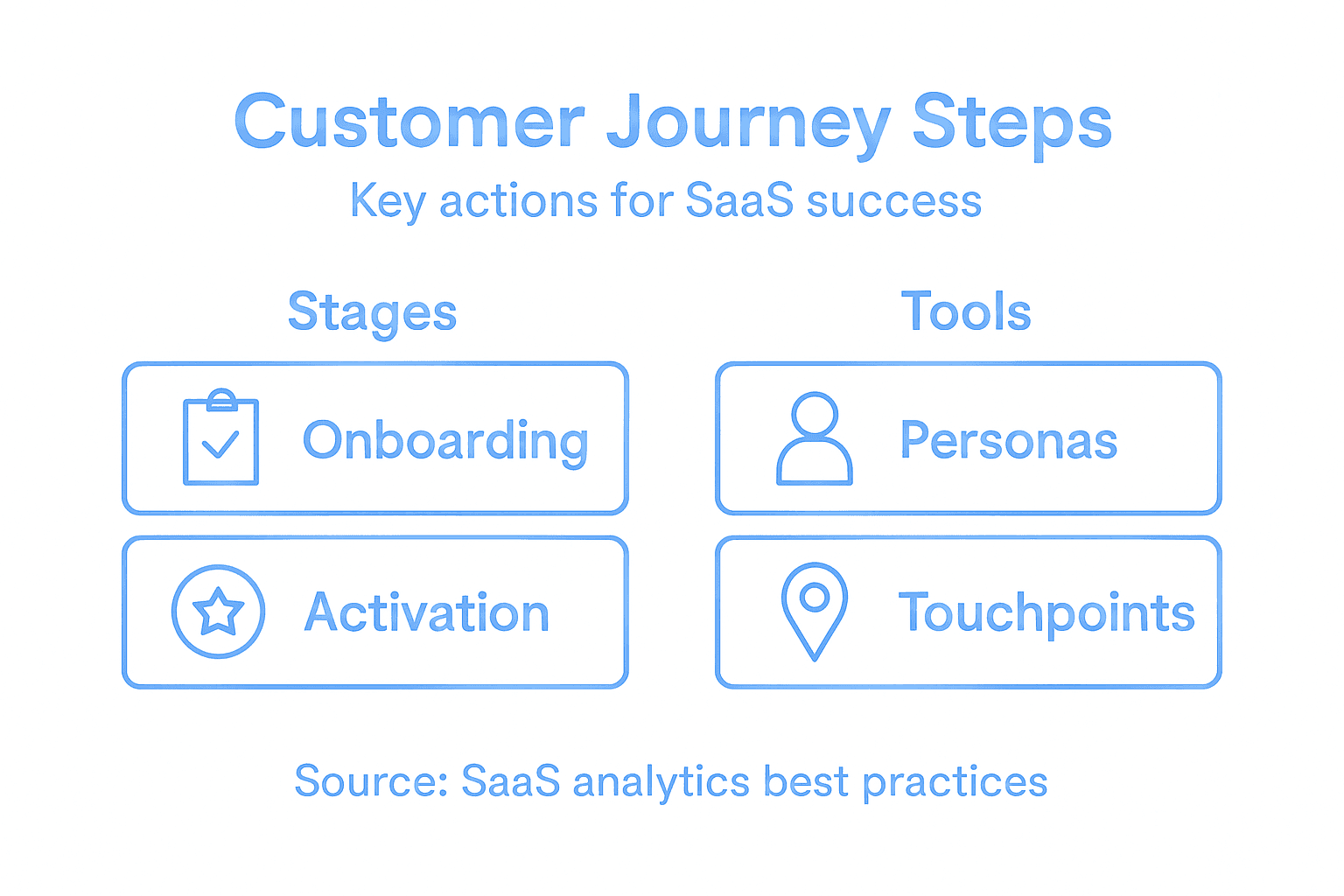
Customer journey mapping encompasses a strategic approach with distinct stages that help SaaS companies understand and optimize user experiences. These stages typically include awareness, consideration, acquisition, onboarding, activation, retention, and expansion. Each stage represents a critical touchpoint where users interact with the product and form perceptions about its value and usability.
One sophisticated methodology for developing comprehensive journey maps is customer journey map discovery, which leverages process mining techniques to analyze actual user interactions. This approach goes beyond traditional mapping by using event logs and behavioral data to construct empirically grounded journey representations. By systematically examining real user pathways, companies can identify precise moments of friction, opportunity, and potential user drop-off.
The mapping process typically involves several key methodological steps. First, teams must develop detailed user personas representing different customer segments. Next, they document each interaction point across the customer lifecycle, capturing both functional interactions and emotional responses. Visualization techniques like flowcharts, swimlane diagrams, and narrative-based maps help teams understand complex user journeys. Advanced methodologies also incorporate quantitative metrics such as time spent, conversion rates, and user satisfaction scores to provide deeper insights into user behavior.
Pro tip: Create multiple journey maps for different user personas to capture the nuanced experiences of various customer segments.
Here’s a summary of the main stages in a typical SaaS customer journey and their strategic focus:
| Journey Stage | User Goal | Touchpoint Focus | Optimization Priority |
|---|---|---|---|
| Awareness | Discover solution | Website, ads, search | Clear messaging, brand |
| Consideration | Evaluate product fit | Reviews, demos, sales | Targeted info, conversions |
| Onboarding | Get started successfully | Sign-up, tutorials | Smooth process, guidance |
| Activation | Experience value quickly | Core features, emails | Feature adoption |
| Retention | Stay engaged long-term | Support, updates | Continuous value delivery |
| Expansion | Increase usage or spend | Upsell, cross-sell | Personalized offers |
Benefits and Real-World Applications in SaaS
Customer journey mapping delivers substantial strategic benefits for SaaS organizations, transforming how companies understand and engage with their user base. Real-time data analytics integration enables businesses to dynamically adapt their approaches, creating more responsive and personalized user experiences that directly impact retention and growth.

In practical application, customer journey mapping helps SaaS companies address critical business challenges. Comprehensive mapping techniques have demonstrated remarkable outcomes, including reduced churn rates, improved customer engagement, and more precise targeting of user needs. By systematically analyzing each interaction point, organizations can identify potential friction areas, redesign problematic user flows, and create more intuitive product experiences that align closely with user expectations and behaviors.
Specific real-world benefits include enhanced customer education, more targeted marketing strategies, and improved product development cycles. Companies employing sophisticated journey mapping techniques can create more nuanced user personas, develop more effective onboarding processes, and build predictive models that anticipate user needs before they arise. These insights enable SaaS businesses to move beyond reactive customer service toward proactive user experience design that continuously evolves with changing user expectations.
Pro tip: Regularly update your customer journey maps with fresh user feedback and behavioral data to maintain their relevance and effectiveness.
Risks, Pitfalls, and Common Misconceptions
Customer journey mapping is fraught with potential challenges that can undermine its effectiveness. Common misconceptions about customer interactions frequently emerge from oversimplified assumptions about user behavior, leading SaaS teams to create journey maps that fail to capture the true complexity of user experiences.
One significant risk involves relying on static, retrospective data that does not reflect the dynamic nature of user interactions. Traditional mapping approaches often assume a linear progression through customer touchpoints, which rarely matches the nonlinear and unpredictable ways users actually engage with SaaS products. This can result in journey maps that are more theoretical constructs than accurate representations of real-world user behaviors.
Additionally, many organizations fall into the trap of creating generalized journey maps that lack specificity and nuance. Traditional visualization risks include overlooking regional variations, temporal differences in user intent, and the unique characteristics of different customer segments. These oversights can lead to misguided product strategies, ineffective onboarding processes, and missed opportunities for improving user experiences. Successful journey mapping requires a more sophisticated, data-driven approach that continuously adapts to changing user behaviors and expectations.
This table compares traditional vs. data-driven customer journey mapping approaches in SaaS:
| Approach | Data Sources | Map Accuracy | Adaptability |
|---|---|---|---|
| Traditional Mapping | Internal assumptions | Theoretical, less precise | Static, slow updates |
| Data-Driven Mapping | User behavior analytics | Empirically validated, nuanced | Dynamic, real-time |
Pro tip: Validate your customer journey maps through ongoing user research, direct customer interviews, and continuous behavioral data analysis to maintain their accuracy and relevance.
How SaaS Teams Embed Journey Mapping for Growth
Successful SaaS teams integrate customer journey mapping as a strategic growth mechanism, transforming it from a theoretical exercise into an actionable framework for continuous improvement. SaaS customer journey analytics enable organizations to combine customer education, performance monitoring, and proactive engagement strategies that directly impact retention and revenue.
Embedding journey mapping requires a multifaceted approach that goes beyond simple visualization. High-performing SaaS teams create cross-functional workflows that integrate journey mapping insights across product development, customer success, marketing, and sales departments. This holistic strategy involves developing comprehensive dashboards that track user behaviors, identifying critical inflection points where users might disengage, and designing targeted interventions that guide customers toward successful product adoption and expansion.
Technological advancements have significantly enhanced journey mapping capabilities. Modern SaaS teams leverage AI-driven tools and real-time data analytics to create dynamic, responsive journey maps that adapt to changing user behaviors. These sophisticated approaches allow for granular segmentation, predictive modeling of user intent, and personalized engagement strategies that can dramatically improve conversion rates, reduce churn, and unlock sustainable growth opportunities.
Pro tip: Develop a centralized journey mapping repository that serves as a single source of truth, accessible to all teams and continuously updated with fresh behavioral insights.
Transform Your SaaS Growth with Expert Customer Journey Mapping
Customer journey mapping is essential for identifying friction points and improving user activation and retention. If your team struggles with creating dynamic, data-driven journey maps that truly capture diverse user behaviors it is time to partner with experienced design leadership who embed strategic ownership into your product development. The Good Side Oy specializes in accelerating SaaS growth by aligning product design, onboarding, and go-to-market experiences to deliver measurable business outcomes.
Avoid stagnant or overly theoretical journey maps by integrating senior designers who understand the nuances of SaaS customer personas and real-time behavioral data. Our embedded designers work directly with your product and engineering teams to co-create intuitive user flows that reduce churn and increase expansion opportunities.
Elevate your SaaS customer journey mapping from theoretical to actionable with The Good Side. Visit The Good Side now to discover how our fractional design partners accelerate your product growth and help you make better product decisions faster. Explore our approach to designing onboarding and activation experiences that turn users into loyal customers at Good Side. Start transforming your customer journey today with proven strategic design leadership tailored for SaaS success.
Frequently Asked Questions
What is customer journey mapping in SaaS?
Customer journey mapping in SaaS is a strategic visualization process that tracks a customer’s comprehensive experience across various interactions with a SaaS product, from initial awareness to long-term product adoption.
What are the key stages of the customer journey in SaaS?
The key stages of the customer journey in SaaS typically include awareness, consideration, acquisition, onboarding, activation, retention, and expansion, each representing critical touchpoints where users interact with the product.
How can customer journey mapping improve user retention for SaaS businesses?
Customer journey mapping can enhance user retention by identifying friction points in user experiences, allowing organizations to optimize onboarding processes, improve customer education, and create proactive engagement strategies that keep users engaged and satisfied.
What methodologies are commonly used in customer journey mapping?
Common methodologies for customer journey mapping include customer journey map discovery, which utilizes process mining techniques and real-time data analytics to analyze actual user interactions, making the maps more accurate and responsive to user behavior.