
Lean UX in SaaS: Driving Faster Product Success
Most American SaaS companies face a common challenge—outdated design processes that slow innovation and leave users wanting more. As competition tightens, finding smarter ways to deliver products that genuinely resonate with users has never been more urgent. Lean UX promises a game-changing shift, blending continuous user feedback with rapid development, so teams move faster and create digital experiences people love. Discover why over 80 percent of high-growth SaaS organizations now view Lean UX as essential for long-term success.
Table of Contents
- Defining Lean UX for SaaS Products
- Principles and Mindset of Lean UX
- Lean UX Process and Key Activities
- Collaboration and Feedback in Lean UX
- Common Pitfalls and How to Avoid Them
Key Takeaways
| Point | Details |
|---|---|
| Collaborative Teamwork | Lean UX emphasizes breaking down silos between design, engineering, and product management to enhance problem-solving and innovation. |
| Hypothesis-Driven Design | Design decisions are treated as testable assumptions, allowing for rapid iteration based on user feedback. |
| Rapid Prototyping | Creating minimum viable products enables quick validation of concepts and responsiveness to user needs. |
| Continuous User Research | Regular interactions with users provide real-world insights that guide product development and refinement. |
Defining Lean UX for SaaS Products
Lean UX represents a transformative approach to product design that reimagines how software teams create user-centered experiences. At its core, Lean UX combines design thinking, Agile methodologies, and rapid iteration to streamline product development. Lean UX integrates design across product management and development teams, focusing on collaborative problem-solving and continuous user validation.
The fundamental philosophy of Lean UX centers on efficiency and user-driven outcomes. Unlike traditional design processes that rely on extensive documentation and linear workflows, this methodology emphasizes quick prototyping, immediate user feedback, and cross-functional collaboration. Designers combine design thinking with Agile development methods to create solutions that rapidly respond to user needs and market demands.
Key principles of Lean UX for SaaS products include:
- Collaborative Teamwork: Breaking down silos between design, engineering, and product management
- Hypothesis-Driven Design: Treating design decisions as testable assumptions
- Rapid Prototyping: Creating minimum viable product (MVP) versions to validate concepts
- Continuous User Research: Gathering real-world feedback through frequent user interactions
- Iterative Refinement: Constantly improving product experiences based on user insights
Successful Lean UX implementation requires a cultural shift toward experimentation, transparency, and user-centricity. SaaS teams must embrace a mindset of continuous learning, where each design iteration brings them closer to solving genuine user problems with elegant, intuitive solutions.
Principles and Mindset of Lean UX
The principles of Lean UX represent a fundamental reimagining of product development, moving beyond traditional design methodologies toward a more dynamic, user-centered approach. Working in small batches helps teams mitigate risk and validate design hypotheses quickly, enabling more responsive and adaptive product strategies.
At the heart of Lean UX lies a transformative mindset that prioritizes actionable outcomes over comprehensive documentation. Teams embracing this approach focus on continuous discovery, conducting frequent user research in real-world contexts, and externalizing work to foster deeper cross-functional collaboration. The goal shifts from producing perfect design artifacts to creating meaningful user experiences through iterative experimentation and rapid learning.
Key principles that define the Lean UX approach include:
- Outcome-Oriented Thinking: Focusing on solving user problems rather than generating design deliverables
- Continuous Discovery: Engaging users frequently to validate assumptions and gather authentic insights
- Collaborative Experimentation: Breaking down organizational silos and promoting transparent teamwork
- Rapid Prototyping: Creating quick, testable versions of product concepts
- Evidence-Based Decision Making: Using real user feedback to guide design and development choices
Successful implementation of Lean UX requires more than adopting new techniques—it demands a cultural transformation. SaaS teams must cultivate an environment of psychological safety where experimentation is encouraged, failure is viewed as a learning opportunity, and user-centricity becomes the fundamental driver of product innovation.
Lean UX Process and Key Activities
The Lean UX process transforms traditional product development into a dynamic, iterative journey centered on continuous learning and user validation. Effective design workflows enable SaaS teams to streamline their product development approach, creating more responsive and user-centered solutions.

A typical Lean UX process involves a series of collaborative, interconnected activities that prioritize rapid experimentation and evidence-based decision making. Teams begin by forming clear hypotheses about user needs, then quickly move to creating minimum viable prototypes that can be tested and refined. This approach replaces lengthy design documentation with tangible, testable product experiences that provide immediate user insights.
Key activities in the Lean UX process include:
- Problem Definition: Clearly articulating user challenges and product objectives
- Hypothesis Formulation: Developing testable assumptions about user needs and product solutions
- Rapid Prototyping: Creating low-fidelity mockups and interactive models
- User Research: Conducting focused, quick feedback sessions with target users
- Collaborative Analysis: Reviewing research findings as a cross-functional team
- Iterative Refinement: Continuously improving product design based on user feedback
Successful implementation requires breaking down traditional organizational barriers. SaaS teams must cultivate a shared understanding that design is not a linear process but a continuous cycle of learning, creating, testing, and improving. This approach demands not just new techniques, but a fundamental shift in how teams conceptualize product development and user experience.
Collaboration and Feedback in Lean UX
Collaboration stands as the fundamental cornerstone of successful Lean UX methodologies, transforming traditional siloed product development into a dynamic, integrated process. Cross-functional collaboration brings together designers, developers, and product managers to solve problems innovatively, creating a unified approach to user-centered design.
Feedback loops are the lifeblood of Lean UX, enabling teams to rapidly validate assumptions and iterate on product concepts. Instead of relying on lengthy design cycles and theoretical predictions, SaaS teams engage in continuous, real-world user interactions that provide immediate insights. This approach replaces guesswork with empirical evidence, allowing product teams to make data-driven decisions that directly address user needs and pain points.
Key collaboration and feedback strategies include:
- Shared Responsibility: Breaking down traditional organizational silos
- Rapid Prototyping Sessions: Collaborative design workshops with cross-functional participation
- User Testing Frameworks: Structured approaches for gathering authentic user insights
- Transparent Communication: Regular, open dialogue across design, engineering, and product teams
- Continuous Learning: Treating each feedback cycle as an opportunity for team growth
- Psychological Safety: Creating an environment where team members can share ideas without fear of criticism
Successful implementation requires more than technical skills. SaaS teams must cultivate a culture of radical transparency, where feedback is viewed as a gift, and collaborative problem-solving becomes the default approach to product development. The most effective teams view collaboration not as a process, but as a dynamic, living strategy for creating exceptional user experiences.
Common Pitfalls and How to Avoid Them
Lean UX adoption often stumbles due to fundamental misunderstandings about its core principles and implementation. Many teams fail by neglecting continuous discovery and working in oversized batches, which prevents rapid iteration and meaningful user insights.
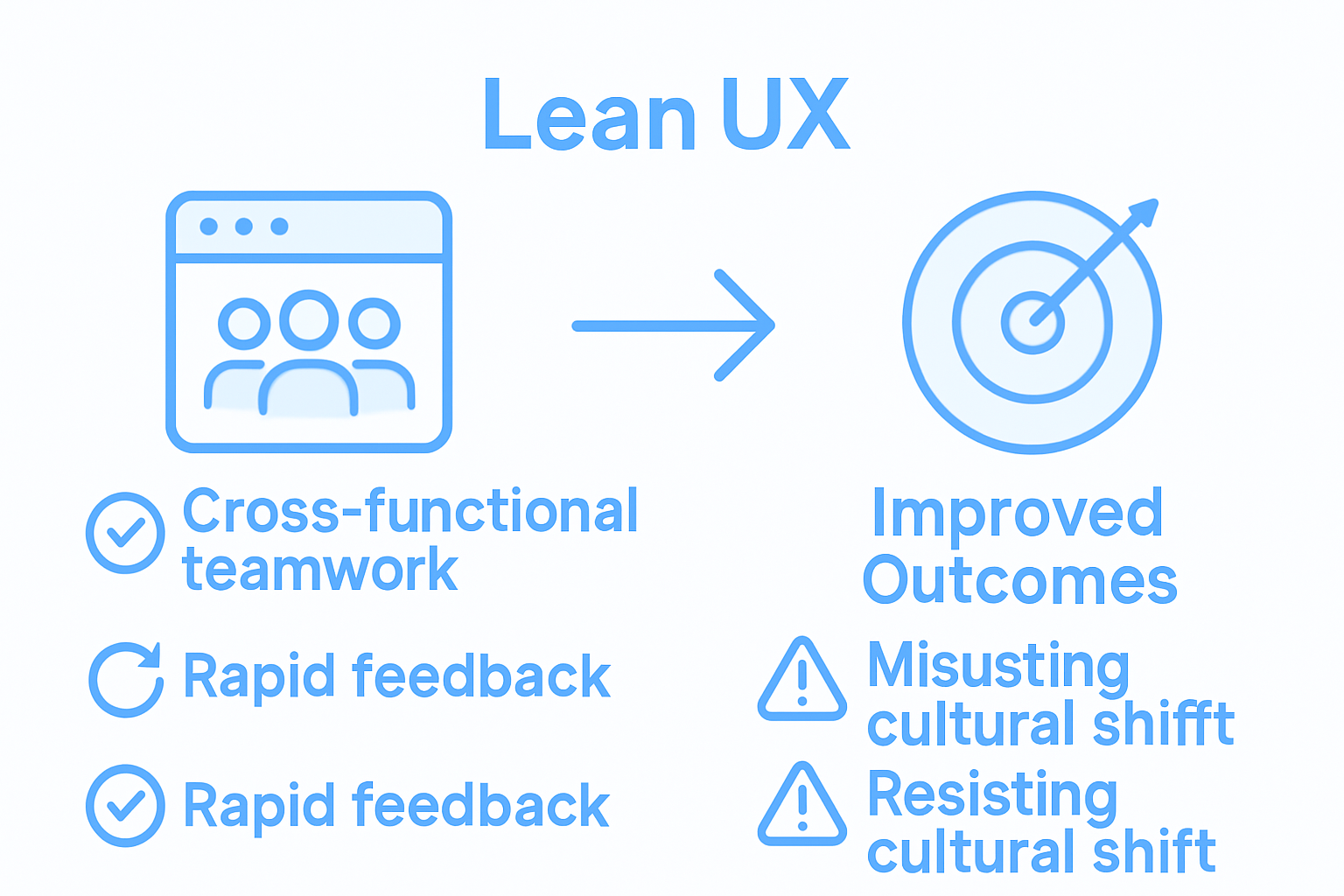
The most critical mistakes typically emerge from deeply ingrained traditional product development habits. SaaS teams frequently fall into traps like over-documenting processes, avoiding genuine user interactions, and prioritizing perfect design artifacts over functional prototypes. These approaches directly contradict Lean UX’s fundamental philosophy of rapid experimentation, continuous learning, and user-centered design.
Common pitfalls in Lean UX implementation include:
- Analysis Paralysis: Getting stuck in endless planning and research without creating tangible solutions
- Siloed Working: Maintaining strict boundaries between design, engineering, and product teams
- Infrequent User Testing: Conducting user research too rarely or too superficially
- Perfectionism: Attempting to create fully polished designs before user validation
- Ignoring Negative Feedback: Treating user critiques as obstacles rather than opportunities
- Inconsistent Iteration: Failing to establish a regular feedback and refinement cycle
Successful Lean UX requires a profound cultural shift. Teams must embrace uncertainty, view failures as learning opportunities, and develop a disciplined yet flexible approach to product development. The most effective organizations transform Lean UX from a methodology into a mindset—one that prioritizes user value, collaborative problem-solving, and continuous improvement over rigid processes and theoretical perfection.
Accelerate Your SaaS Product Success with Lean UX Expertise
The challenges outlined in the article highlight the need for cross-functional collaboration, rapid prototyping, and continuous user feedback to overcome pitfalls like siloed working and infrequent user testing. If you are struggling to embed Lean UX principles effectively, drive faster iterations, and create compelling user experiences that convert, you are not alone. The journey to cohesive, user-centered SaaS products demands a strategic partner who understands these exact pain points.
Partner with The Good Side, a dedicated strategic design partner specialized in SaaS products. Our senior designers bring deep expertise in UI/UX design, user research, and end-to-end user journey optimization designed to unlock activation and revenue growth. Whether you need part-time consulting or fully embedded design talent, we accelerate your Lean UX adoption through a streamlined process that begins with a free design audit and quick integration.
Take the next step toward transforming your SaaS product with proven Lean UX strategies and hands-on collaboration. Explore how our team creates measurable outcomes while avoiding common Lean UX pitfalls by visiting The Good Side. Your faster, smarter product journey starts now.
Frequently Asked Questions
What is Lean UX?
Lean UX is a user-centered approach to product design that combines design thinking, Agile methodologies, and rapid iteration, focusing on collaboration, user validation, and efficiency in SaaS product development.
How does Lean UX differ from traditional design processes?
Lean UX differs from traditional design processes by emphasizing quick prototyping, immediate user feedback, and cross-functional teamwork rather than extensive documentation and linear workflows.
What are the key principles of Lean UX for SaaS products?
The key principles of Lean UX for SaaS products include collaborative teamwork, hypothesis-driven design, rapid prototyping, continuous user research, and iterative refinement to enhance user experience and meet market demands.
What common pitfalls should teams avoid when implementing Lean UX?
Common pitfalls in Lean UX implementation include analysis paralysis, siloed working, infrequent user testing, perfectionism in design, ignoring negative feedback, and inconsistent iteration, all of which can hinder successful user-centered product development.